

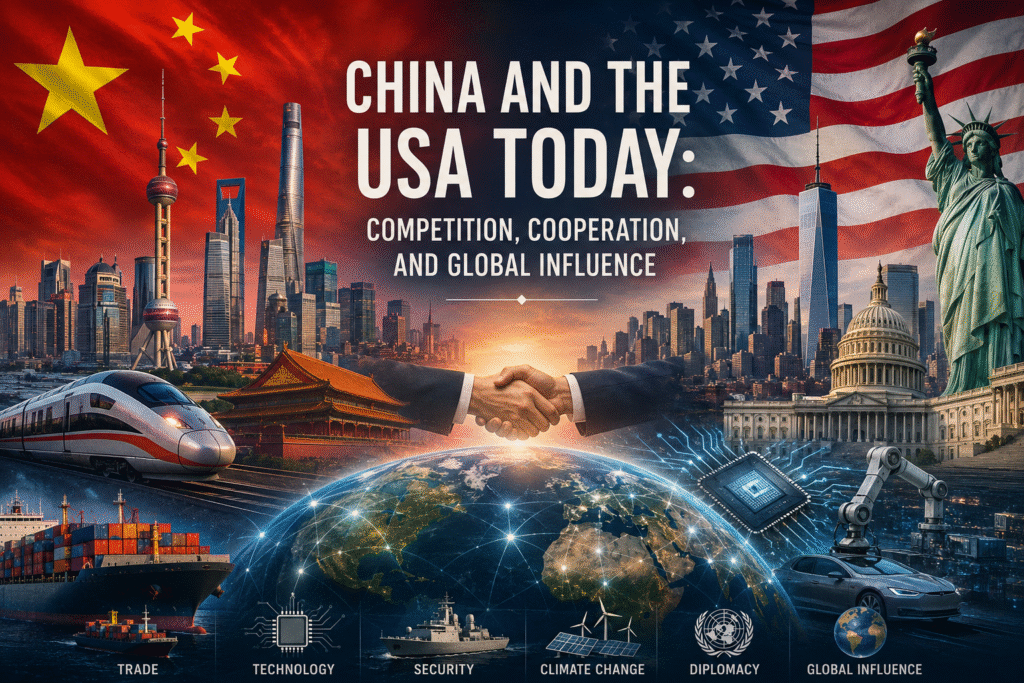
The relationship between China and the United States is one of the most important forces shaping the modern world. These two nations are the largest economies on Earth and hold major influence in politics, technology, military power, trade, and culture. Today, the relationship between China and the USA is complex. They are economic partners in some areas, but strategic rivals in others. Their competition affects global markets, international security, climate policy, and the future of technology.
In recent years, tensions between China and the USA have increased. Trade disputes, military activity in the Asia-Pacific region, technological rivalry, and disagreements over political values have created challenges between the two countries. At the same time, both nations remain deeply connected through trade, investment, and global institutions. Understanding the current situation between China and the USA is essential for understanding global affairs today.
Economic Power and Trade Rivalry
China and the USA are the two largest economies in the world. The United States remains the largest economy by nominal GDP, while China is the second largest and continues to grow rapidly. For decades, the economic relationship between the two countries was based on cooperation. American companies invested heavily in Chinese manufacturing, while China exported large amounts of goods to American consumers.
However, economic tensions have become stronger in recent years. The USA has accused China of unfair trade practices, intellectual property theft, and government subsidies that harm international competition. China, on the other hand, argues that the USA is trying to limit its economic rise and technological development.
Trade tariffs introduced during recent years significantly changed the relationship between the two economies. Many products moving between the countries became more expensive because of taxes placed on imports. Despite these tensions, trade between China and the USA remains extremely large. American businesses still rely on Chinese factories, while China continues to depend on access to American markets and technology.
Another important issue is supply chains. After the COVID-19 pandemic, many American companies began reducing dependence on Chinese manufacturing. Some companies moved factories to countries such as Vietnam, India, and Mexico. This process, often called “supply chain diversification,” reflects growing concerns about economic security and political risk.
Technology Competition
Technology has become one of the main battlegrounds between China and the USA. Both countries are competing for leadership in artificial intelligence, semiconductor production, space exploration, robotics, and telecommunications.
The USA has long dominated the global technology industry through companies such as Apple, Microsoft, Google, and NVIDIA. China, meanwhile, has rapidly developed its own major technology firms including Huawei, Tencent, and Alibaba Group.
One major area of conflict is semiconductor technology. Advanced computer chips are essential for artificial intelligence, military systems, smartphones, and modern industries. The USA has placed restrictions on China’s access to advanced chip-making technology in an effort to slow China’s progress in AI and high-performance computing. China has responded by investing heavily in domestic chip production and scientific research.
Artificial intelligence is another key area of rivalry. Both countries see AI as critical for future economic growth and national security. The USA currently leads in many advanced AI systems, but China is rapidly expanding its capabilities through large investments and state-supported programs.
Military and Security Issues
Security concerns are another major source of tension between China and the USA. The Asia-Pacific region has become the center of strategic competition between the two powers.
One of the most sensitive issues is Taiwan. China considers Taiwan part of its territory and has stated that reunification is a national goal. The USA officially follows the “One China” policy but also supports Taiwan’s self-defense capabilities. Increased military exercises and political visits in recent years have raised fears about possible conflict.
The South China Sea is another area of disagreement. China claims large parts of the sea, while neighboring countries and the USA oppose these claims. The USA regularly conducts naval operations in the region to support freedom of navigation. These actions have increased military tensions between the two countries.
Both China and the USA continue to strengthen their armed forces. China has modernized its navy, missile systems, and cyber capabilities, while the USA maintains strong military alliances with countries such as Japan, South Korea, and the Philippines. Competition between the two powers has led many experts to describe the relationship as a new form of great-power rivalry.
Political and Ideological Differences
China and the USA also differ politically and ideologically. The United States is a democratic system with multiple political parties and regular elections. China is governed by the Chinese Communist Party under a one-party political system.
American leaders often criticize China on issues such as human rights, freedom of speech, and political freedoms. China argues that every country should choose its own political path and accuses the USA of interfering in internal affairs.
These ideological differences influence international diplomacy. The USA often promotes democratic governance and alliances with democratic countries, while China emphasizes economic development, sovereignty, and non-interference. Many developing nations work with both countries and attempt to balance their relationships carefully.
Climate Change and Global Cooperation
Despite their rivalry, China and the USA also cooperate in important global areas. Climate change is one example. China is the world’s largest emitter of greenhouse gases, while the USA is historically one of the largest contributors to carbon emissions. Without cooperation between these two countries, global climate goals are difficult to achieve.
Both countries have invested in renewable energy technologies such as solar power, electric vehicles, and wind energy. China has become a global leader in solar panel manufacturing and battery production, while the USA continues to innovate in clean technology research and investment.
The two nations also cooperate in international organizations such as the United Nations and the World Health Organization. During global crises, including pandemics and economic instability, communication between China and the USA remains important for international stability.
Influence on the Developing World
China and the USA are both competing for influence in Africa, Latin America, the Middle East, and Asia. China’s Belt and Road Initiative has financed roads, ports, railways, and energy projects across many developing countries. Supporters say these investments improve infrastructure and economic growth, while critics argue that some countries become heavily dependent on Chinese loans.
The USA remains influential through international financial institutions, military partnerships, educational exchanges, and cultural influence. American universities, media, entertainment, and technology companies continue to shape global culture.
Countries around the world often benefit from investment and trade with both powers, but they also face pressure to choose sides in areas such as technology, security, and diplomacy.
The Future of China–USA Relations
The future relationship between China and the USA will likely define international politics for decades. Some analysts fear that increasing rivalry could lead to military conflict or economic separation. Others believe that strong economic ties and global responsibilities will force both countries to maintain cooperation.
Several factors will influence the future: technological competition, military activity in Asia, trade policy, climate cooperation, and domestic political developments inside both nations. Managing competition without allowing it to become open conflict is one of the greatest challenges facing global leaders today.
In conclusion, China and the USA are deeply connected yet increasingly competitive powers. Their relationship includes trade, diplomacy, technology, military strategy, and global influence. While tensions remain high, cooperation is still necessary in areas that affect the entire world. The balance between rivalry and cooperation between China and the USA will continue to shape the 21st century and the future of international relations.
