

Introduction: The World’s Most Dangerous Waterway
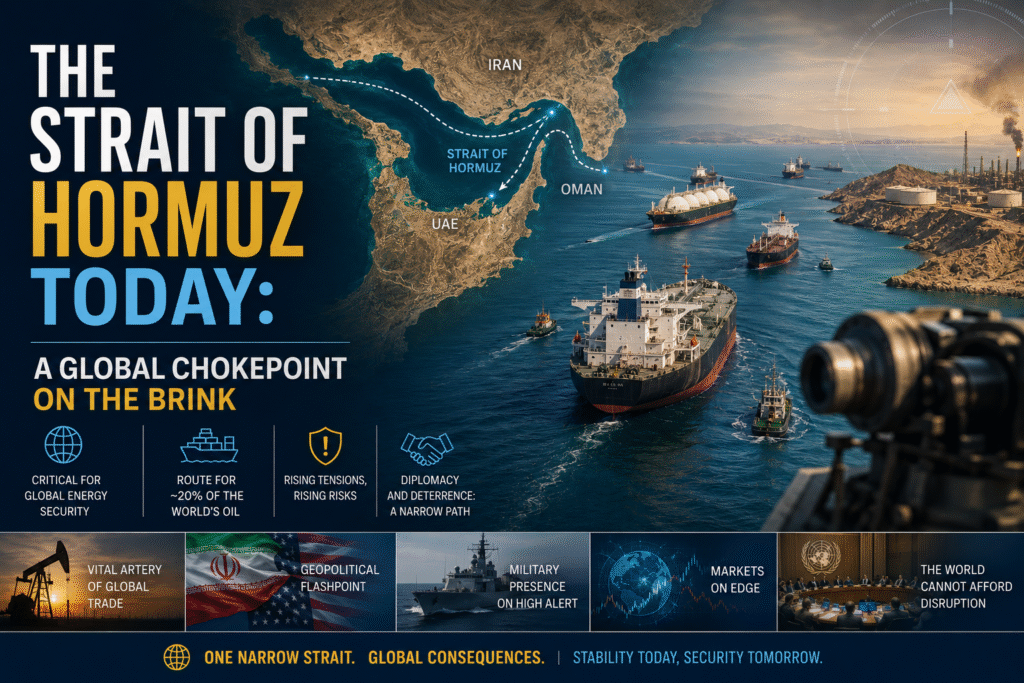
In the sweltering heat of the Persian Gulf, a narrow passage just 33 kilometers wide at its narrowest point has become the epicenter of a geopolitical earthquake. The Strait of Hormuz, through which approximately one-fifth of the world’s petroleum passes, is today a fully militarized confrontation zone. Following dramatic military exchanges between the United States and Iran in recent days, commercial shipping has ground to a halt, global energy markets are bracing for impact, and the rules of maritime navigation are being rewritten in real-time. This article examines the state of the Strait of Hormuz today, drawing on developments from the past week to paint a comprehensive picture of a world held hostage to a 33-kilometer waterway.
Part 1: The Military Escalation – Missiles in the Narrow Strait
The past week witnessed the most significant direct military confrontation between U.S. and Iranian naval forces in decades. On May 7, Iranian media released footage claiming to show an Iranian attack on U.S. destroyers near the strategic waterway, reportedly using ballistic missiles, anti-ship cruise missiles, and explosive drones . The Islamic Revolutionary Guard Corps (IRGC) Navy confirmed it had carried out a large-scale “combined operation” against U.S. naval vessels .
According to Iranian accounts, the operation came after what Tehran described as a U.S. ceasefire violation involving an attack on an Iranian oil tanker near Jask port. The IRGC claimed that intelligence assessments showed the targeted U.S. vessels sustained “significant damage” and that three destroyers withdrew from the Strait of Hormuz area . Iranian state broadcaster IRIB reported that the targeted “enemy units” sustained damage before withdrawing .
A very different picture emerged from Washington. President Donald Trump, speaking to ABC News, described the U.S. strikes as “just a love tap” and insisted the ceasefire remained in effect. Writing on his Truth Social platform, Trump claimed that three U.S. destroyers had passed through the strait “very successfully” while “under fire,” with “no damage done to the three destroyers, but great damage done to the Iranian attackers” .
Regardless of whose account one accepts, the undeniable reality is that American and Iranian forces have exchanged direct fire in one of the world’s most sensitive maritime corridors—an escalation that many analysts had long feared but hoped would never materialize.
Part 2: Commercial Shipping Halts – The Economic Blockade Begins
The military confrontation has had an immediate and devastating impact on commercial shipping. According to reports, tanker traffic through the strait has dropped by more than 80 percent, with approximately 150 tankers currently anchored in open waters outside the strait. These vessels are holding an estimated 16 billion liters of oil, effectively trapped while waiting for conditions to stabilize .
The risks are not merely theoretical. At least ten commercial ships have been reported struck by projectiles or drones near the strait, while widespread GPS jamming across the Persian Gulf compounds the danger for any vessel attempting passage . The combination of physical threats and electronic warfare has made navigation through Hormuz a potentially lethal proposition.
Among the few vessels that have successfully transited, a pattern of stealth has emerged. Three super oil tankers, carrying a total of 6 million barrels of Gulf crude oil, left the strait last week without turning on their navigation systems. These ships, carrying oil from Iraq and the United Arab Emirates, reportedly turned off their Automatic Identification Systems (AIS) to avoid possible detection and attack from Iranian forces . One oil tanker, the Odessa, successfully docked at a port in South Korea—marking the first crude oil shipment to reach the country through Hormuz since the fighting broke out .
The situation remains dire for many vessels. According to data analysis platform Kpler, 42 container ships remain stranded in the Strait of Hormuz, with only nine successfully exiting. Two ships have been seized by Iran. More than 40 ships heading to India, nearly half carrying energy products, are still stranded in the Persian Gulf, unable to pass through the vital waterway . India, heavily dependent on energy imports, is particularly vulnerable to these disruptions.
Part 3: Soaring Insurance Costs – The Hidden Economic Toll
Even if commercial traffic were to resume tomorrow, the cost of shipping through the Strait of Hormuz would remain dramatically elevated for the foreseeable future. Before the conflict, war-risk insurance premiums averaged about 0.25 percent of vessel value. Today, those premiums have surged to between 3 percent and 8 percent—translating into insurance bills of $3 million to $8 million for a single large tanker transit .
Maritime insurers and shipping associations warn that the decisive factor in restoring confidence is not reopening the strait itself, but whether risks become predictable again. As Oscar Seikaly, chief executive of NSI Insurance Group, explained, “The market can insure volatility, but it struggles to insure uncertainty.” Insurers need predictable rules of engagement and consistent freedom of navigation before restoring full coverage .
Munro Anderson, director of marine strategy at Vessel Protect, added that a durable ceasefire and the absence of vessel seizures are essential conditions for underwriting capacity to return. Even under improved conditions, premiums are unlikely to return quickly to pre-conflict levels, suggesting that shipping through Hormuz could remain structurally more expensive well into the recovery phase .
Part 4: Iran’s New Doctrine – Sovereignty or Extortion?
Perhaps the most significant long-term development is Iran’s announcement of a fundamental shift in its posture toward the strait. On May 10, Iranian Army Spokesman Mohammad Akraminia declared that Iran will no longer allow vessels of countries that join U.S. sanctions policy against the Islamic Republic to pass through the Strait of Hormuz .
“From now on, countries that follow the example of the United States and impose sanctions on the Islamic Republic of Iran will undoubtedly face difficulties passing through the Strait of Hormuz,” Akraminia told the IRNA news agency. He further stated that the military conflict against the United States and Israel had forced Iran “to use the geopolitical potential of the Strait of Hormuz” and that the Islamic Republic was now “exercising sovereignty” over it. Any vessel wishing to pass through the strait must now “coordinate its actions with Iran” .
This announcement represents a dramatic escalation in Iran’s leverage over global energy flows. By effectively declaring the strait subject to Iranian approval for nations it deems hostile, Tehran has weaponized geography in a way that could reshape maritime law and global trade patterns for years to come.
Supporting this doctrinal shift is a tactical innovation. Satellite imagery and multi-source intelligence suggest Iran may be deploying fast-attack boat formations to escort vessels transiting the strait . According to maritime analytics firm Windward, multiple clusters of high-speed craft activity were observed on May 9, including five formations comprising more than 80 fast boats moving northward. On the same day, six vessels entered the Gulf via the strait under what appeared to be Iranian escort .
The Financial Times reported that Iran maintains hundreds of these fast-attack craft, dispersed along its southern coast and concealed in coves, caves, and tunnels. This flotilla of small boats has faced off against the might of the U.S. Navy, playing an integral role in what the report described as an effective blockade that has strained global energy flows .
Part 5: The French-Led Naval Response – Europe Steps In
As the United States conducts its own military operations under the banner of “Operation Epic Fury,” European nations have chosen a different path. France has moved to organize a European naval response, with President Emmanuel Macron announcing the formation of a coalition aimed at escorting commercial vessels through the waterway .
The mission, described as purely defensive, will serve as an emergency expansion of Operation Agenor, the existing European-led maritime security mission in the region. Paris has deployed its flagship aircraft carrier, the Charles de Gaulle, which will lead a fleet of eight frigates and two amphibious helicopter carriers. Greece, Cyprus, and the Netherlands have confirmed their participation .
Significantly, European nations have deliberately distanced this mission from the ongoing U.S. offensive against Iran. Since Washington is a primary combatant in the conflict, many European and Gulf governments have preferred to align with the French-led effort rather than risk being seen as direct participants in American strikes . This divide reflects the diplomatic complexities of a conflict where allies agree on the threat but differ on the response.
France’s move to lead a coalition response reflects a broader European calculation that the economic consequences of inaction now outweigh the diplomatic risks of engagement. The stakes could hardly be higher: disruptions to Hormuz traffic threaten energy supplies, manufacturing supply chains, and global economic stability .
Part 6: Diplomatic Maneuvers – The Negotiating Table Beckons
Amid the military escalation and economic disruption, diplomatic efforts continue behind the scenes. President Trump announced a pause in the military’s new operation to clear a transit path through the strait “at the request of Pakistan and other countries for a short period of time to see whether or not the peace agreement with Iran can be finalized and signed” .
Saudi Arabia reportedly pressured the U.S. to halt its Hormuz mission, suspending the U.S. military’s ability to use its bases and airspace to carry out the operation. A call between Trump and Saudi Crown Prince Mohammed bin Salman did not resolve the issue, forcing the president to pause the project to restore U.S. military access to critical airspace .
The contours of a potential agreement remain unclear. According to reports, the U.S. is seeking Iran’s attestation that it does not seek nuclear weapons, the dismantlement of key nuclear facilities, a 20-year moratorium on Iranian nuclear enrichment, and the handover of all enriched nuclear material. Iran would have to reopen Hormuz gradually as the U.S. relaxes its blockade .
However, substantial points of dispute remain, including the payment Iran is demanding from ships that pass through the strait, the issue of missiles, and support for regional terrorist organizations. The White House also reportedly refuses to open the strait to Iranian ships until there is a guarantee that agreements reached by the political echelon will not be canceled by commanders of the Revolutionary Guards .
Part 7: The Human Toll – Mariners Trapped at Sea
Behind the geopolitical maneuvering and economic calculations lies a human story that is often overlooked. According to Gen. Dan Caine, chair of the U.S. Joint Chiefs of Staff, 22,500 mariners aboard more than 1,550 commercial vessels remain trapped in the Persian Gulf . These are real people—fathers, mothers, sons, and daughters—stranded at sea with no clear timeline for departure, uncertain when they will see their families again.
The conditions aboard these vessels are increasingly dire. Supplies are running low, and the uncertainty of when passage might become possible weighs heavily on crew morale. For the families waiting on shore, the inability to communicate or plan for reunion adds another layer of anxiety to an already tense situation.
Secretary of War Pete Hegseth described the U.S. response as erecting a “red, white and blue dome” over the corridor, with American destroyers on station, supported by hundreds of fighter jets, helicopters, drones, and surveillance aircraft providing “24/7 overwatch for peaceful commercial vessels, except Iran’s” . Yet for the trapped mariners, the sight of military aircraft overhead provides cold comfort when the path home remains blocked.
Part 8: Oil Markets and Global Implications
The disruption of traffic through the Strait of Hormuz has sent shockwaves through global energy markets. With approximately 150 tankers holding 16 billion liters of oil unable to transit, the supply-demand balance has been severely distorted. Refineries in Asia, Europe, and beyond that depend on Gulf crude are scrambling to secure alternative supplies, driving up prices and squeezing margins.
The longer the disruption continues, the more severe the economic consequences become. Strategic petroleum reserves are being drawn down, shipping routes are being rerouted around the Cape of Good Hope—adding weeks to transit times and significantly increasing costs—and the global economy faces the prospect of sustained higher energy prices that could tip already fragile economies into recession.
For countries like India, which is heavily dependent on energy imports from the Gulf, the situation is particularly acute. More than 40 ships heading to India, nearly half carrying energy products, remain stranded in the Persian Gulf . Without those supplies, Indian industry faces the prospect of energy shortages that could disrupt manufacturing, transportation, and power generation.
Part 9: The Nuclear Dimension – A Shadow over the Strait
Beneath the immediate crisis of shipping disruptions and military confrontations lies the longer-term threat of Iranian nuclear proliferation. According to U.S. intelligence estimates, Iran is only one year away from a nuclear weapon—though the June 2025 air campaign against Iran’s nuclear sites significantly damaged the regime’s capabilities .
The nuclear dimension complicates any potential resolution to the current crisis. The U.S. is demanding comprehensive nuclear rollbacks as part of any broader agreement, while Iran seeks relief from crippling economic sanctions. The strait has become a bargaining chip in a larger strategic negotiation—one where the stakes include not just the free flow of oil but the prevention of nuclear proliferation in the world’s most volatile region.
Conclusion: A World Held Hostage to Geography
The Strait of Hormuz today is a microcosm of 21st-century geopolitics: a narrow passage where military power, economic leverage, diplomatic maneuvering, and human suffering converge. What happens in these 33 kilometers of water affects every person who depends on energy, every business that relies on global supply chains, and every nation that seeks stability in an increasingly uncertain world.
As the crisis enters its second week, the questions multiply. Will diplomatic efforts succeed in de-escalating tensions? Can a framework be found that addresses both U.S. security concerns and Iranian economic needs? How long can the global economy absorb the shock of disrupted oil flows? And perhaps most fundamentally: has the era of free passage through international straits come to an end?
For now, the tankers remain anchored, the navies remain on station, and the world watches. The Strait of Hormuz, always a chokepoint, has become a pressure cooker. And no one knows when the lid will be safely removed.
