

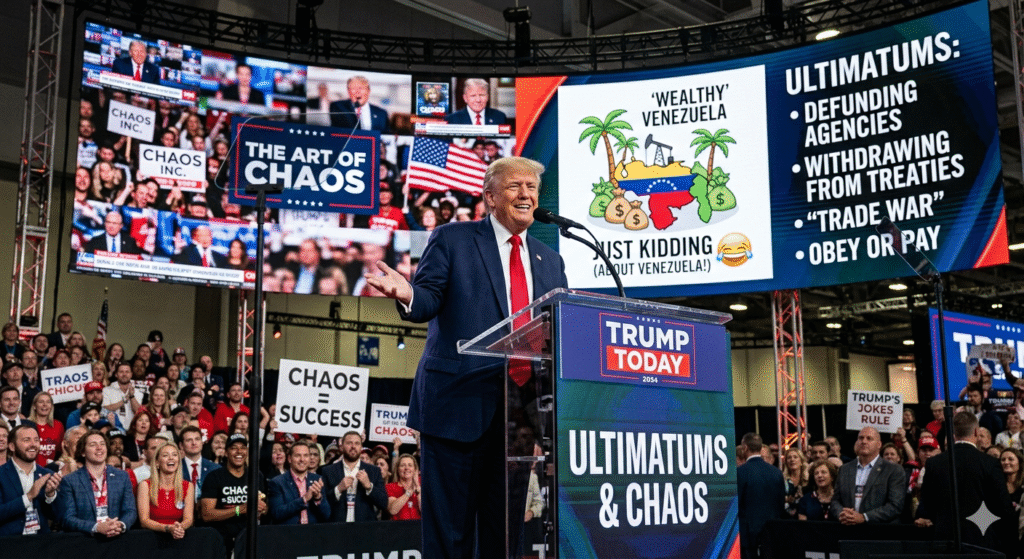
It is April 7, 2026, and Donald John Trump is holding court at the White House. The setting is familiar: the podium, the off-script tangents, the casual threats, and the utter certainty that only he can fix—or run—the world. But today, the 45th and 47th President of the United States is operating on a different level of intensity.
In the span of a single press conference, Trump dismissed a peace proposal from Iran, threatened to “take out” the entire country by Tuesday night, celebrated the rescue of a downed pilot, complained that Australia and Japan weren’t helping him enough, and suggested that after he is done with his final term in the White House, he might just run for president of Venezuela.
Here is what Donald Trump looks like today: simultaneously managing a shooting war, trolling foreign allies, proposing to reopen Alcatraz, and hinting at a bizarre political future that defies constitutional logic. It is vintage Trump, but with the volume turned up to eleven.
Part 1: The Tuesday Night Ultimatum
The most pressing headline out of Washington today is the iron deadline hanging over Tehran. Trump told reporters on Monday that Iran has until Tuesday night to strike a deal to forswear nuclear weapons and reopen the Strait of Hormuz, or face a devastating escalation .
“Iran could be taken out in one night, and that night might be tomorrow night,” Trump said flatly during a White House press conference . He added that while he hopes he doesn’t have to do it, the alternative is the systematic destruction of the country’s critical infrastructure—including power plants and bridges .
Despite reports that Iran had presented a “significant proposal” in ongoing negotiations, Trump dismissed it as “not good enough” . Pentagon chief Pete Hegseth backed up the rhetoric, warning that Monday would see the largest volume of strikes since the conflict began, with Tuesday expected to be even heavier .
For a President who campaigned on bringing troops home, Trump is currently waging a high-intensity air war, justifying it by claiming the U.S. is “obliterating” a powerful nation in record time .
Part 2: The Pilot and the “Needle in a Haystack”
Amid the threats of bombing, Trump pivoted to a moment of genuine drama: the rescue of a downed U.S. airman inside Iran. The pilot, identified only by the call sign “Dude 44 Bravo,” was shot down on Friday. For two days, he hid in a mountainous crevice while Iranian forces searched for him .
Trump described the operation in cinematic detail. He claimed that the airman kept climbing higher to improve his chances of being seen on a U.S. camera link. “It was like finding a needle in a haystack,” Trump said .
CIA Director John Ratcliffe revealed that the agency ran a “deception campaign” to convince the Iranians the pilot was somewhere else entirely. On Sunday morning, American forces descended on the real location, extracted the officer, and destroyed all threats without taking a single casualty .
The pilot’s first message upon contact, according to Hegseth, was: “God is good” . For Trump, this rescue operation serves as a counter-narrative to the chaos of war: a story of American competence, loyalty to troops, and a happy ending.
Part 3: The Oil Temptation
At the White House Easter Egg Roll on Monday, Trump revealed the internal tension driving his strategy in the Middle East. When asked about Iran’s oil fields, he admitted he has a massive temptation to simply seize them .
“If I had my choice, what would I like to do? Take the oil because it is there for the taking,” Trump said. “There is not a thing they could do about it” .
He contrasted this with the capture of Venezuelan dictator Nicolás Maduro, noting that the U.S. now has 100 million barrels of Venezuelan oil sitting in Houston being refined . However, regarding Iran, Trump held back, citing the American public. He claimed that while his MAGA base gives him 100% support, most Americans “wouldn’t understand” keeping the oil and just want the troops to “win and come home” .
Part 4: The Venezuela Pivot (Seriously?)
In what might be the most surreal moment of the day, Trump suggested that his political career does not end with the U.S. presidency. Speaking about Venezuela—where the U.S. recently installed a new acting president after capturing Maduro—Trump mused about a run for office there .
“The people of Venezuela, they say, if I ran for president of Venezuela, I’m polling higher than anybody has ever polled in Venezuela,” Trump claimed. “So after I’m finished with this, I can go to Venezuela” .
He added, with characteristic modesty: “I will quickly learn Spanish. It won’t take too long. I’m good at language” . This is a direct contradiction to his stance just last month, when he told a Latin American summit that he wasn’t learning “your damn language” . Whether a serious trial balloon or simply trolling the international community, the remark underscores Trump’s view of geopolitics as a series of real estate deals and elections he can win by acclamation.
Part 5: The $152 Million Alcatraz Plan
Back on the domestic front, Trump’s budget proposal for fiscal year 2027 includes a line item that has stunned historians and tourism officials: $152 million to reopen Alcatraz prison .
The infamous island prison, closed since 1963 and currently a major tourist attraction generating $60 million annually, would be “rebuilt as a state-of-the-art secure prison facility” to house “America’s most ruthless and violent offenders” . Trump first floated the idea on Truth Social last year, and now it is in the official budget request.
The reaction from California politicians was swift and brutal. Former House Speaker Nancy Pelosi called the proposal “absurd on its face” and “a stupid notion that would be nothing more than a waste of taxpayer dollars” . Critics point out that the island has no running water, no sewage, and that historically, Alcatraz cost three times more to operate than any other federal prison . For Trump, however, “The Rock” represents a powerful symbol of law and order—even if it bankrupts the Bureau of Prisons to run it.
Part 6: The Diplomatic Pile-On (Australia, Korea, Japan)
As the press conference wound down, Trump turned his fire on America’s allies. He expressed frustration that NATO members were refusing to help secure the Strait of Hormuz, but he saved his sharpest words for the Pacific .
“You know who else didn’t help us? Australia didn’t help us. South Korea didn’t help us. Japan didn’t help us,” Trump fumed . He noted the irony: the U.S. maintains tens of thousands of troops in South Korea and Japan to protect them from North Korea, yet when Washington is fighting a major war in the Middle East, those allies are sitting on the sidelines .
It is a classic Trump grievance—the transactional view that allies are tenants who haven’t paid their rent—and it signals potential friction at future security summits.
Part 7: The Economic Backlash
While Trump projects strength abroad, his opponents at home smell blood. House Minority Leader Hakeem Jeffries (D-N.Y.) used a Thursday briefing to blast the President’s economic record, coining a new attack line just days before the press conference .
“What Donald Trump has done is decimate the bank accounts of the American people,” Jeffries said . He tied the rising cost of living directly to Trump’s tariffs and the war in Iran, arguing that gas prices are surging because of a “reckless war of choice” . With the Supreme Court having already ruled some of Trump’s tariff maneuvers unlawful, Democrats are signaling that the economy—not Iran—will be the defining issue of the midterms .
Part 8: The Art of the Deadline
Why Tuesday? Trump is fixated on the reopening of the Strait of Hormuz. He has demanded Iran reopen the vital shipping lane by Monday (now passed) or face attacks on power plants and bridges . Iran’s culture minister dismissed Trump as an “unstable, delusional figure,” while the Iranian president’s spokesperson demanded compensation for war damages in exchange for reopening the strait .
Trump is using the deadline as a pressure tool. “The entire country can be taken out in one night,” he repeated . For the world watching, the clock is ticking toward a potentially catastrophic escalation or a last-minute diplomatic fudge.
Conclusion: The Trump Constant
If there is a unifying theme to Donald Trump today, it is movement. He is moving troops, moving deadlines, moving money to Alcatraz, and moving the goalposts of his own political future. He dismisses CNN polls that show his support holding firm, citing 100% approval from MAGA voters . He dismisses critics of his infrastructure strikes as worrying about “war crimes,” countering that a nuclear Iran is the real crime .
Love him or loathe him, Trump has ensured that the world is watching Washington every single day. In April 2026, Donald Trump is not just a president; he is a one-man geopolitical earthquake—joking about learning Spanish for Venezuela while threatening to blow up Iran’s power grid by Tuesday. And as always, he insists that he knows exactly what he is doing.