

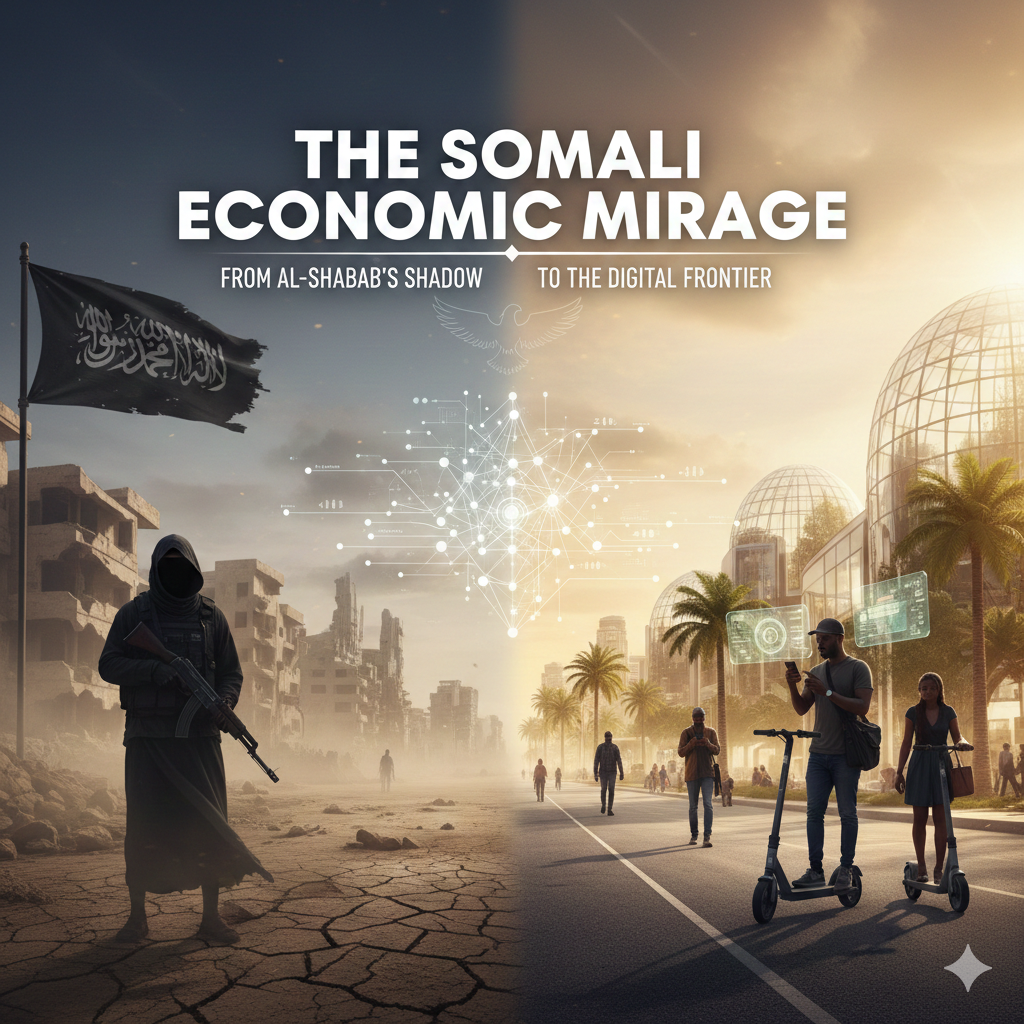
MOGADISHU, Somalia – To speak of “business” in Somalia conjures images of chaos: the bombed-out remnants of a state, the piracy-infested coastlines, and the specter of Al-Shabaab extortion. This narrative, while rooted in a painful reality, misses a more complex and counterintuitive truth. Beneath the headlines of conflict, a fierce, adaptive, and remarkably resilient economy is not only surviving but evolving. Somalia’s business environment today exists in a parallel universe to its political one—a world defined by sophisticated digital finance, a booming import-export trade, vast diaspora capital, and a generation of entrepreneurs building ventures in one of the world’s most challenging markets. This is the story of an economy that functions despite the state, not because of it.
The Foundation: An Economy Built on Trust, Not Contracts
The first rule of Somali business is to forget Western models of incorporation, commercial courts, and centralized banking. Somalia’s economy operates on a foundation of social capital and clan-based trust (xeer). The hawala system, personified by giants like Dahabshiil, is not merely a money transfer service; it is the nation’s de facto financial architecture. It provides banking, credit, and investment capital through networks built on familial and clan accountability. A promise made within this system carries more weight than a stamped contract in a nonexistent court. This allows for remarkably large transactions—financing a shipment of construction materials from Dubai or a fleet of trucks—to occur with a handshake and a follow-up call. While this fosters incredible agility, it also reinforces social fragmentation, as capital flows more readily within clan lines.
The Telecommunications Revolution: The Real Infrastructure of the State
In the absence of roads, stable electricity, and a formal government, Somalia’s most successful and competitive sector is telecommunications. Companies like Hormuud Telecom (south), Telesom (Somaliland), and Golis (Puntland) have achieved what the state could not: near-nationwide coverage. They provide not just voice and data, but the critical infrastructure for the entire economy.
The crown jewel is mobile money. Hormuud’s EVC Plus and Telesom’s Zaad are more revolutionary than M-Pesa was for Kenya. In a nation where physical cash is bulky and dangerous, and banks are absent, these platforms facilitate everything. Salaries are paid, invoices are settled, and utility bills (for the few who have them) are processed via phone. During the worst droughts, humanitarian cash assistance is distributed directly to phones. For businesses, this means seamless, secure transactions, from a merchant in Bakara Market paying a wholesaler to a diaspora member in Minneapolis investing in a relative’s new kiosk. The telecom sector is the closest thing Somalia has to a functioning, transparent, and efficient public utility.
Sectoral Deep Dive: Where the Money Flows
- The Import Bazaar: Somalia is a quintessential mercantile economy. Its business class are master importers. The ports of Mogadishu, Bosaso, and Berbera are frenetic hubs. Everything enters: rice and sugar from Brazil, textiles from China and Turkey, construction materials (the capital is in a perpetual state of rebuilding), and every manner of consumer good. These goods flood into sprawling open-air markets like Mogadishu’s Bakara Market, a labyrinthine ecosystem of wholesalers and retailers. Success hinges on navigating complex logistics, securing foreign exchange through the hawala network, and understanding the purchasing power of a population whose primary income often comes from remittances.
- The Livestock Lifeline: Beyond the cities, the economy still runs on camels, goats, and sheep. Somalia remains a major exporter of livestock to the Gulf, particularly during the Hajj season. This trade, centered on the port of Berbera, is a sophisticated, large-scale operation involving herders, brokers, exporters, and veterinary services. It is a volatile sector, vulnerable to climate-induced drought and bans due to animal disease, but it remains a critical source of hard currency and rural livelihood.
- The Humanitarian-Industrial Complex: The presence of the UN, international NGOs, and African Union forces has spawned a parallel service economy. This sector demands secure compounds, logistics companies, translation services, and local staff. While often criticized for creating a “bubble” economy, it provides stable employment and contracts for a segment of the educated, urban class and fuels demand for high-end housing and services.
- The Diaspora Engine: This is the single most important economic force. An estimated $2 billion in remittances flows into Somalia annually—far outstripping foreign aid and investment. This capital is not just for consumption; it is venture capital for the Somali economy. Diaspora members fund the start-up of hotels, telecommunications towers, transport companies, and tech startups. They are the primary investors in Mogadishu’s real estate boom, where property prices in secure enclaves rival those in stable regional capitals. This creates a unique transnational business model, where ideas and capital from London, Toronto, or Minneapolis are executed by relatives on the ground.
The Al-Shabaab Tax: The Cost of Doing Business
No analysis is complete without acknowledging the armed elephant in the room. Al-Shabaab controls significant territory and operates a shadow governance and taxation system. For businesses operating in or through these areas, paying extortion fees (zakat as they frame it) is a standard, if dangerous, operating cost. The group runs its own lucrative businesses in charcoal, sugar, and telecommunications. Their presence massively inflates security costs for all formal businesses, from hiring armed guards to investing in blast walls. It is a pervasive tax on growth and a deterrent to large-scale foreign direct investment.
The Tech and Youth Frontier
A surprising development is the rise of a tech-savvy entrepreneurial youth culture. In cities like Mogadishu and Hargeisa, young Somalis, many educated abroad or online, are launching startups. These include:
- E-commerce platforms like SomMall, attempting to bring order to the informal market.
- Digital advertising and media companies, leveraging the high mobile penetration.
- Logistics and ride-hailing apps tailored to local conditions.
- Renewable energy startups, particularly in solar, aiming to solve the chronic power shortage.
They operate in co-working spaces, pitch at local competitions, and represent a powerful counter-narrative to extremism—one of opportunity, innovation, and a future built on code rather than conflict.
Conclusion: The Phoenix Economy
Somalia’s business environment is the ultimate test of neoliberal theory: a space with almost no government, yet brimming with capitalist enterprise. It is a hyper-competitive, high-risk, high-reward frontier. The “best” businesses are those that master the art of navigating multiple parallel systems: the digital finance world, the clan-based trust networks, the import-export logistics, and the grim reality of security.
The future hinges on whether the incremental progress of the federal government—and notable regional administrations like Somaliland—can gradually create a more predictable, secure, and unified regulatory space. Can the dynamism of the private sector and the diaspora be harnessed to build a state, rather than simply bypass it?
For now, the Somali entrepreneur remains the most resilient actor on the stage. Their business is not just about profit; it is an act of defiance and a statement of faith in a future beyond the current fragility. Somalia’s economy is a phoenix, forever rising from ashes not through grand design, but through millions of daily transactions, remittances sent with love, and the unbreakable will to trade, connect, and build.
