

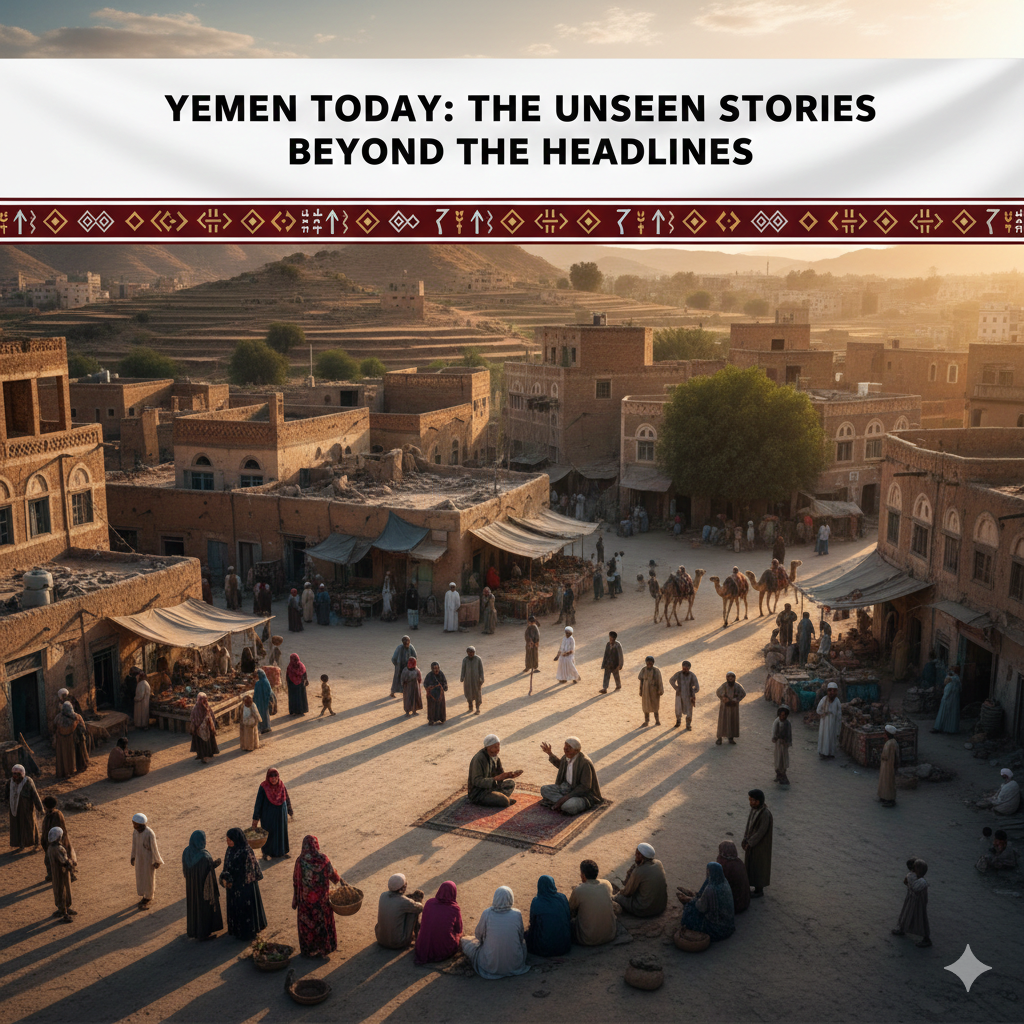
When the world reads about Yemen, it is often through a single, devastating lens: “The World’s Worst Humanitarian Crisis.” This phrase, repeated for nearly a decade, is tragically true. A catastrophic war, now in a fragile and complex stalemate, has shattered the nation’s infrastructure, economy, and social fabric. Over 20 million people require humanitarian aid, 17 million are food insecure, and a generation of children has known only conflict.
But if this is the only story we know, we fail to understand Yemen. Yemen Today is a land of profound, heartbreaking duality. It is a place where unspeakable suffering coexists with astonishing resilience, where ancient traditions are tested by modern calamity, and where life, in its most stubborn and creative forms, insists on continuing. To look closer is to see a tapestry far more intricate than the monochrome of war.
The Unyielding Grip of Crisis: A Daily Reality
Any portrayal must begin by acknowledging the scale of the emergency. The war, which erupted in 2014 when Houthi forces seized Sana’a, has evolved into a multi-layered conflict involving regional powers, local factions, and separatist movements. While a UN-brokered truce in April 2022 dramatically reduced frontline violence, it has not ended the war. The country remains divided, with the Houthis controlling the north (including the capital, Sana’a) and the internationally recognized government based in Aden in the south.
For ordinary Yemenis, this means:
- An Economy in Freefall: The national currency has collapsed, making salaries—if paid at all—almost worthless. Imports, on which Yemen depends for 90% of its food and medicine, are prohibitively expensive. Fuel shortages are chronic. This economic warfare is often more lethal than the battlefield.
- A Broken Health System: Hospitals have been bombed, doctors have fled, and supplies are scarce. Deadly diseases like cholera, diphtheria, and measles surge in the wake of damaged water and sanitation systems. Preventable illnesses become death sentences.
- The Shadow of Famine: Food insecurity is not merely a lack of food; it is a complex result of blockades, inflation, and the destruction of agriculture. Parents skip meals so their children can eat, and malnutrition stunts the growth and future of millions.
The Other Yemen: Resilience, Adaptation, and Daily Life
Yet, within and around this landscape of despair, Yemenis are living. They are not passive victims but active agents of survival, adapting with a courage that defies comprehension.
- The Innovation of Necessity: In the absence of a functioning state, communities have developed remarkable coping mechanisms. Local councils, often led by elders and volunteers, manage water distribution and security. Engineers jury-rig solar panels to power wells and clinics, creating decentralized green energy networks out of sheer need. In Sana’a’s old markets, artisans repair everything from mobile phones to war-torn water tanks.
- The Currency of Community: In a hollowed-out economy, social capital and barter have become vital. Neighbors share what little they have. Skills are traded for food. The ancient system of collective support (‘aoneeya) has been revitalized, binding people together in webs of mutual obligation that are often their only safety net.
- Cultural Fortitude: Yemen’s profound cultural identity—rooted in its history as “Arabia Felix”—remains a bedrock. The intricate architecture of Sana’a’s Old City, a UNESCO site, still stands. Poetry, the soul of Yemeni expression, flourishes, offering solace, satire, and a record of this era. The daily ritual of chewing qat, despite its controversies, provides a space for social gathering, debate, and temporary escape from hardship.
- The Unsung Heroes: Yemeni civil society, especially women-led organizations, operates on the front lines of humanity. With minimal funding and at great personal risk, they run community kitchens, document human rights abuses, provide psychosocial support, and educate children where schools are closed. They are the true first responders.
The Fractured Political Landscape: Beyond a Simple Binary
The political reality is far more fragmented than a simple north-south, Houthi-government divide. Within the government-held areas, the Southern Transitional Council (STC) pushes for an independent South Yemen. A constellation of local militias, tribes, and Islamist groups holds sway in various regions, each with their own allegiances and agendas. The Houthi movement itself has transformed from a rebel group into a de facto state authority in the north, enforcing its own strict governance.
This fragmentation makes achieving a comprehensive peace deal immensely difficult. The truce is less a path to resolution and more a tense pause, where economic warfare and internal repression have replaced major military offensives. For citizens, this means navigating a patchwork of authorities, checkpoints, and often contradictory rules.
The Regional and Global Chessboard
Yemen’s tragedy is not self-contained. It is a proxy battleground in the regional cold war between Saudi Arabia/Iran and, more broadly, a stage where global interests play out. The war has exposed the limits of foreign intervention and the catastrophic human cost of geopolitical rivalry. The reduction in Saudi-led airstrikes since the truce is a welcome relief, but the underlying regional tensions remain unresolved.
Internationally, “Yemen fatigue” is a real danger. As other global crises dominate headlines, donor funding for the humanitarian response is shrinking drastically, forcing aid agencies to cut essential programs even as needs rise.
Yemen Today: A Nation at a Crossroads
So, what does the future hold? Several possible paths exist in this uncertain present:
- A Frozen Conflict: The current stalemate could solidify, with the country partitioned into zones of influence. This would perpetuate the humanitarian crisis indefinitely, creating a permanent state of emergency.
- A Sporadic Return to War: The truce could collapse, leading to renewed large-scale fighting, potentially worse than before given the time all sides have had to rearm.
- A Gradual, Fragmented Peace: The only hopeful path is a long, messy, and incremental process of local ceasefires, confidence-building measures, and ultimately, a new political compact that includes all Yemeni voices—especially women, youth, and civil society.
Conclusion: Seeing the Full Picture
To write about Yemen Today is to hold two truths in balance: the scale of the man-made catastrophe is staggering and unforgivable, and the resilience of the Yemeni people is breathtaking and humbling.
The story is not just one of war and aid. It is a story of a mother selling homemade bread to pay for her daughter’s notebook. It is the story of a farmer in the terraced highlands trying to revive ancient agricultural techniques as climate change brings drought. It is the story of a teenage girl, denied formal schooling, who teaches herself to code via a shaky internet connection.
Yemen is more than its crisis. It is a civilization with 3,000 years of history, struggling to survive its darkest chapter. The world must not look away from the suffering, for the need for a just political solution and robust humanitarian support is absolute. But we must also learn to see the endurance, the innovation, and the quiet, defiant pulse of daily life. In that pulse lies not only the survival of a nation but the seeds of its eventual rebirth. The story of Yemen Today is ultimately a testament to the human capacity to endure, and a plea for the world to match that endurance with the political will to forge a lasting peace.
