

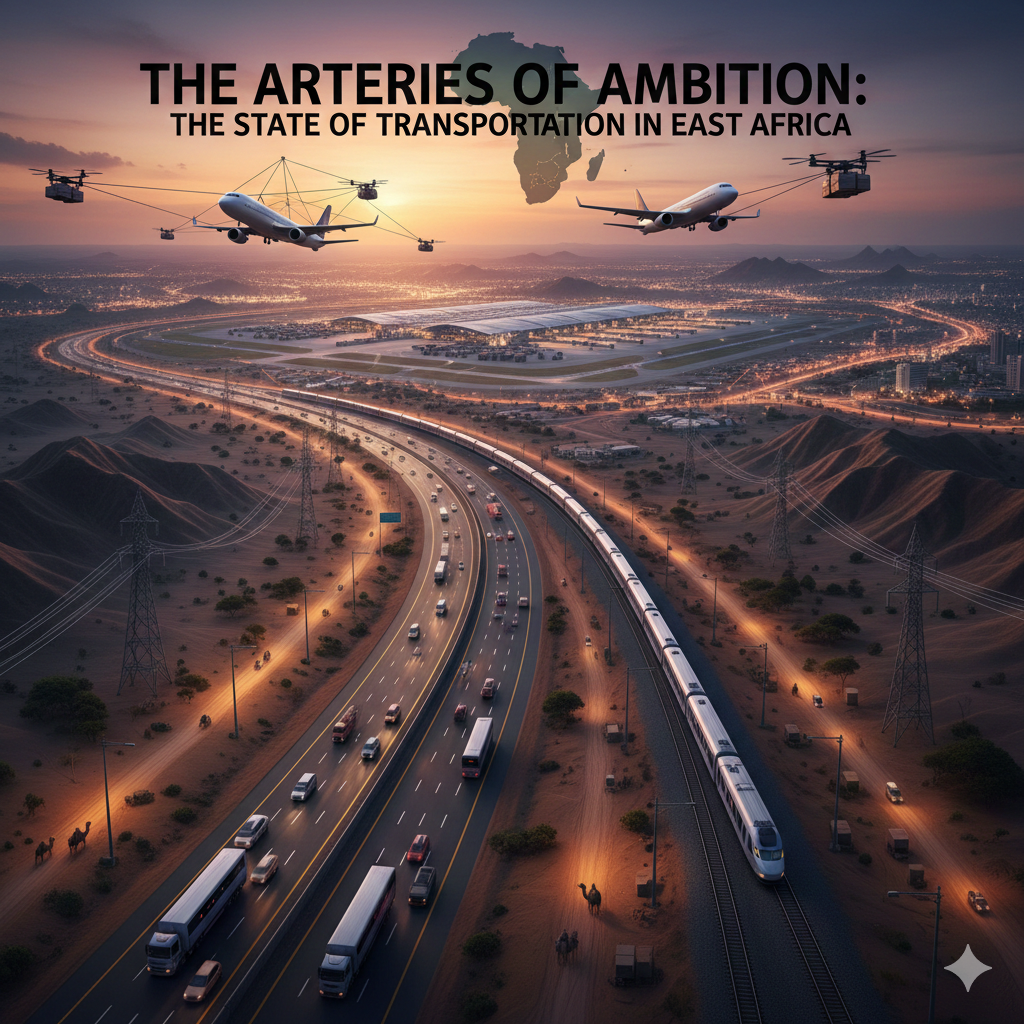
DATELINE: NAIROBI, KENYA – To understand East Africa’s economic aspirations and its daily frustrations, one need only observe its roads, rails, and runways. The region’s transportation network is a physical manifestation of its dual reality: a story of breathtaking, state-backed ambition to become a continental logistics hub, running headlong into the gritty, improvisational hustle of millions moving people and goods. From the gleaming Standard Gauge Railway (SGR) cutting through the Kenyan savannah to the gridlocked streets of Kampala and the motorcycle taxis weaving through Dar es Salaam, transportation in East Africa is a sector in radical, uneven, and often chaotic transition.
The Macro-Vision: Corridors, Rails, and the Dream of Integration
At the strategic level, East African governments are engaged in a high-stakes race to build the infrastructure of the future. The driving philosophy is the development of transnational economic corridors, transforming from landlocked to land-linked. The crown jewel is the Northern Corridor, running from the Port of Mombasa through Nairobi and Kampala to Kigali and South Sudan. Its rival, the Central Corridor, connects the Port of Dar es Salaam to Burundi, Rwanda, Uganda, and the DRC.
The most visible symbol of this ambition is the Standard Gauge Railway (SGR). Kenya’s Chinese-built SGR, stretching from Mombasa to Naivasha, represents the largest infrastructure project since independence. It has shifted millions of tons of freight off the congested Mombasa Road and cut passenger travel time dramatically. Tanzania is constructing its own even more ambitious SGR, aiming to connect Dar es Salaam to Mwanza, Kigoma, and ultimately neighboring countries. These projects promise to revolutionize regional trade, reduce cargo dwell times at ports, and lower the cost of business.
Simultaneously, port expansion is critical. Mombasa and Dar es Salaam are in a direct competition for gateway supremacy, both undergoing massive dredging and berth-construction projects. New ports like Lamu Port in Kenya (part of the LAPSSET corridor) and Bagamoyo in Tanzania (though currently stalled) envision a future of Pan-African trade on an unprecedented scale.
The Daily Reality: The Tyranny of the Road and the Rise of “Bodaboda”
For the vast majority of East Africans, however, the macro-projects remain abstract. Daily life is dominated by the road—and its failures. Chronic congestion chokes major cities. Nairobi’s traffic is legendary, costing the economy an estimated $1 billion a year in lost productivity. Dar es Salaam, Kampala, and Kigali face similar, if variably managed, gridlock. The reasons are universal: rapid urbanization outpacing road construction, a surge of second-hand vehicle imports, inadequate public transit, and often poor traffic management.
This crisis has given rise to the region’s most iconic and chaotic transport solution: the motorcycle taxi, known as bodaboda in Kenya/Uganda, boda in Tanzania, or moto in Rwanda. These ubiquitous two-wheelers represent the ultimate in flexible, door-to-door, and affordable transit. They are the bloodstream of the informal economy, delivering people, parcels, and even livestock through impossible traffic. Yet, they are also a major source of accidents, crime, and urban disorder, prompting governments to struggle with regulation, registration, and safety mandates, often with limited success.
Public Transit’s Troubled Journey: From Matatus to BRTs
Formal public bus systems are typically weak, leaving a gap filled by the vibrant, anarchic, and essential paratransit sector. In Kenya, it’s the matatu; in Tanzania, the dala-dala; in Uganda, the taxi. These privately-owned minibusses are a cultural and economic force, decorated wildly and driven aggressively. They provide vital connectivity but are plagued by safety issues, noise, pollution, and exploitative labor practices for drivers and touts.
The response in major cities has been a push toward formalized Bus Rapid Transit (BRT) systems. Dar es Salaam’s DART system was a regional pioneer and has seen significant success in dedicating lanes for high-capacity buses. Nairobi’s BRT, long delayed, is finally launching its first lines, while Kampala and Kigali have plans in various stages. These systems represent a fundamental clash between the state’s desire for order, efficiency, and modernity, and the entrenched, politically powerful paratransit cartels.
The Air and Digital Leap: Connectivity at Different Altitudes
Aviation tells another story of stratification. Ethiopian Airlines has become a continental juggernaut, with Addis Ababa’s Bole Airport a major global hub. Kenya Airways, despite financial struggles, maintains a key network. New airports like Rwanda’s Bugesera International aim to replicate the hub model. For the elite and the diaspora, the region is more connected than ever.
Meanwhile, a digital transportation revolution is underway. The ride-hailing app has been fully localized. Uber and Bolt operate, but they compete with homegrown giants like Little in Ethiopia and SafeBoda in Uganda, which started as a ride-hailing app for motorcycle taxis and has expanded into financial services and deliveries. These platforms are formalizing the informal, providing safety tracking, digital payments, and accountability, though they face constant tension with traditional taxi and bodaboda unions.
The Core Challenges: Financing, Maintenance, and the Last Mile
Beneath the flashy projects lie persistent, systemic problems:
- The Financing Trap: Mega-projects like the SGR have saddled nations with massive debt to China, raising concerns about sovereignty and long-term sustainability. Maintenance budgets are often the first casualty of fiscal shortfalls, leading to rapid deterioration of new roads.
- The “Last Mile” Problem: A container can travel from Shanghai to Mombasa in 21 days, then take 21 more to reach a warehouse in Kampala due to delays at the port, paperwork, and poor inland roads. This logistical friction is the true barrier to trade.
- Regional Non-Tariff Barriers: While infrastructure connects, bureaucratic red tape disconnects. Long waits at border crossings, inconsistent standards, and corruption at weighbridges add huge costs and delays, negating the benefits of new hardware.
The Future: Green Shoots and Smart Roads
The path forward is pointing toward integration and innovation:
- The Single Customs Territory: The East African Community (EAC) is slowly implementing systems to allow cargo to be cleared once at the port of entry, then move seamlessly across borders.
- Digital Logistics Platforms: Companies are deploying software to track shipments, match truckers with loads, and clear customs online, bringing transparency to opaque processes.
- A Focus on Green Mobility: With air pollution a crisis, there is growing interest in electric vehicles. Rwanda is leading with electric motorcycle incentives, and startups across the region are piloting electric buses and charging networks. Cycling infrastructure is also getting rare but growing attention in cities like Kigali.
- The Railway’s Renewed Promise: If completed and integrated, a connected East African railway network could be truly transformative, but it requires unprecedented political and financial cooperation between nations.
Conclusion: The Road to Prosperity is Under Construction
Transportation in East Africa is a sector of profound contrasts. It is where the futuristic vision of a seamlessly integrated, high-speed economic powerhouse meets the present-day reality of the sweating bodaboda driver and the stalled matatu. The success of the grand visions—the SGR, the expanded ports, the BRTs—will not be measured in kilometers of track laid or lanes painted, but in their ability to connect meaningfully with the informal, organic, and overwhelmingly human systems that move the majority of people every day.
The true transformation will occur when the efficiency of the new port reaches the small-scale farmer via a paved rural road; when the bodaboda rider is part of a regulated, safe, and digitally-enabled ecosystem; and when a business owner in the interior can receive supplies with the same predictability as one in the capital. East Africa’s transportation story is still being written, one pothole-filled highway, one sleek train, and one smartphone-enabled motorcycle ride at a time. The destination is clear—greater prosperity through mobility. The journey, however, remains a uniquely East African blend of grand ambition and gritty improvisation.
