

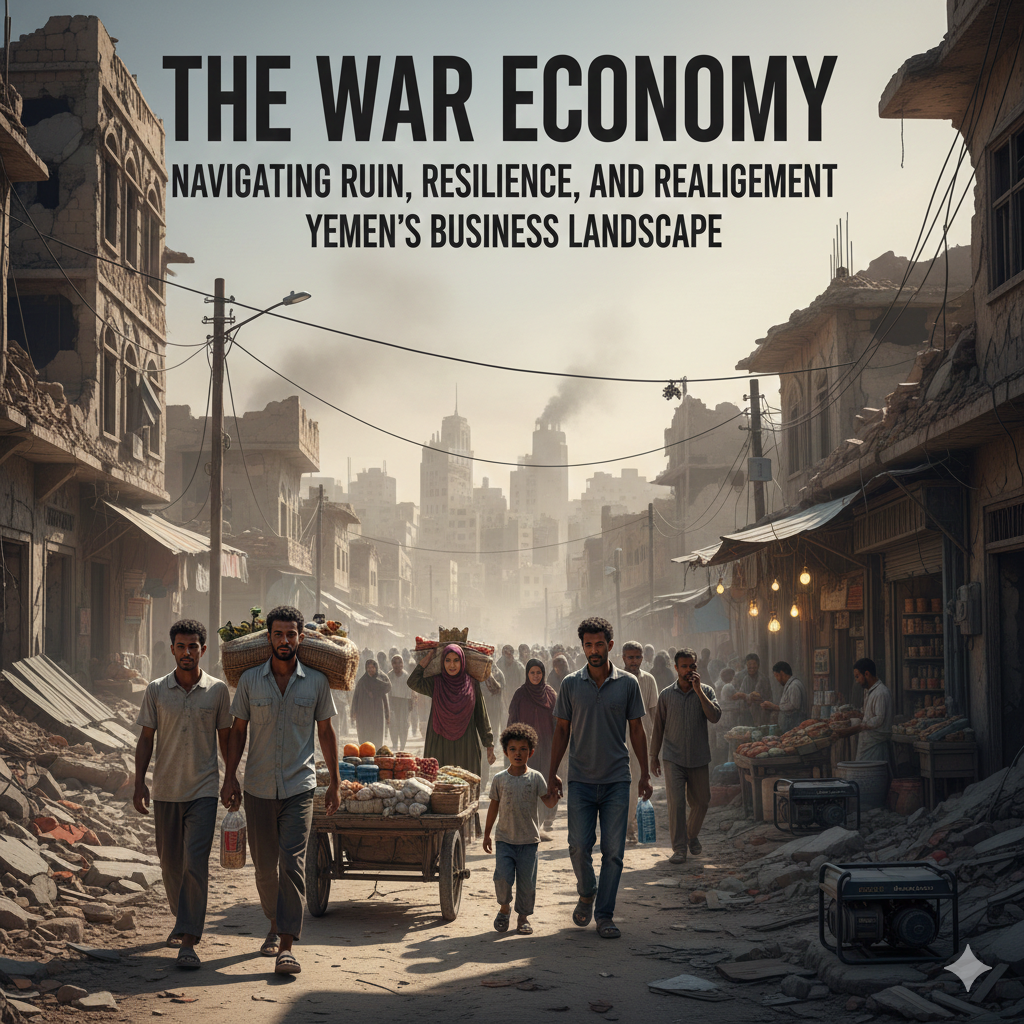
ADEN / SANAA, Yemen – To speak of “business as usual” in Yemen is a profound misnomer. Instead, the nation’s commercial landscape is a stark reflection of its nine-year conflict: a shattered formal economy operating in parallel with a fiercely resilient, adaptive, and often brutal war economy. For the businesspeople who remain, survival is a daily calculus of risk, navigating a maze of shifting frontlines, competing authorities, and an unprecedented humanitarian crisis that has also created perverse new markets. Yemen today is a case study in how commerce persists, distorts, and even thrives in an environment of near-total institutional collapse.
The Collapse of the Formal Economy and the Rise of the “War Merchant”
The conventional Yemeni economy lies in ruins. Key indicators paint a dire picture:
- Currency Collapse: The Yemeni rial (YER) has lost over 80% of its pre-2015 value, decimating purchasing power and savings.
- Banking Paralysis: The central bank has been fractured, with rival institutions in Aden (internationally recognized government) and Sana’a (Houthi-controlled). Most international banks have severed ties, making foreign transactions a labyrinthine process of intermediaries in Jordan or Oman. Liquidity is perpetually scarce.
- Infrastructure Obliteration: Ports, roads, bridges, factories, and telecommunications networks have been repeatedly damaged. The cost of moving goods is astronomical.
- Displacement and Poverty: Over two-thirds of the population—more than 21 million people—require humanitarian aid. This is not a consumer market in any traditional sense; it is a market of basic need.
In this vacuum, a new class of “war merchants” or “conflict entrepreneurs” has risen. These are not traditional industrialists but agile traders whose capital is information, connections, and a tolerance for extreme risk. Their business model is simple: identify a critical shortage—be it cooking gas, pharmaceuticals, flour, or fuel—navigate the complex web of import approvals from one of the multiple authorities (including the Saudi-led Coalition’s restrictions and Houthi regulations), broker safe passage through checkpoints controlled by various militias, and sell at a massive markup. Profits are staggering, but so are the overheads: “taxes” (extortion) at checkpoints, astronomical insurance costs, and the ever-present threat of confiscation or bombardment.
The Dual Commercial Capitals: Aden vs. Sana’a
Yemen now effectively has two competing commercial hubs, each operating under different rules.
1. Aden (Government-Held South): Propped up by Saudi financial injections and hosting the headquarters of international NGOs, Aden has a semblance of a functioning import economy. It is the primary gateway for goods sanctioned by the Saudi-led Coalition. The city buzzes with logistics companies servicing the humanitarian sector and traders importing luxury goods for a small, aid-funded elite. However, it is plagued by insecurity, political infighting within the Presidential Leadership Council, and crippling power outages. Business here is tied inextricably to the patronage of the Coalition and the influx of humanitarian dollars.
2. Sana’a (Houthi-Controlled North): The Houthi authorities have established a tightly controlled, autarkic economic system. They impose strict import regulations, levy taxes on goods and businesses, and have built a robust internal revenue stream. Surprisingly, some sectors in Sana’a show a twisted form of stability. The qat trade—the national stimulant—has boomed, as have local industries that fill gaps created by the siege, like small-scale food processing and bottling plants. The Houthi bureaucracy, while opaque and punitive, provides a single, predictable (if harsh) set of rules for businesses that acquiesce to its authority. Commerce here is less about international connection and more about internal control and survival.
The Lifeline and the Market: The Humanitarian Sector
The UN-led humanitarian response, one of the world’s largest, is itself a multi-billion-dollar economic sector. It has created a parallel economy with its own dynamics:
- Local Partnerships: INGOs are required to work through local partners, creating a class of Yemeni NGO-entrepreneurs.
- Service Economy: A vast ecosystem has emerged to service the aid machine: secure compounds, transportation and logistics firms, translation services, and security contractors.
- Market Distortion: The injection of cash assistance and the purchase of local goods for distribution can inflate prices in local markets, benefiting traders but hurting the poor not receiving aid.
- Diversion as Business: The systematic siphoning of aid—a well-documented issue—has become a lucrative black market. Food, fuel, and medical supplies meant for free distribution often end up in shops for sale.
Resilient Sectors and Forced Innovation
Amidst the ruins, certain sectors display remarkable resilience:
- Agriculture: Despite the war, agriculture remains a lifeline. Yemenis still farm wheat, qat, and coffee. However, water scarcity, fuel shortages for pumps, and landmine contamination have severely reduced output.
- Fisheries: Coastal communities rely on fishing. However, this is fraught with danger from naval patrols, suspected smuggling, and attacks.
- Remittances: The Yemeni diaspora is the nation’s true central bank, sending an estimated $3-4 billion annually. This inflow, via complex hawala networks, is what keeps millions of families afloat and provides the liquidity for small-scale trade. It is the most important source of foreign currency.
- Telecoms & Digital Survival: In a country where physical movement is deadly, mobile networks and the internet are crucial. The telecom sector, dominated by a few companies, remains profitable. Digital platforms are used for everything from money transfer (though limited) to coordinating aid and, grimly, documenting the sale of humanitarian goods on Facebook marketplace groups.
The Profiteers of Conflict: Illicit Trades and Resource Extraction
The war has also birthed overtly illicit economies:
- Weapons and Fuel Smuggling: Complex networks move weapons within the country and smuggle discounted Iranian fuel into Houthi areas, defying the coalition blockade.
- Resource Capture: Local factions profit from controlling and taxing resource extraction, from marble quarries to sand mines and fishing grounds.
- Ransom Economies: Kidnapping for ransom, both politically and criminally motivated, has become a brutal “business” model.
The Future: Pathways in a Broken Landscape
The outlook for Yemeni business is inextricably linked to the political future, which remains bleak. Several scenarios exist:
- Prolonged Fragmentation: The current “cold war” between North and South commercial zones becomes permanent, with two distinct economic systems hardening. Businesses will continue to adapt to this duality.
- Aid Dependency Trap: The economy becomes permanently structured around the humanitarian influx, stifling genuine productive capacity and creating a dependent, import-only trading class.
- Post-Conflict “Reconstruction” Rush: Should a credible peace emerge, Yemen would witness a flood of international funding for reconstruction. The businesses positioned to benefit are today’s war merchants with capital, networks, and ruthlessness—not the decimated pre-war manufacturing class. This risks cementing corruption and inequality.
Conclusion: The Business of Survival
Business in Yemen today is the ultimate exercise in risk management and adaptation. It operates in the space where the humanitarian imperative, the profiteering instinct, and the sheer will to survive intersect. The traditional merchant class of old Sana’a or Aden has been largely replaced by a more opportunistic, networked, and often militarized elite.
For the ordinary Yemeni, “business” might mean selling a few tomatoes at a roadside stall or driving a water truck through a contested valley. The economy has been hyper-informalized, reduced to its most basic element: the trade of absolute necessities to secure the next day’s survival.
The story of Yemeni commerce is not one of GDP growth or foreign investment, but of a people navigating an economy weaponized by war. Its future depends not on market forces, but on the elusive arrival of peace and the difficult, generational task of rebuilding not just infrastructure, but the very institutions of economic life. Until then, Yemen’s business landscape will remain a testament to the dark, adaptive ingenuity that conflict breeds.