

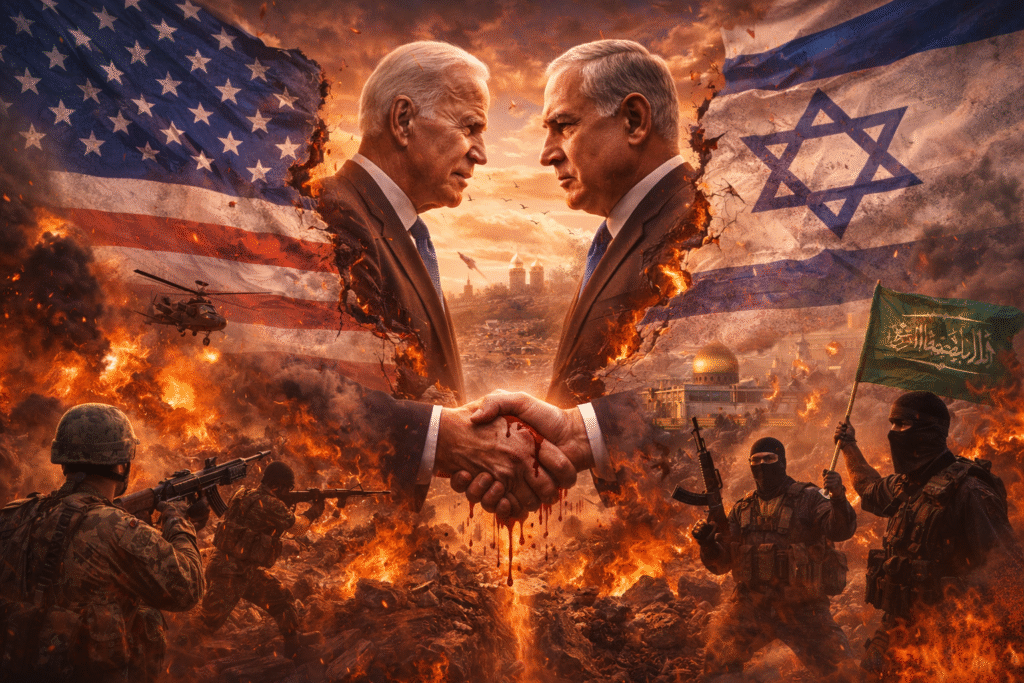
Part 1: Introduction – An Alliance Redefined by Crisis
The United States and Israel, long described as having an “unbreakable” bond, now navigate the most complex and publicly fraught period in their 75-year relationship. The bedrock of shared democratic values and strategic interests remains, but it is being stress-tested by fundamental disagreements over the conduct of the Gaza war, the vision for a postwar future, and the leadership styles of their respective governments. Today, the alliance is defined not by harmony, but by intense, high-stakes negotiation between a superpower and its most militarily capable ally in the Middle East.
Part 2: The Iron Dome of Support: Unwavering Military and Intelligence Ties
Despite political tensions, the core of the security relationship has never been stronger. The US continues to provide Israel with over $3.8 billion in annual military aid, supports its Iron Dome and new Arrow missile defense systems, and maintains unparalleled intelligence sharing. In the immediate aftermath of October 7th, the US rushed military supplies and positioned carrier strike groups as a deterrent. This strategic and operational cooperation is deeply institutionalized and transcends the political disagreements of any given moment.
Part 3: The Gaza War: A Strategic and Moral Rift
The war against Hamas in Gaza has created a profound and public rift. While the Biden administration affirms Israel’s right to self-defense, it has grown increasingly vocal in its criticism of the war’s conduct, citing the catastrophic humanitarian crisis and the staggering Palestinian death toll. The White House speaks of “red lines” regarding a major ground operation in Rafah and pleads for more precision and restraint. Prime Minister Netanyahu’s government, however, insists on “total victory” and the elimination of Hamas as a military and governing force, a goal US officials privately view as unattainable.
Part 4: The Biden-Netanyahu Dynamic: A Clash of Politics and Personality
The relationship is deeply personalized in the tense dynamic between President Joe Biden and Prime Minister Benjamin Netanyahu. Biden, who calls himself a “Zionist,” operates from a deep emotional and historical connection to Israel but is increasingly frustrated by Netanyahu’s hardline coalition. Netanyahu, fighting for his political survival amid corruption trials and post-October 7th blame, uses defiance of US pressure to bolster his domestic standing as a leader who will not bow to foreign demands. Their calls are described as blunt and difficult.
Part 5: The Domestic American Divide: A Political Wedge Issue
Israel has become a sharply polarizing issue in American domestic politics. Traditionally bipartisan support has shattered. While a majority of the US Congress still votes for aid, a growing progressive wing of the Democratic Party is vocally critical of Israeli policy, pushing for conditions on military aid and using terms like “genocide.” On college campuses and in city streets, massive pro-Palestinian protests reflect a generational shift in opinion. Meanwhile, the Republican Party has positioned itself as Israel’s unequivocal defender, using Democratic dissent to paint the left as anti-Israel.
Part 6: The “Day After” Dilemma: No Shared Vision for Gaza
The allies have no agreed plan for Gaza’s future. The US advocates for a “revitalized” Palestinian Authority eventually governing Gaza as part of a clear pathway to a two-state solution. Israel flatly rejects this, with Netanyahu’s coalition refusing any role for the PA and dismissing talk of Palestinian statehood. Israeli officials speak of indefinite military control and local Palestinian administrators with no political authority. This fundamental disagreement over political horizons is the single biggest obstacle to a coherent postwar strategy.
Part 7: The Hostage Crisis: A Shared Priority, Divergent Pressures
The fate of the hostages taken on October 7th is a searing, shared trauma. The US has deployed CIA Director William Burns and other senior officials to mediate desperate negotiations between Israel and Hamas. However, the prioritization of hostage releases versus military objectives creates tension. Families of hostages and the US government pressure for a deal at almost any cost, while the Israeli war cabinet weighs these demands against the goal of dismantling Hamas, sometimes seeing them as contradictory.
Part 8: The Iranian Deterrence: A Quiet Area of Alignment
In contrast to the public disputes over Gaza, coordination on countering Iran remains tightly aligned. The US and Israel share the goal of preventing Iran from obtaining a nuclear weapon and rolling back its regional aggression. They reportedly collaborate on intelligence and covert actions. While the US seeks to avoid a full-scale regional war, it has joined Israel in militarily retaliating against Iranian proxies, as seen in strikes against Houthi assets in Yemen and IRGC targets in Syria, creating a de facto military partnership on this front.
Part 9: The West Bank Explosion: A Simmering Point of Contention
The Biden administration views instability in the West Bank as a major threat. It has repeatedly condemned rising violence by extremist Israeli settlers, imposing visa bans on some individuals, and criticized the expansion of settlements as an obstacle to peace. The Netanyahu government, reliant on far-right pro-settler parties, has done little to curb the violence and continues to advance settlement plans. This issue is a constant, low-grade source of diplomatic friction.
Part 10: The Legal Front: The ICC and ICJ Challenges
International legal actions against Israel have put the US in a difficult position. At the International Court of Justice (ICJ), the US has defended Israel against South Africa’s genocide charge, but it cannot shield Israel from the separate investigation by the International Criminal Court (ICC), where the prosecutor is seeking arrest warrants for Israeli leaders and Hamas officials. The US, while criticizing the ICC’s move as unfair, is constrained by its own complex history with the court and must balance its legal principles with its ally’s demands for unconditional support.
Part 11: Humanitarian Aid: A Channel for Leverage and Conflict
The delivery of aid into Gaza has become a major operational and diplomatic challenge. The US has taken the extraordinary step of constructing a temporary pier for maritime aid delivery and exerts immense pressure on Israel to open more land crossings and facilitate the flow of supplies. Israeli officials, concerned about aid diversion to Hamas, conduct strict inspections, causing bottlenecks. This daily negotiation over truck counts is a microcosm of the wider struggle between military and humanitarian priorities.
Part 12: The Regional Strategy: Normalization vs. “The Palestinian Issue”
US and Israeli long-term strategies are misaligned. The US still believes regional integration for Israel (like the now-paused Saudi normalization deal) must be coupled with progress for Palestinians to be sustainable. Israel’s current government, and much of its public after October 7th, is focused on security first and sees normalization with Arab states as a way to bypass the Palestinians, not reward them. This strategic divergence blocks the kind of grand diplomatic bargain the US envisions.
Part 13: The American Jewish Community: A Mirror of the Divide
The debate is tearing at the American Jewish community. Major establishment organizations maintain strong support for Israel’s government, while groups like J Street and IfNotNow are fiercely critical of the war and advocate for a ceasefire. Synagogues and families are experiencing painful internal divisions, reflecting the broader national debate and making the politics of the alliance deeply personal for a key constituency.
Part 14: The Future of Aid: The Debate Over “Conditionality”
The foundational US policy of unconditional military aid is now under open debate. For the first time, senior voices in Congress and the administration are openly discussing leveraging aid to influence Israeli military conduct and postwar plans. While a majority still opposes formal conditions, the mere emergence of this debate marks a seismic shift. The future of the aid package itself—once a bipartisan given—is now a subject of intense annual negotiation and public scrutiny.
Part 15: Conclusion: Managing a Necessary, Tumultuous Partnership
The US-Israel relationship is no longer on autopilot. It is a daily, grinding, high-stakes management crisis. The alliance endures because their strategic, intelligence, and technological interdependence is immense, and because a fundamental rupture would be catastrophic for both. But the relationship has matured from one of automatic support to one of hard, pragmatic bargaining between two sovereign governments with increasingly divergent immediate interests and political imperatives. The “unbreakable alliance” is not breaking, but it is being bent and reshaped in the fire of war and disagreement, forging a new, more transactional, and less sentimental partnership for an unstable age.
