

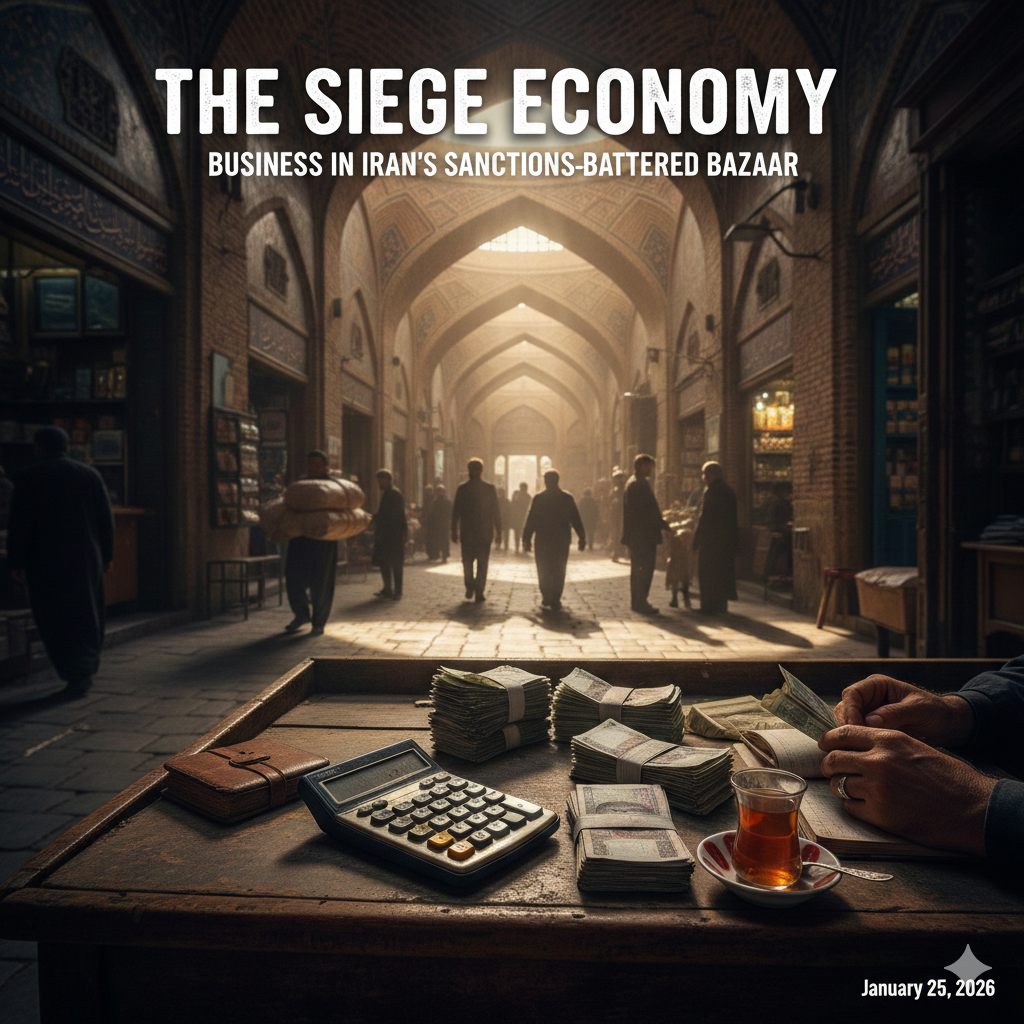
To do business in Iran today is to navigate an arena of profound paradox. It is an economy crippled by hyperinflation, international isolation, and suffocating sanctions, yet one that displays a relentless, street-level resilience. It is a system where the state and its military conglomerates control the commanding heights, while a vast, informal “bazaar” economy of traders, speculators, and hustlers adapts daily to survive. Iran’s business environment in 2024 is a high-risk, high-stress experiment in economic endurance, defined not by growth, but by the desperate search for stability and workarounds in a nation under siege.
The Foundation: The Stranglehold of “Maximum Pressure”
The single, overwhelming fact of Iranian business is the U.S.-led sanctions regime. While designed to target the state and its military apparatus, the “maximum pressure” campaign functions as a blanket financial and commercial embargo. International banks refuse to clear transactions for fear of astronomical fines, severing Iran from the global financial system (SWIFT). This makes legitimate cross-border trade, repatriation of profits, and access to spare parts and machinery a logistical nightmare of byzantine complexity. Businesses must resort to a shadowy network of money exchangers, front companies, and barter deals, all of which add massive risk and cost. The result is not just hardship but a structural distortion of the entire economy toward illegality and speculation.
The State Leviathan: The IRGC’s Economic Empire
In this sanctioned landscape, the biggest and most powerful “business” entity is not a private corporation, but the Islamic Revolutionary Guard Corps (IRGC). Through its vast engineering and industrial conglomerate, Khatam al-Anbiya, and a web of subsidiaries and front companies, the IRGC controls an estimated 30-40% of the entire economy. Its tendrils extend across oil and gas, construction, telecommunications, mining, and finance. For private businesses, this creates an impossible playing field. The IRGC enjoys preferential access to foreign currency, state contracts, and regulatory exemptions. It is both a competitor and a potential “partner” whose involvement is often a necessary condition for any large-scale project, effectively forcing the private sector into a patronage relationship with the military-security apparatus.
The Currency Crisis: The rial’s Freefall and the Speculator’s Paradise
The most visceral daily reality for every Iranian business is the catastrophic devaluation of the rial. The national currency has lost over 90% of its value against the dollar since 2018. This creates a hyperinflationary environment where pricing is guesswork, long-term planning is impossible, and capital is vaporized. It has spawned a parallel economy centered on currency speculation. Savvy operators make fortunes not by producing goods, but by arbitraging the gap between the state’s artificial official rate and the true market rate on the street. This diverts critical capital away from productive investment and into speculative financial games, further hollowing out the country’s industrial base.
The Private Sector: Survival Through Informality and Agility
Amidst this chaos, Iran’s traditional mercantile class—the bazaaris—and smaller private enterprises survive through astonishing agility and informality. They have mastered the art of the workaround: using cryptocurrencies and hawala (informal transfer systems) for international payments, sourcing goods through third countries like Turkey, the UAE, or Afghanistan, and maintaining lean, cash-based operations. Sectors like agriculture, small-scale manufacturing, and domestic tech services persist by focusing almost entirely on the captive domestic market of 85 million. However, they are hamstrung by erratic import restrictions, unreliable electricity, and the constant struggle to secure raw materials. Profit margins are thin, and the risk of sudden regulatory change or asset seizure is ever-present.
The Digital Oasis: A Domestic Tech Ecosystem Under Pressure
One of the few relative bright spots has been the growth of a domestic technology sector, born of necessity. Cut off from global app stores and major platforms, Iran has nurtured its own versions: Snapp (ride-hailing), Digikala (e-commerce), and Aparat (video sharing). These companies have thrived by serving a large, young, and digitally-native population. However, they now face immense pressure. Hyperinflation erodes their capital, and skilled engineers are emigrating in droves—a devastating brain drain known as the “flight of the minds.” Furthermore, the state views the internet and tech platforms as a threat to control, leading to frequent throttling, censorship, and a push for a tightly regulated “national internet.” The tech sector’s future depends on its ability to innovate while operating in a digital cage.
The Oil Endgame: Smuggling and Sanctions Evasion
Despite sanctions, oil remains Iran’s lifeline. Official exports have plummeted, but a sophisticated global network of sanctions evasion has emerged. Iran uses ship-to-ship transfers, disables trackers on its tankers, and relies on shadowy buyers in China, Syria, and Venezuela. This “ghost fleet” trade brings in billions, but the revenue is opaque, flowing primarily to state and IRGC coffers to fund the regime’s priorities, not national development. For the few private businesses able to tap into this clandestine logistics network, the rewards are immense, but the legal perils are existential.
The Human Capital Catastrophe: The Flight of Minds
The most damning indictment of Iran’s business climate is its human capital crisis. Chronic instability, plummeting real wages (with the average monthly salary now worth less than $150), and social restrictions have triggered a mass exodus of the educated middle class. Doctors, engineers, entrepreneurs, and academics are leaving at an unprecedented rate. This brain drain strips the economy of its most productive citizens, consumers, and innovators, creating a demographic time bomb. It leaves behind an economy increasingly managed by ideologues and populated by a struggling underclass.
Conclusion: An Economy of Resistance, Not Growth
Business in Iran today does not operate within a normal market economy. It operates within a “Resistance Economy”—the official state doctrine of self-reliance and perseverance against external pressure. In practice, this means prioritizing regime survival over prosperity, autarky over integration, and security control over entrepreneurial freedom.
The result is a system where the most successful “business” strategies are those aligned with the state’s security apparatus or those exploiting the chaos of a fractured market through speculation and informal trade. Genuine private-sector-led growth, job creation, and foreign investment are not just difficult; they are largely incompatible with the current structure. For the international community, Iran represents a market of immense potential locked behind a wall of geopolitical conflict. For the Iranian people, it is a daily struggle for economic dignity in a system engineered for political endurance, not shared prosperity. Until the fundamental dynamic of sanctions and state control shifts, Iranian business will remain a story of survival, not success.
