

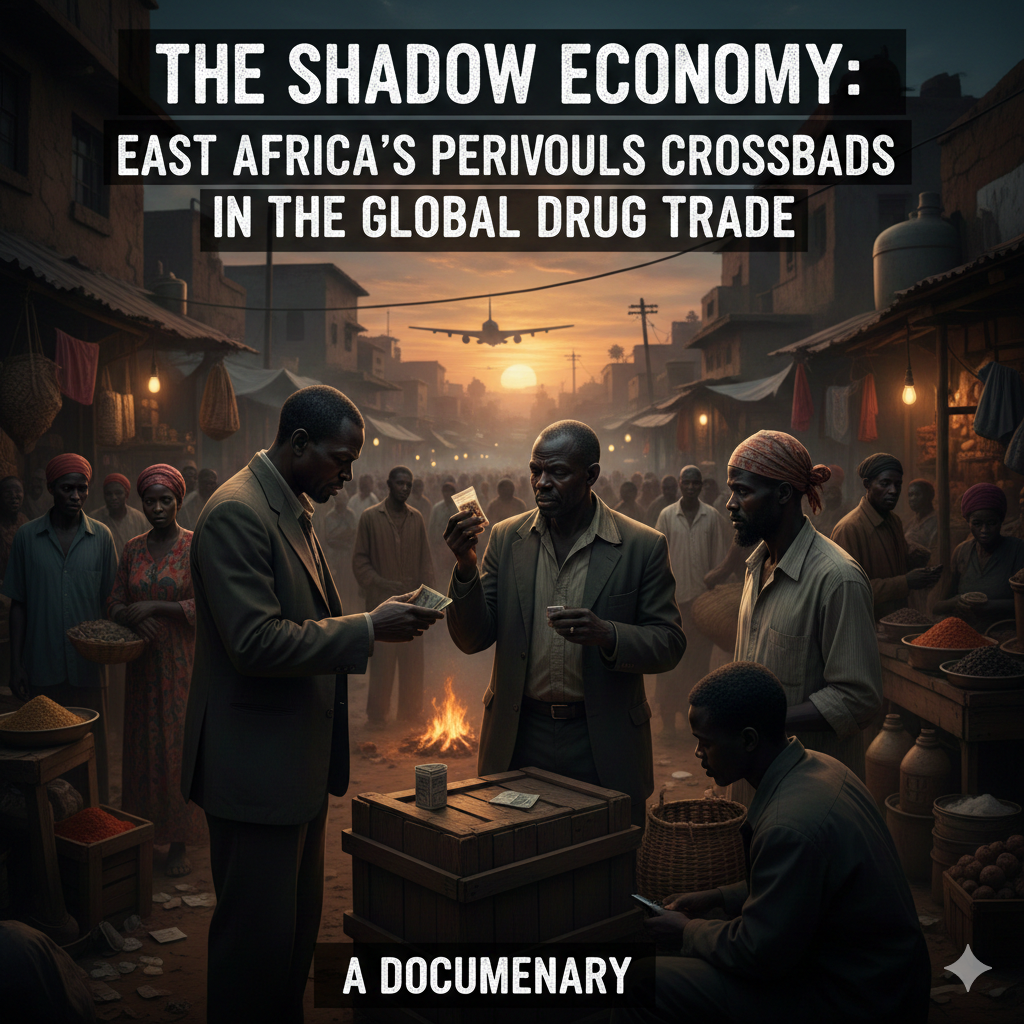
NAIROBI, Kenya / DAR ES SALAAM, Tanzania – Beneath the surface of East Africa’s vibrant economic growth and youthful dynamism flows a dark, corrosive current. The region, long considered a transit corridor for narcotics en route to Europe and Asia, has transformed into a significant consumer market in its own right. The trafficking and consumption of heroin, cocaine, and synthetic drugs have exploded, weaving themselves into the fabric of coastal cities and inland towns, corrupting institutions, destroying families, and overwhelming already fragile health systems. East Africa today is not merely a pit stop on the global drug highway; it is a destination, a battlefield, and a tragedy unfolding in slow motion.
The Heroin Coast: From Transit Corridor to Consumer Market
For decades, the Indian Ocean coastline—from Mogadishu to Mombasa to Dar es Salaam—has served as a porous entry point for heroin produced in Afghanistan and smuggled via Pakistan and Iran. What has changed dramatically in the past fifteen years is the business model. Traffickers, primarily Somali and Tanzanian networks, began paying local transporters not in cash, but in product. This “commodity-based payment” system flooded coastal communities with high-purity, cheap heroin, creating a captive consumer base almost overnight.
Today, Kenya, Tanzania, and Uganda are estimated to host hundreds of thousands of injecting drug users, the vast majority addicted to heroin. The Nyumba coast in Mombasa, the backstreets of Dar es Salaam’s Kariakoo market, and the slums of Kampala have become open-air narcotics supermarkets. The price of a dose can be less than a dollar, cheaper than a meal. This accessibility has normalized addiction among the urban poor, creating a self-perpetuating cycle of dependency, petty crime, and generational entrapment.
The Smuggling Superhighway: Routes, Networks, and Impunity
The logistics of the East African drug trade are staggering in their sophistication. Heroin and synthetic cathinones (known as khat derivatives or mairungi) flow overland from Afghanistan via Iran and Pakistan, loaded onto dhows and fishing vessels that glide undetected across the Arabian Sea. These small craft rendezvous with larger motherships off the Somali and Kenyan coasts, transferring cargo to speedboats that race to shore under cover of darkness.
The key nodes of this network are:
- The Somali Coast: Especially the port of Bossaso in Puntland, where weak state control and the presence of armed groups create ideal conditions for transshipment.
- The Lamu Archipelago (Kenya): Thousands of islands and inlets, largely unpoliced, serve as perfect drop-off points.
- Zanzibar and Coastal Tanzania: The semi-autonomous islands and remote beaches are favored landing sites for shipments destined for the Southern African corridor.
The trafficking networks are ethnically Somali, transnational, and deeply embedded in legitimate commerce. They exploit the same hawala financial systems and clan networks that enable Somalia’s remittance economy, making them exceptionally difficult to infiltrate or dismantle. Corruption is the lubricant of this entire machinery. Port officials, police commanders, and even judges are routinely bribed to look the other way, secure impunity, and ensure that seized shipments are quietly released.
The New Plague: Synthetic Drugs and Chemical Innovation
While heroin dominates the addiction landscape, a more volatile and unpredictable threat is rapidly gaining ground: synthetic drugs. Methamphetamine labs have been discovered in Kenya and Tanzania, producing cheap, highly addictive crystal meth for local consumption and export to Asia and Australia. The precursors are easily imported from China and India, and the manufacturing process, once mastered, can be executed in makeshift laboratories in residential areas.
Simultaneously, the abuse of prescription opioids (tramadol) and benzodiazepines has reached epidemic proportions, particularly among young people and truck drivers along the Northern Corridor. These pills, often counterfeit and containing unpredictable dosages, are trafficked from South Asia and sold openly in markets and pharmacies. The combination of cheap heroin, accessible synthetics, and unregulated pharmaceuticals has created a poly-substance crisis that defies simple intervention.
The Health Catastrophe: Collateral Damage of an Unchecked Epidemic
The human cost of East Africa’s drug crisis is measured in shattered bodies and truncated lives. Injecting drug use is now a primary driver of HIV transmission in the region. Kenya’s Ministry of Health estimates that over 20% of new HIV infections in coastal counties are attributable to shared needles. Tuberculosis, hepatitis C, and septic infections are rampant among the injecting population.
Yet, treatment and harm reduction services are grossly inadequate. Medically-assisted therapy using methadone or buprenorphine is available only in a handful of pilot programs in Nairobi, Mombasa, and Dar es Salaam, reaching fewer than 5% of those in need. Needle exchange programs operate in a climate of legal ambiguity and intense social stigma. Most addicts who seek help are relegated to overcrowded, under-resourced detoxification centers where relapse rates exceed 90%. The health system, already struggling with infectious diseases and maternal mortality, is simply overwhelmed.
The Social Fissures: Crime, Family Collapse, and Stigma
The drug trade does not exist in a vacuum; it parasitizes communities already weakened by poverty and unemployment. In Mombasa’s Old Town and Dar es Salaam’s Tandale, addiction has become a family tragedy. Grandmothers raise grandchildren whose parents are incapacitated or dead. Young men turn to petty theft, mugging, and housebreaking to finance their habits, driving crime rates and community fear. The cycle is self-perpetuating: addicted parents raise children in chaos, who are then recruited as runners and lookouts by traffickers, ensuring the next generation of users and dealers.
Women who use drugs face a double burden of addiction and sexual exploitation. Many exchange sex for drugs or money, exposing themselves to violence, HIV, and unwanted pregnancy. They are excluded from community support networks and often abandoned by their families. The stigma attached to female drug use is so severe that it effectively bars women from seeking help.
The Law Enforcement Failure: The Perpetual “War” on Drugs
East African governments have responded to the crisis with a familiar, failed script: criminalization and militarization. Police sweeps, publicized drug busts, and the occasional extradition of a kingpin to the United States dominate headlines. Beneath the surface, the approach is deeply flawed.
- Corruption: The same police units tasked with interdiction often extort traffickers or resell seized drugs.
- Victimization: Users are arrested, imprisoned, and brutalized, not treated. The punitive approach clogs courts and prisons but does nothing to reduce demand.
- The “Big Fish” Mirage: While high-profile arrests make good press, the decentralized, networked nature of the trade means that kingpins are easily replaced, and the supply chain adapts within weeks.
This enforcement-heavy, health-poor strategy has manifestly failed. The price and purity of heroin remain stable, indicating no effective supply disruption. The addiction population continues to grow. The war on drugs in East Africa, as elsewhere, is a war on the poor.
The Path Forward: A Public Health, Not Criminal, Approach
Breaking East Africa’s drug dependency requires a radical paradigm shift:
- Decriminalization and Diversion: Portugal’s model, treating addiction as a public health issue rather than a criminal offense, must be adapted. Users should be diverted from prisons to health assessments and treatment programs.
- Massively Scaled Harm Reduction: Governments and donors must fund a dramatic expansion of needle exchange programs, medically-assisted therapy, and outreach services. These are not moral endorsements of drug use; they are pragmatic, evidence-based interventions that save lives and prevent HIV.
- Treating the Drivers: Any effective strategy must address the root causes: chronic unemployment, lack of opportunity, and mental health neglect. Youth in coastal communities need viable economic alternatives to the quick cash offered by the drug trade.
- Regional Intelligence Sharing: The transnational nature of trafficking requires a coordinated, regional law enforcement strategy focused on high-level financial networks, not street-level users. The East African Community must establish a dedicated anti-narcotics task force with real investigative powers.
- Ending the Stigma: Public health campaigns must reframe addiction as a chronic, relapsing medical condition, not a moral failing. This requires the engagement of religious leaders, media, and community elders to rebuild a compassionate response.
Conclusion: The Tide That Cannot Be Ignored
East Africa’s drug crisis is no longer a hidden scourge; it is a visible, metastasizing wound on the body politic. The cheap heroin that washes ashore in Mombasa poisons not only the individual who injects it, but their family, their community, and the institutions meant to protect them. The traffickers operate with impunity, the health systems are overwhelmed, and the political will for meaningful reform remains tepid.
The choice before the region is stark. It can continue the failed punitive policies that fill prisons with addicts and do nothing to disrupt supply. Or it can embrace a radical, evidence-based reorientation toward public health, harm reduction, and regional cooperation. The human cost of inaction is measured in the hollowed eyes of young men on the coast, the grandmothers burying their children, and the children born already dependent on the poppy. East Africa is awash in drugs. The question is whether it will finally find the courage to treat the disease, not just curse the symptoms.