

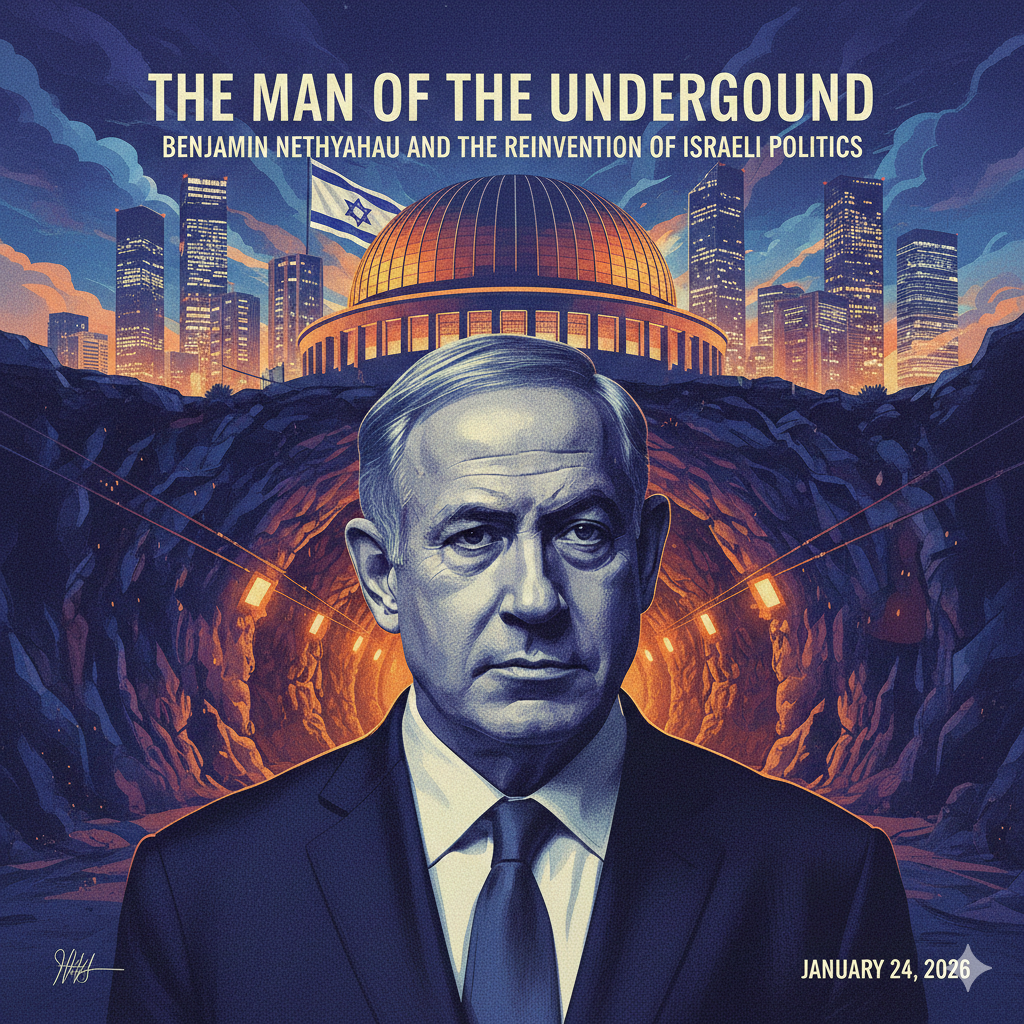
Benjamin “Bibi” Netanyahu is not merely Israel’s longest-serving prime minister. He is a political phenomenon who has fundamentally and permanently reshaped the nation’s political landscape. His story is one of brilliant strategic instinct, relentless survivalism, and the profound transformation of Israel’s national identity from a pioneering social democracy to a security-first, nationalist state. To understand Netanyahu is to understand the rightward ideological shift of a nation over three tumultuous decades, a shift he both led and meticulously engineered.
The American Forge and Early Ascent (1949-1988)
Born in Tel Aviv in 1949 to a fiercely ideological Zionist family, Netanyahu’s worldview was forged not in a kibbutz, but in suburban America. His father, the revisionist historian Benzion Netanyahu, was a disciple of Ze’ev Jabotinsky—the intellectual father of the hardline, nationalist strain of Zionism that rejected territorial compromise with the Palestinians. This ideology, which viewed the Jewish people in a state of perpetual siege, became Bibi’s foundational creed.
After distinguished service in an elite special forces unit, Netanyahu attended MIT. This American experience was formative, granting him flawless, unaccented English, a deep understanding of U.S. media and politics, and a polished, telegenic persona that set him apart from Israel’s traditionally gruff, socialist-era leaders. He returned to Israel and, after a stint as a diplomat, rocketed to fame as Israel’s articulate, polished spokesperson during the First Intifada in the late 1980s. In a nation terrified by stones and Molotov cocktails, Netanyahu offered a clear, defiant message: security above all.
The Political Project: Marketing Security (1988-1996)
Elected to the Knesset in 1988, Netanyahu quickly identified his vehicle: the Likud party. His great insight was to translate his father’s hardline ideology into a modern, potent political brand. He didn’t just oppose the Oslo Peace Accords, signed by Yitzhak Rabin in 1993; he masterfully framed them as a mortal threat. In televised addresses and on American news shows, he spoke in the accessible, terrifying language of terrorism, arguing that Oslo had created “an Iranian base next to Kfar Saba.”
This message resonated with a public traumatized by a wave of Hamas suicide bombings. Following Rabin’s assassination in 1995 by a right-wing extremist—an event Netanyahu was accused by many of helping to inflame with incendiary rhetoric—he narrowly defeated Shimon Peres in 1996. His campaign was a masterpiece of modern political marketing, focused relentlessly on Peres’s perceived weakness on security. At 46, he became Israel’s youngest-ever prime minister.
The First Term and the Art of Political Jiu-Jitsu (1996-1999)
Netanyahu’s first term established his lifelong modus operandi: publicly hawkish rhetoric combined with pragmatic, if grudging, action under immense American pressure. Though he campaigned against Oslo, he signed the Hebron Protocol in 1997, ceding part of the city to Palestinian control. This infuriated his hardline base but kept the U.S. at bay. His tenure was marked by economic growth but constant political turbulence. He was seen as arrogant and aloof, clashing with his own cabinet. He lost the 1999 election to Ehud Barak, appearing, for a moment, to be a political artifact.
The Wilderness, Reinvention, and Triumphant Return (1999-2009)
His defeat began a period of reinvention. He temporarily left politics, earning a fortune in high-dollar speaking engagements. When he returned, he had honed his skills. He served as Finance Minister under Ariel Sharon from 2003-2005, where he executed a ruthless and highly successful free-market revolution—privatizing state assets, cutting taxes and welfare, and unleashing Israel’s tech sector. This endeared him to the business class but alienated the working-poor Likud base, whom he would later win back with populist, nationalist appeals.
His moment came in 2009. After the politically disastrous Second Lebanon War (2006) and a fractious political scene, Israelis turned again to the known quantity of “Mr. Security.” Netanyahu returned to the premiership, a position he would not relinquish for the next 12 years.
The Indelible Decade: The Netanyahu Doctrine (2009-2021)
This period cemented his legacy. The Netanyahu Doctrine was built on two pillars, one international and one domestic.
- The Global Diplomatic Offensive: Netanyahu systematically bypassed the stagnant Palestinian peace process to forge direct alliances with the Arab world, based on a shared fear of Iran. He cultivated an unprecedented closeness with the Trump administration, securing the moving of the U.S. embassy to Jerusalem and the Abraham Accords with the UAE and Bahrain. He presented himself on the world stage as the lonely defender of Western civilization against the dual threats of Iranian nukes and Islamic terrorism. At the UN, with his famous cartoon bomb diagram, he was the master of the political spectacle.
- Domestic Political Domination: At home, he perfected the politics of coalition and polarization. He formed alliances with ultra-Orthodox parties and, critically, the rising force of the far-right, religious-nationalist settlers. He nurtured a base that saw him as the only bulwark against a leftist elite and an antagonistic international community. Simultaneously, he used his political longevity to reshape the judiciary, appointing conservative judges and battling the Supreme Court, which he depicted as an unelected liberal cabal thwarting the popular will. He turned multiple criminal indictments for fraud, bribery, and breach of trust into a rallying cry, accusing the police, media, and legal establishment of a “witch hunt” designed to overthrow the right.
The Ultimate Survivor: Opposition, Comeback, and War (2021-Present)
His political magic finally faltered in 2021. After four deadlocked elections, a disparate coalition of his opponents—from the right-wing nationalist Naftali Bennett to the left-wing Meretz—united solely to oust him. In opposition, however, he remained the center of gravity. He ruthlessly undermined the fragile coalition, which collapsed in 2022, paving the way for his return at the head of the most right-wing, religiously conservative government in Israel’s history.
This government’s push for a radical judicial overhaul—seen by critics as a bid to quash his own corruption trial—triggered the greatest internal crisis in Israel’s history: months of mass pro-democracy protests that split the military and society. That crisis was violently subsumed on October 7, 2023, by the deadliest day for Jews since the Holocaust. Netanyahu’s lifelong political identity as the ultimate security guarantor was shattered overnight. His government is now defined by the ongoing war in Gaza, plunging domestic unpopularity, and a desperate fight for political survival.
Conclusion: The Architect of Modern Israel
Benjamin Netanyahu’s history is the history of modern Israel’s transformation. He moved the ideological center of gravity to the right, made free-market economics orthodoxy, and made the Iranian threat the focal point of national security. He is a political genius of stamina and strategic vision, but his legacy is indelibly stained by the profound societal divisions he cultivated to retain power and the catastrophic intelligence and strategic failure of October 7th. He built a political empire on the promise of safety and strength, a promise that now rings hollow for many. Whether he survives politically, his true legacy is the Israel he leaves behind: a wealthy, technologically advanced nation, more accepted in parts of the Arab world than ever, but also more polarized, more distrustful of its institutions, and facing threats more severe than at any point in his long tenure. He is the indispensable architect of contemporary Israel, for both its formidable strengths and its deep, perhaps enduring, fractures.