

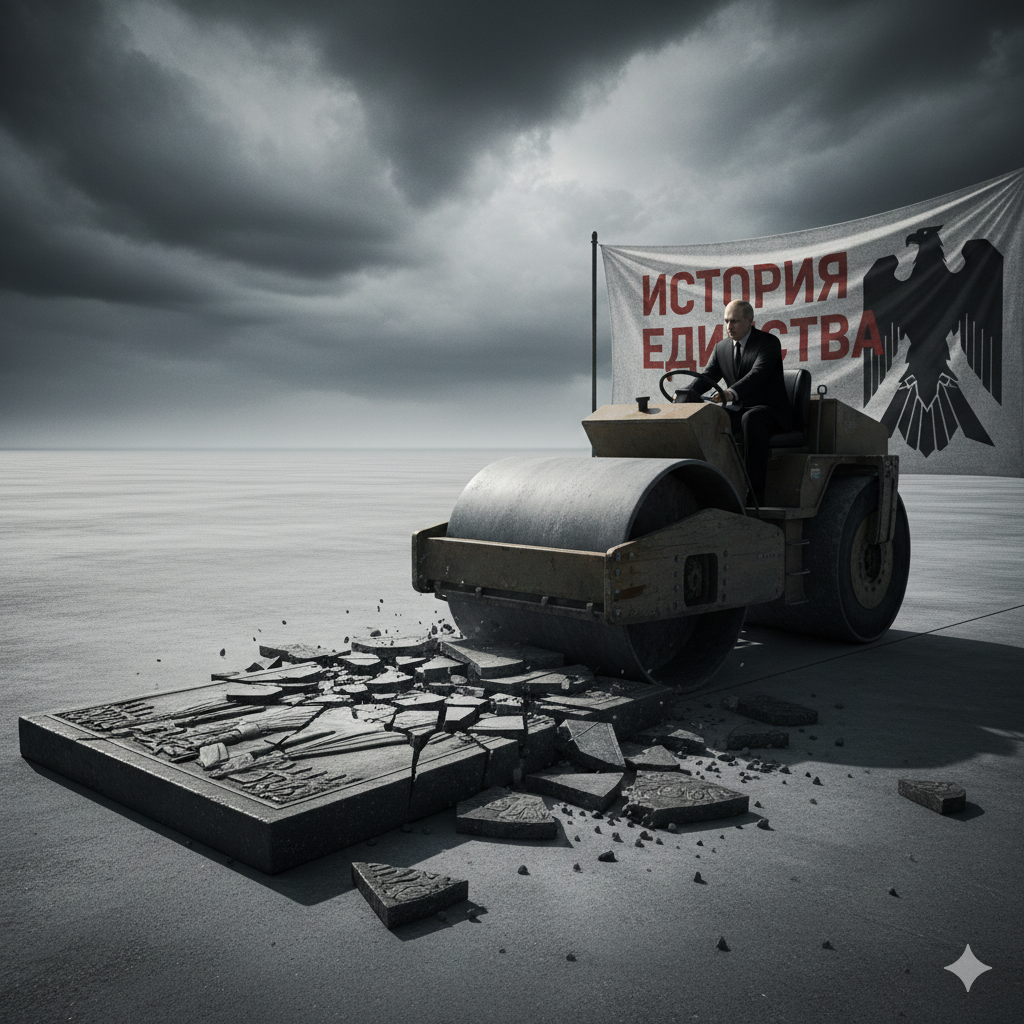
In the twenty-first century, history is no longer a passive subject studied in archives; under Vladimir Putin, it has become an active, dangerous instrument of state power. The Russian president’s worldview and his political survival are built upon a specific, weaponized interpretation of the past—one that is flat. By “flat,” we mean a narrative stripped of complexity, ambiguity, and inconvenient facts, hammered into a singular, monolithic tool for justifying present-day authority and future expansion. This process, the creation of a flat history, is central to understanding modern Russia and the ideology driving its war in Ukraine.
The Foundations: Grievance and Greatness
Putin’s historical vision rests on two pillars, both simplified to their extreme.
Pillar One: The Trauma of Collapse. The dissolution of the Soviet Union in 1991 is not viewed as a complex event with multiple causes, but solely as “the greatest geopolitical catastrophe of the century.” In this flat telling, it was a humiliating, externally-engineered dismemberment of a historic state—not a result of internal economic failure, political ossification, or the will of its republics. This narrative transforms a multifaceted historical process into a simple story of national victimhood and Western treachery, fueling a politics of resentment and a desire for restoration.
Pillar Two: The Myth of Eternal Statehood. Putin and his ideologues promote the concept of “historical Russia”—a timeless, continuous civilization stretching from Kyivan Rus’ to the Russian Empire, to the USSR, to the modern Russian Federation. This view deliberately flattens a millennium of history. It ignores the distinct evolution of Ukrainian and Belarusian identities, the voluntary and forced incorporations of diverse nations, and the brutal complexities of imperial and Soviet rule. History becomes a linear, predetermined path toward the consolidation of power under Moscow.
The Mechanism: Control, Propaganda, and Law
Creating and enforcing this flat history requires a systematic, state-led campaign:
- Institutional Control: The state has dismantled independent historical analysis. Memorial, Russia’s foremost human rights and historical research organization, was forcibly liquidated. State-approved textbooks now present a standardized, patriotic narrative where Russian leaders are rarely criticized and the state’s actions are always justified by national interest or external threat.
- Propaganda as Pedagogy: Television, the primary news source for most Russians, operates as a 24/7 history channel. Documentaries and talk shows relentlessly recycle the flat narrative: Russia is a besieged fortress, forever fighting Nazis (now rebranded as the Ukrainian government), defending Orthodox civilization, and rectifying historic injustices. The past is not past; it is a continuous present-day war.
- Legislating Memory: The state has criminalized alternative interpretations. Laws against “rehabilitating Nazism” and “discrediting the Russian military” are used to prosecute anyone who challenges the official narrative of World War II (the “Great Patriotic War”) or the current war in Ukraine. History is no longer debatable; it is a matter of criminal law.
The Function: Justifying Power and War
This flattened history serves critical political functions:
- Legitimizing Autocracy: If Russia is in a perpetual state of existential conflict, then strong, centralized, unchallenged leadership is not a choice but a historical necessity. Democracy, debate, and dissent become dangerous luxuries that weaken the nation in its endless struggle.
- Annulling Ukrainian Sovereignty: The war against Ukraine is the ultimate application of flat history. By insisting Ukrainians and Russians are “one people” and that Ukraine has no legitimate history as a separate state—calling it a modern “fiction” created by Lenin—Putin provides the ideological pretext for invasion. He is not conquering a neighbor; he is “collecting historical lands” and correcting a “historical mistake.”
- Mobilizing the Population: A flat, heroic past of triumph over Nazis and Western plots provides a clear, emotionally resonant script for public mobilization. It simplifies a confusing, costly war into a familiar, sacred struggle for survival.
The Consequences: A Society Unmoored
The relentless enforcement of flat history has profound consequences:
- The Erosion of Truth: When historical facts are subordinate to state utility, the very concept of objective truth evaporates. This creates a populace living in a manufactured reality, making internal dissent or critical reasoning exceptionally difficult.
- Historical and Cultural Vandalism: The war in Ukraine physically destroys the complex, layered history it claims to protect—shelling museums, archives, and ancient cities like Odesa and Chernihiv. It is an attempt to literally erase a competing historical tapestry and replace it with a flat, Russian one.
- International Alienation: This historical revisionism, particularly regarding WWII, is an affront to the memory and sovereignty of Eastern European nations that view Soviet rule as occupation, not liberation. It makes diplomatic reconciliation impossible, as it denies the core historical experiences of Russia’s neighbors.
Conclusion: The Past as a Battlefield
Vladimir Putin has turned history into the central battlefield of his regime. His flat history is a powerful, dangerous tool: it consolidates domestic power, justifies imperial aggression, and forges a national identity based on grievance and grandeur. However, it is also brittle. It requires constant reinforcement through censorship and repression because it is built on the denial of observable reality and the lived experience of millions. The ultimate failure of this project may lie in its very flatness. Just as a flat map cannot accurately represent a spherical world, a flat history cannot forever contain the multifaceted, resilient, and ultimately uncontrollable truth of the past. The war for Ukraine is, in part, a war to force this flattened history onto a people whose own rich, complex story refuses to be erased. In the end, history itself—in all its messy, contradictory, human complexity—may prove to be Putin’s most formidable enemy.