

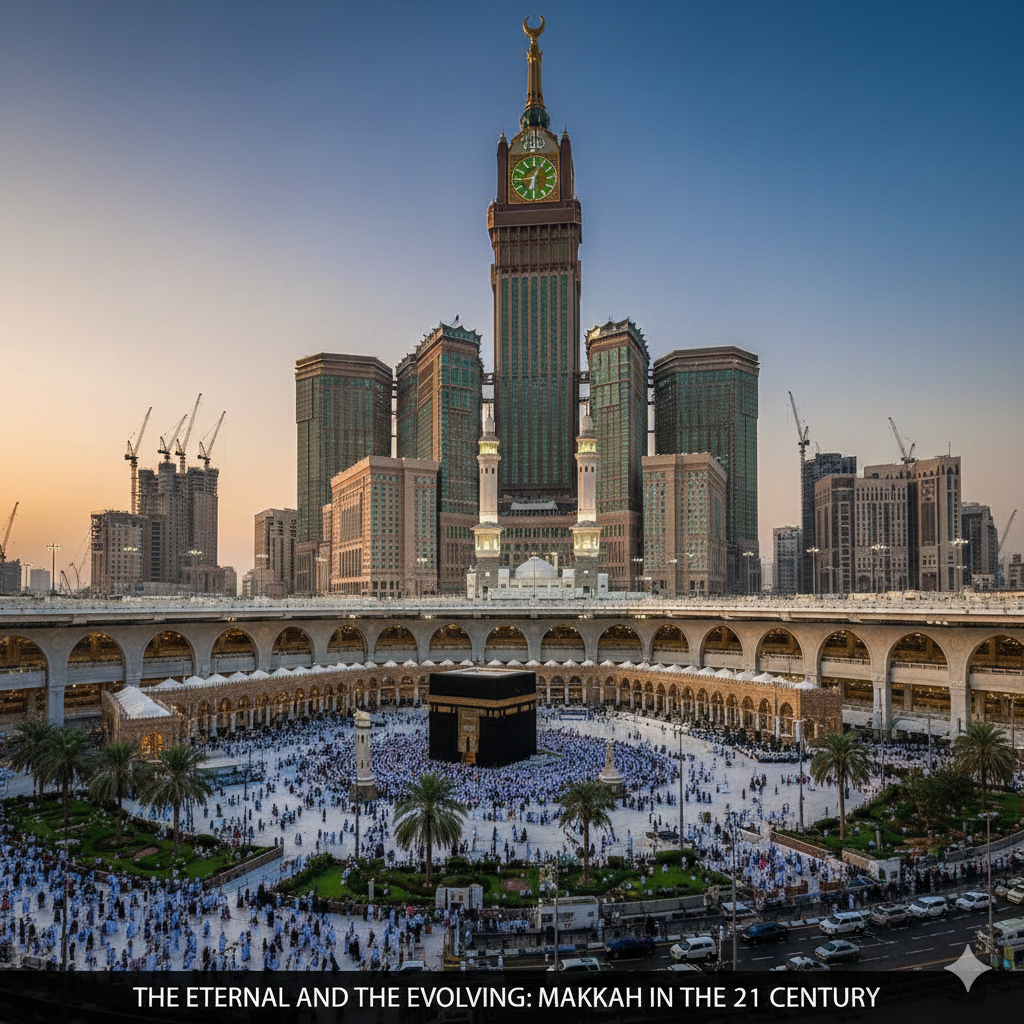
MAKKAH, SAUDI ARABIA – For over 1.4 billion Muslims, Makkah is the spiritual center of the universe, a city whose direction they face five times a day and whose sanctity is etched into the very bedrock of their faith. Yet, the Makkah of today is a place of profound duality: it is the ancient, unchanging sanctuary of Ibrahim (Abraham) and the site of the first revelation to the Prophet Muhammad (PBUH), while simultaneously being one of the world’s most rapidly transforming urban landscapes. It exists in a state of perpetual tension between preserving timeless ritual and accommodating the logistical realities of the modern, globalized Ummah. To witness Makkah today is to see a city straining under the weight of its own cosmic significance, evolving at a breathtaking pace to manage the faithful while striving to retain its soul.
The Spiritual Heartbeat: The Unchanging Hajj and Umrah
At its core, Makkah’s purpose is immutable. Every day of the year, but crescendoing during the Hajj season, the city pulses with the rhythms of devotion. The focal point remains the Masjid al-Haram (The Sacred Mosque), centered on the Kaaba, the cubical structure draped in black silk (kiswa) that Muslims believe was first built by Prophet Ibrahim and his son Ismail. The ritual of Tawaf—the counter-clockwise circumambulation of the Kaaba by tens of thousands at any given moment—creates a mesmerizing, human river of faith, a physical manifestation of unity and submission.
The rites of Hajj—standing at Arafat, stoning the pillars at Mina, sacrificing an animal—follow a celestial calendar and a script unchanged for over fourteen centuries. These rituals, demanding and profound, connect the modern pilgrim directly to the footsteps of the prophets. This timeless spiritual core is what gives Makkah its eternal power; it is a city where history is not studied but performed, where every pilgrim becomes part of a living, breathing tradition that transcends nationality, ethnicity, and social class.
The Urban Metamorphosis: Engineering for the Faithful
To accommodate the ever-growing number of pilgrims (pre-pandemic Hajj saw over 2.5 million participants, with Umrah visitors exceeding 19 million annually), Saudi Arabia has embarked on one of the most ambitious urban renewal projects on earth. The goal is clear: to maximize capacity, ensure safety, and enhance the pilgrim experience. The result is a skyline that has been utterly reinvented.
Dominating this new landscape are the Abraj al-Bait Towers, a government-owned mega-complex directly adjacent to the Grand Mosque. Its centerpiece, the Royal Clock Tower, soars over 600 meters, its gargantuan timepiece visible for miles and its top floor crowned with a golden crescent moon. The complex houses ultra-luxury hotels (like the Fairmont and Raffles), shopping malls featuring global brands, and vast prayer spaces capable of holding hundreds of thousands. For its supporters, it is a feat of engineering that provides essential lodging and services steps from the Haram. For its critics, its opulent, gleaming presence represents a jarring commercialization of the sacred, casting a literal and metaphorical shadow over the simple, ancient Kaaba.
This development extends far beyond the towers. The entire Mashair region (the ritual sites of Mina, Muzdalifah, and Arafat) has seen massive investment. Mina, once a valley of simple tents, now hosts the world’s largest temporary city of fire-resistant, air-conditioned fiberglass tents arranged in a highly organized grid. A $16 billion Makkah Metro (the Al Mashaaer Al Mugaddassah Metro Line) whisks pilgrims between the holy sites, replacing hours of traffic-clogged bus journeys. These projects are framed by the Saudi state as a sacred duty (khidmah al-haramayn – service to the two holy cities) and a cornerstone of its Vision 2030 plan to diversify the economy through religious tourism.
The Technology of Devotion: A Digital Hajj
Makkah is now a smart city for the faithful. Pilgrims navigate with dedicated apps that provide prayer times, GPS-guided ritual instructions, and crowd-density heat maps. The Nusuk platform (formerly Eatmarna) is the official Saudi portal for Hajj and Umrah visa applications, package bookings, and health registrations, digitizing a process once mired in middlemen and paperwork.
Surveillance and security are omnipresent but discreet. Thousands of high-definition cameras, facial recognition systems, and sensors monitor crowd flow in real time in a command center worthy of a science-fiction film. This vast apparatus is designed to prevent tragedies like the 2015 stampede, managing the world’s largest annual gathering with a mix of traditional crowd-control mutawwif (guides) and cutting-edge AI predictive analytics. The sacred rites are now safeguarded by some of the most advanced technology on the planet.
Contradictions and Contentions: The Soul of the City
This breakneck modernization has sparked deep debate within the Muslim world.
- Commercialization vs. Contemplation: The proliferation of five-star hotels, Rolex stores, and Starbucks within sight of the Kaaba leads many to question whether the egalitarian spirit of Hajj—where all stand equal before God in simple white cloth (ihram)—is being undermined by blatant consumerism and the visible stratification of pilgrim luxury.
- Heritage and History Lost: The expansion of the Haram and the new construction has come at the cost of Makkah’s historical and archaeological heritage. Centuries-old Ottoman and Abbasid-era structures, including homes of the Prophet’s companions, have been demolished to make way for wider plazas and new hotels. Critics argue that in creating a space for the global present, the city has severed tangible links to its own Islamic past.
- A Managed Experience: The Hajj is increasingly a highly regulated, state-controlled event. While this brings order and safety, some scholars and pilgrims lament a loss of individual spiritual struggle and improvisation, feeling the journey has become overly packaged and sanitized.
Makkah as a Mirror of Saudi Arabia
The transformation of Makkah is a direct reflection of the Saudi state’s evolving identity. It showcases the kingdom’s immense wealth and technical prowess. It also highlights the central contradiction of Vision 2030: leveraging the deep conservatism and religious capital of the holy cities to fund a future that Crown Prince Mohammed bin Salman envisions as more modern, open, and economically diversified. The state presents itself as the benevolent, capable custodian of Islam’s holiest sites, using this role to bolster its legitimacy on the world stage.
Conclusion: Between the Minaret and the Crane
Today’s Makkah is a city where the cry of “Allahu Akbar” echoes not just from minarets but through the marble halls of shopping malls. It is where the desert pilgrim and the billionaire sheikh perform the same prostration on floors cooled by industrial-scale air conditioning. It is a place of profound spiritual power, increasingly housed within a shell of staggering modern engineering.
The essential question for Makkah—and for the Muslim world—is whether the spiritual essence of the city can survive its physical metamorphosis. Can the humility of ihram coexist with the luxury of the Clock Tower? Can the timeless, personal connection to God be maintained within a meticulously managed, hyper-digital crowd of millions?
For the believer, the answer is often found not in the skyline, but in the heart. The true Makkah resides in the tearful prayer of a pilgrim touching the Black Stone, in the exhaustion and elation of the walk between Safa and Marwah, in the collective plea of millions on the Plain of Arafat. The cranes and the cameras are the backdrop; the foreground remains, and will always remain, an act of faith. Makkah today is eternal in its calling, but perpetually evolving in its container—a testament to a faith navigating its place in a modern world it is striving both to accommodate and transcend.