

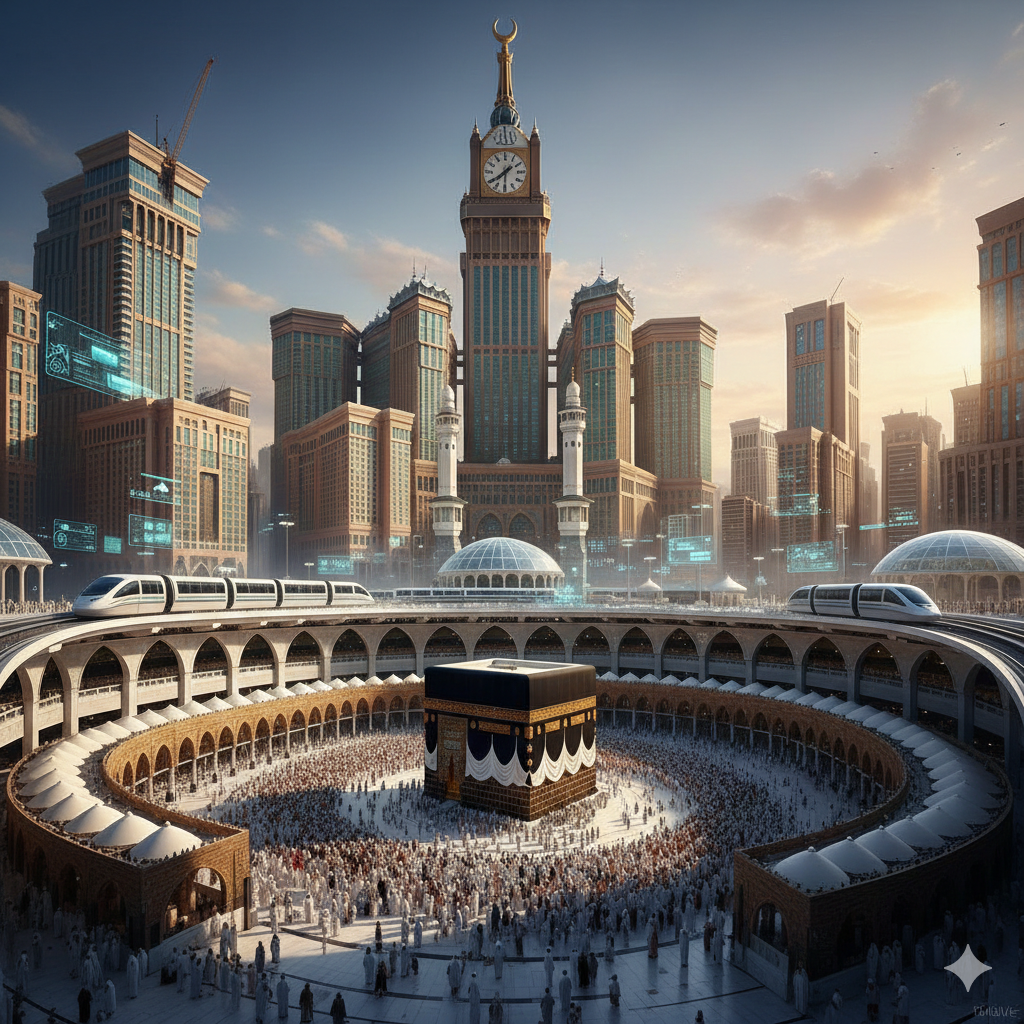
Makkah, the Umm al-Qura (Mother of Cities), exists in a unique state of perpetual timelessness and constant transformation. It is the spiritual axis for 1.8 billion Muslims, a city whose sacred geography has been fixed for millennia, yet whose physical infrastructure is being reshaped with staggering ambition and scale. Today, Makkah is a city of profound duality: it is the site of the most intimate acts of worship and the world’s largest, most logistically complex annual human gathering. It is a place where ancient rituals are performed amidst hyper-modern towers, where spiritual serenity coexists with intense urban density. To witness Makkah today is to see a holy city navigating the immense pressures of the modern world while striving to preserve its sanctified essence.
The Spiritual Heart: Unchanging Ritual in a Changing City
At its core, Makkah’s purpose remains singular and unchanged: to facilitate the Hajj and Umrah pilgrimages. The rituals of Tawaf (circumambulation of the Kaaba), Sa’i (walking between Safa and Marwah), and the standing at Arafat define the city’s rhythm and purpose. The Grand Mosque (Al-Masjid al-Haram) is the epicenter, having undergone its most recent and colossal expansion under the late King Abdullah. The mosque can now accommodate over two million worshippers at once, its vast marble courtyards and multi-level prayer halls equipped with state-of-the-art cooling systems to combat the desert heat.
The experience of the pilgrim today is a blend of the ancient and the technologically assisted. The Kiswa, the black silk cloth draping the Kaaba, is still woven by hand in a dedicated Makkah factory, but its design and production are aided by computerized precision. The Mataf (the circumambulation area around the Kaaba) is cooled by embedded granite chillers. Pilgrims navigate with digital apps offering prayer times, guidance, and crowd density maps, while a fleet of electric golf carts assists the elderly and disabled. This integration of technology seeks not to alter the ritual, but to preserve the worshipper’s focus and physical capacity amidst the overwhelming scale of the crowds.
The Urban Metamorphosis: Ambition on a Biblical Scale
The skyline encircling the Grand Mosque is the most visible testament to Makkah’s new era. A ring of skyscrapers, led by the towering Abraj Al Bait complex with its iconic Royal Clock Tower, dominates the view. These structures are more than hotels; they are vertical cities designed to house hundreds of thousands of pilgrims mere steps from the mosque. They contain shopping malls, prayer halls, and helipads, representing a vision of pilgrimage that is both efficient and commercial.
This urban transformation is part of Saudi Arabia’s broader Vision 2030, which aims to diversify the economy and increase Umrah and Hajj capacity to 30 million annual visitors. Massive projects are re-engineering the city’s topography itself. The Makkah Grand Mosque Master Plan involves expanding plazas, constructing pedestrian tunnels and automated walkways to ease movement, and developing the mountainous areas around the city to create new residential and hospitality zones. The Masar project is a vast urban boulevard designed to organize the chaotic traffic flows with dedicated bus lanes and improved infrastructure.
Critics, both within and outside the Islamic world, voice concerns that this relentless vertical development risks commercializing the sacred space, turning the holy sanctuary into a “Las Vegas of the Middle East.” They worry that the awe-inspiring simplicity of the Kaaba is being overshadowed by glittering luxury hotels, shifting the focus from spiritual poverty (ihram) to material wealth. The Saudi authorities counter that these developments are acts of service (khidmah), necessary to accommodate the ever-growing number of believers who fulfill their religious duty, providing safety, comfort, and accessibility on an unprecedented scale.
The Ultimate Logistical Challenge: Managing the Hajj
For a few days each year, Makkah becomes the focal point of the planet’s most complex crowd management operation. The Hajj is a non-negotiable deadline that tests every facet of the city’s infrastructure. Today, this management is a high-tech science.
- The Hajj Smart Identity System: Each pilgrim wears a biometric-enabled wristband (Nusk card) containing their personal data, medical records, and travel information. This system streamlines movement through checkpoints, helps locate lost individuals, and manages the flow of crowds in real-time.
- Crowd Control and AI: A network of thousands of high-resolution cameras feeds into command centers where AI algorithms analyze crowd density, movement patterns, and potential bottlenecks. Authorities can then direct flows via digital signage, mobile alerts, and on-the-ground stewards to prevent deadly crushes like the 2015 Mina stampede.
- Health and Safety: The post-pandemic Hajj has integrated rigorous health protocols. The Saudi Ministry of Health deploys mobile field hospitals, clinics along pilgrimage routes, and real-time epidemiological surveillance. The scale of sanitation is monumental, with thousands of workers cleaning the Holy Mosque around the clock.
Despite these advances, the fundamental challenge remains: compressing over two million people from every corner of the earth into a series of specific rites, in a narrow desert valley, within a strict five-day window. It is an operation where spiritual devotion and hyper-rational logistics are inextricably linked.
The Living City: Beyond the Pilgrimage
Beyond the pilgrimage cycles, Makkah is a living city of over two million residents. For them, life is shaped by the city’s sacred status and its seasonal rhythms. The economy is almost entirely oriented towards hospitality and services for pilgrims. Traffic patterns, business hours, and the very pace of life ebb and flow with the Umrah and Hajj seasons. Residents navigate a city perpetually under construction, balancing their daily needs with their role as hosts (mujawireen) to the global Muslim community.
There is also a growing emphasis on developing Makkah’s historical and cultural sites beyond the immediate Haram area. Projects aim to restore and showcase sites linked to the life of the Prophet Muhammad and Islamic history, such as the Cave of Hira, where he received the first revelation. This seeks to provide pilgrims with a deeper, more historically rooted connection to the city.
Conclusion: A Delicate Balance Between Sanctuary and Metropolis
Makkah today stands at a crossroads between its eternal identity and its future-facing ambitions. It is grappling with a fundamental question: How does a city scale itself to serve a global faith community in the 21st century without eroding the spiritual austerity and universality that are its very reason for being?
The Saudi project is one of monumental facilitation, seeking to harness technology, finance, and urban planning to serve the believer. The success of this project will not be measured in square meters of marble or hotel capacity alone, but in whether the pilgrim, amidst the grandeur and the crowds, can still find that moment of untouched, personal connection with the Divine at the House of Ibrahim.
The vision for Makkah is ultimately a vision for modern Islam itself: confidently embracing progress and scale, while holding fast to an unchanging spiritual core. The cranes on the horizon and the prayers rising from the courtyard are not in contradiction; they are two expressions of the same reality—a faith that is eternally ancient, perpetually renewed, and now, being housed in a city built for the ages.
