

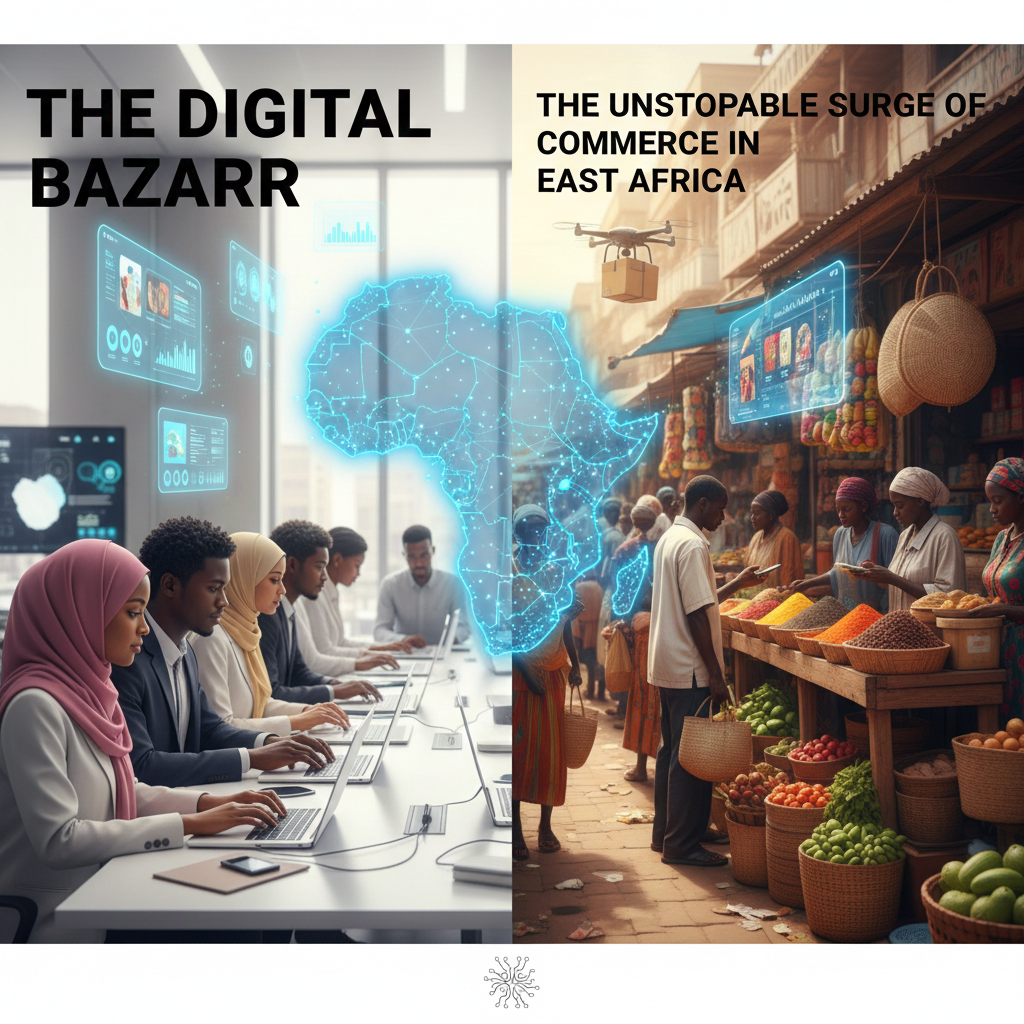
NAIROBI, Kenya – The heartbeat of East Africa’s economy is no longer measured solely in the hum of factory machinery or the tonnage of cargo in the ports of Mombasa and Dar es Salaam. Today, its most dynamic pulse can be found in the digital chatter of millions of smartphones, in the glow of a merchant’s screen in a dimly lit kiosk, and in the complex dance of goods moving across borders both physical and regulatory. Commerce in East Africa is undergoing a radical, technology-driven transformation, building upon ancient trading traditions to create a uniquely African, 21st-century marketplace. This is a story of mobile money ubiquity, logistical revolution, and a relentless entrepreneurial spirit navigating a landscape of immense opportunity and stubborn obstacles.
The Mobile Money Foundation: The Engine of the Digital Economy
Any discussion of modern commerce in East Africa must begin with mobile money. What started with M-Pesa in Kenya has evolved into the foundational layer for all commercial activity. Platforms like M-Pesa, Airtel Money, and Tigo Pesa are not just for sending remittances; they are the payment rails for an entire economy.
For commerce, this has been revolutionary:
- Micro-Transaction Enablement: A farmer can sell a single crate of tomatoes to a vendor hundreds of miles away and receive instant payment.
- Formalizing the Informal: The mama mboga (vegetable vendor) who once dealt only in cash now accepts mobile payments, creating a digital financial footprint that can lead to micro-credit and inventory management tools.
- E-commerce Fuel: Every major e-commerce platform, from Jumia to specialized agricultural marketplaces, relies on mobile money as the primary payment method, solving the critical trust and cash-on-delivery dilemma that plagued early models.
This deep financial inclusion has created a continent-leading environment for digital commerce to flourish, turning every phone into a potential storefront.
The E-commerce Evolution: Beyond Jumia
While Jumia, often dubbed the “Amazon of Africa,” remains a major pan-African player, the East African e-commerce scene has diversified. The market has matured beyond selling just smartphones and electronics to encompass core economic sectors:
- Agri-Commerce (Agri-tech): This is where some of the most impactful innovation is happening. Platforms like Twiga Foods in Kenya have revolutionized the fresh produce supply chain. By connecting smallholder farmers directly to urban retailers via a mobile-based platform, Twiga cuts out layers of middlemen, reduces post-harvest waste by over 30%, and guarantees farmers a fair, predictable market. Similar models are emerging for grain, dairy, and livestock.
- B2B Commerce: Startups are digitizing the vast, fragmented world of informal retail. Platforms like Sokowatch (now Wasoko) and MarketForce operate a network of agents and a logistics fleet to deliver fast-moving consumer goods (FMCG) like soap, cooking oil, and airtime directly to hundreds of thousands of small shops (dukas) across the region. They offer inventory on credit, paid via mobile money, solving capital and stock-out problems for micro-retailers.
- Social Commerce and Hyper-Local Models: The true engine of daily commerce for many is WhatsApp and Instagram. From hair salons to bakers, entrepreneurs use social media as a catalogue, customer service channel, and ordering platform. Payment is confirmed via mobile money, and delivery is arranged through motorcycle taxis (bodaboda). This low-tech, high-trust model dominates the service and bespoke goods economy.
The Logistics Revolution: The “Last Mile” Frontier
E-commerce is only as strong as its delivery network. Here, East Africa is seeing a boom in logistics-tech. The challenge is legendary: poor addressing systems, congested cities, and high costs. The response has been ingenious:
- Motorcycle Armadas: Companies like Sendy and Beyonic have formalized the bodaboda network into on-demand delivery fleets, tracked via GPS.
- Aggregation and Tech: Platforms aggregate delivery requests and use algorithms to optimize routes, bringing efficiency to a traditionally chaotic space.
- Cross-Border Hurdles: For regional trade, the physical movement of goods remains hampered by bureaucracy. However, digital platforms are emerging to streamline customs documentation, cargo tracking, and freight matching, slowly chipping away at the non-tariff barriers that plague the East African Community (EAC) common market.
The Rise of the Super-Apps and Fintech Integration
The future of commerce is moving towards integrated ecosystems. Super-apps, inspired by Asian models like WeChat, are beginning to emerge. Safaricom’s M-Pesa is the prime candidate, having evolved from a money transfer tool into a platform hosting millions of merchants, offering savings and credit products (Fuliza), and integrating with shopping and bill payment services.
This fintech-commerce convergence is powerful. A merchant’s sales data on a B2B platform can be used to underwrite a digital loan. A consumer’s payment history can unlock “buy now, pay later” options at checkout. Commerce is becoming seamlessly interwoven with financial identity and access to capital.
Regional Integration: The Unfulfilled Promise
The theoretical potential of the EAC common market, with its 300 million consumers, is staggering. The reality is more complex. While goods are supposed to move freely, in practice, non-tariff barriers (NTBs)—cumbersome customs procedures, roadblocks, and varying standards—significantly increase the time and cost of cross-border trade. A truck transporting goods from Mombasa to Kigali can still be subject to multiple checks and delays.
Initiatives like the Electronic Single Window for customs and the pursuit of a unified EAC e-commerce framework aim to digitize and harmonize these processes. The success of regional commerce hinges on political will to move from agreements on paper to seamless implementation on the ground.
Challenges on the Horizon
For all its dynamism, East African commerce faces significant headwinds:
- The Trust Deficit: Beyond mobile money, many consumers remain wary of paying for goods they haven’t seen, and merchants fear chargebacks. Building robust digital trust is an ongoing process.
- The Digital Divide: While urban centers are well-connected, rural inclusion in the digital commerce revolution is slower, limited by internet coverage, digital literacy, and last-mile logistics costs.
- Regulatory Uncertainty: The rapid growth of digital platforms has outpaced regulation. Governments are grappling with how to tax digital transactions, protect consumer data, and foster competition without stifling innovation.
Conclusion: A Blueprint for the Future of African Trade
Commerce in East Africa today is a vibrant hybrid. It respects the power of the social, community-based trade that has existed for centuries while boldly embracing the tools of the digital age. It is building a system that is inherently mobile-first, logistics-aware, and financially inclusive.
This model, born of necessity and local context, may well provide a blueprint for the future of commerce across the developing world. It demonstrates that the path to a modern, connected economy does not have to mimic the West’s; it can leapfrog, adapt, and innovate in uniquely relevant ways.
The duka owner using an app to restock her shelves, the farmer checking commodity prices on his phone, and the fashion designer selling her creations on Instagram—these are the faces of East Africa’s commercial revolution. They are not waiting for the future to arrive; they are building it one mobile transaction at a time. In the digital bazaars of East Africa, the future of trade is being written, and it is unmistakably local, relentlessly entrepreneurial, and increasingly borderless.