

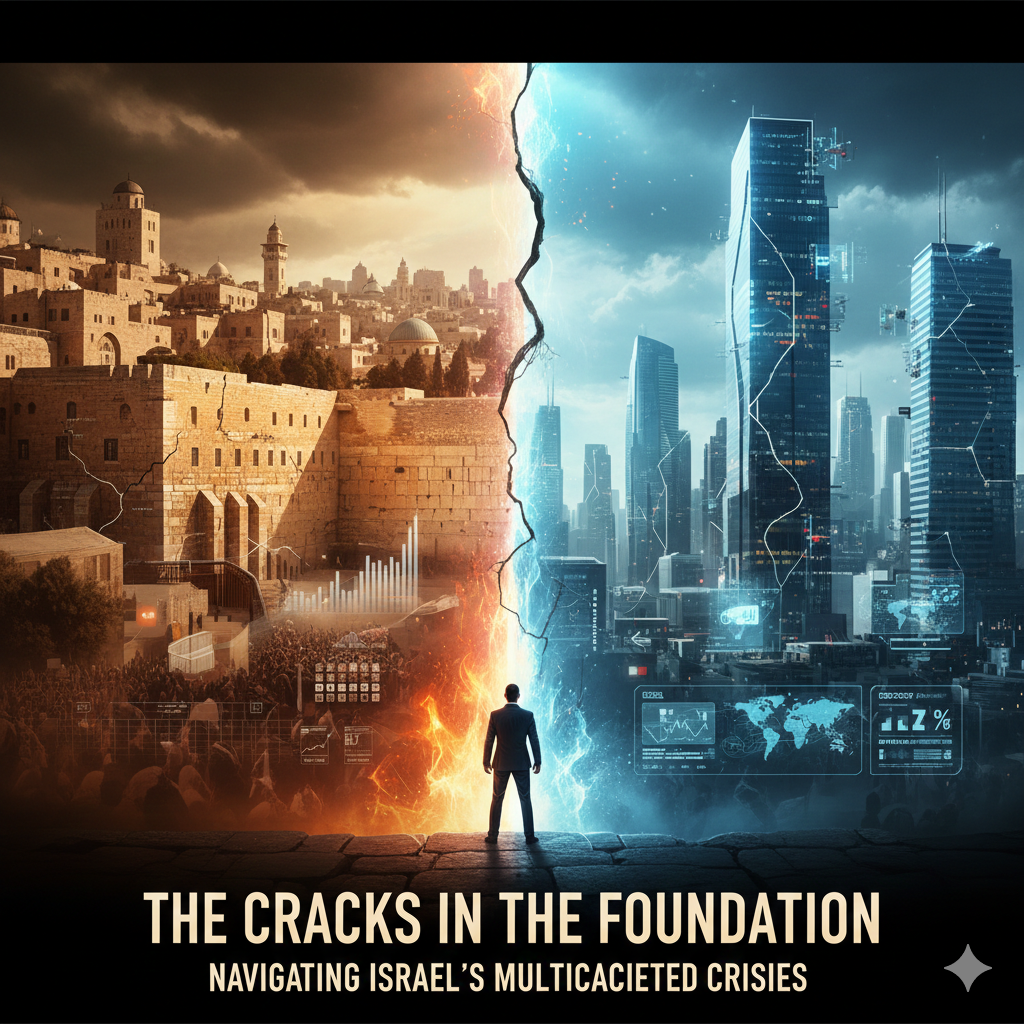
Israel, a nation born from conflict and steeped in a narrative of resilience and innovation, stands at one of the most complex and precarious junctures in its 75-year history. The image of a “Start-Up Nation,” a beacon of democracy in a turbulent region, is being severely tested by a convergence of domestic, geopolitical, and societal fractures. The problems facing Israel today are not isolated issues but interlocking crises that challenge its social cohesion, democratic integrity, international standing, and long-term security.
1. The Constitutional Crisis and the Assault on Democracy
The most immediate and explosive crisis is domestic. The government’s sweeping judicial overhaul plan, pushed by a coalition of nationalist and ultra-Orthodox parties, has sparked the largest and most sustained protest movement in the nation’s history. Proponents argue it is a necessary rebalancing of power, curbing an overly activist Supreme Court. Opponents, including a majority of the country’s legal scholars, economists, and security establishment veterans, see it as a fatal blow to Israel’s system of checks and balances, paving the way for majoritarian rule.
The crisis has ripped open deep societal fissures. It is a battle over the very soul of the state: Will Israel remain a liberal democracy with strong independent institutions, or evolve into a more illiberal democracy where parliamentary majority is unchecked? The months of protests have revealed an unprecedented rift within the Israeli Defense Forces (IDF), with thousands of reservists—including elite pilots and intelligence officers—threatening to suspend voluntary service, warning that the erosion of democracy directly imperils national security and their willingness to fight.
2. The Enduring Conflict and the Collapse of the Two-State Solution
The Israeli-Palestinian conflict remains the inescapable backdrop, but its nature has shifted. The prospect of a negotiated two-state solution appears moribund, a casualty of hardened politics on both sides, continued settlement expansion in the West Bank, and the fragmentation of Palestinian leadership. The current Israeli government includes ministers who openly advocate for annexation and oppose Palestinian statehood.
This vacuum has given rise to a grim, unsustainable status quo. In the West Bank, a cycle of Palestinian militant attacks, Israeli military raids, and escalating settler violence creates perpetual instability. The Palestinian Authority is weak and unpopular, while Israel exercises overarching security control without granting political rights to millions. In Gaza, Hamas rules over a besieged, impoverished enclave, with conflicts erupting in devastating cycles, as seen in 2021 and 2023. The absence of a political horizon fuels despair, radicalism, and ensures that the conflict remains a festering wound, poisoning Israel’s international relations and demanding constant military and diplomatic resources.
3. Social Fractures: The Tensions Within
Israel’s internal identity politics are as volatile as its borders. The schism between secular and ultra-Orthodox (Haredi) Jews has reached a boiling point. The Haredi community, which enjoys widespread exemptions from military service and state subsidies for full-time religious study, is the fastest-growing demographic. This creates intense resentment among the secular majority who bear the burden of military service, taxes, and see government funds diverted to support a community largely outside the modern workforce. The judicial crisis is deeply intertwined with this, as many secular Israelis fear the overhaul will allow religious authorities to impose their norms on public life.
Furthermore, the 21% Arab-Israeli minority, while having made strides in political representation and education, continues to face systemic discrimination in budgeting, land allocation, and a national narrative that often treats them as a fifth column. The 2021 intercommunal violence within mixed cities during the Gaza conflict exposed the fragility of this coexistence. For many Arab citizens, the intensified nationalism of the government and the “nation-state” law, which enshrines Jewish supremacy, deepen their alienation.
4. Geopolitical Shifts and Regional Anxiety
Israel’s foreign policy landscape is undergoing a seismic shift. The Abraham Accords, normalizing relations with several Arab states, were a historic achievement, driven by shared antipathy toward Iran and economic opportunity. However, this “outside-in” approach has come at a cost. Many Arab partners, while welcoming open ties, have made clear that deeper integration and public acceptance are contingent on progress with the Palestinians. The current government’s hardline policies strain these new relationships.
The greatest external threat remains Iran and its proxy network, notably Hezbollah in Lebanon. Iran’s relentless pursuit of nuclear capabilities and its precision missile projects present an existential challenge. Israel’s alleged shadow war—including cyber-attacks and covert operations—aims to delay this threat, but a direct military confrontation remains a terrifying possibility that could draw in the entire region. Simultaneously, Israel’s relationship with its foremost ally, the United States, is experiencing significant strain. The Biden administration’s vocal criticism of settlement expansion and the judicial overhaul marks a notable public divergence, revealing Israel’s growing reliance on bipartisan support in a politically polarized America.
5. Economic and Cost-of-Living Pressures
Beneath the high-stakes political and security dramas lies a grinding economic pressure felt by everyday citizens. Israel suffers from a severe cost-of-living crisis, particularly in housing. Sky-high real estate prices, outpacing wage growth, have made homeownership a distant dream for many young couples. Basic necessities, from food to childcare, are extraordinarily expensive. While macroeconomic indicators like GDP growth and low unemployment often appear strong, they mask deep inequalities and a economy that feels rigged in favor of a concentrated elite and large conglomerates. The protest movement has explicitly linked the judicial overhaul to these economic fears, arguing that an independent judiciary is essential for protecting Israel’s economic stability and attractiveness to foreign investment.
Conclusion: A Nation at an Inflection Point
Israel’s problems form a perfect storm. The domestic democratic crisis weakens its moral foundation and internal unity precisely when it needs cohesion to face external threats. The stalemate with the Palestinians ensures perpetual insecurity and diplomatic isolation. The social contracts between secular and religious, Jewish and Arab, are fraying. And all of this unfolds under the shadow of a nuclearizing Iran.
The path forward is fraught. It requires leadership capable of forging a new national consensus—one that rebuilds independent institutions, addresses legitimate grievances of all citizens, re-engages with the reality of Palestinian aspirations, and manages complex alliances. The energy and mobilization seen in the pro-democracy protests demonstrate the profound strength of Israeli civil society. Whether this vitality can be channeled to heal the nation’s divisions, rather than deepen them, is the defining question for Israel’s next chapter. The “Start-Up Nation” now faces its most critical test: can it innovate not just in technology, but in governance, diplomacy, and the forging of a shared society? The answer will determine Israel’s character and security for generations to come.