

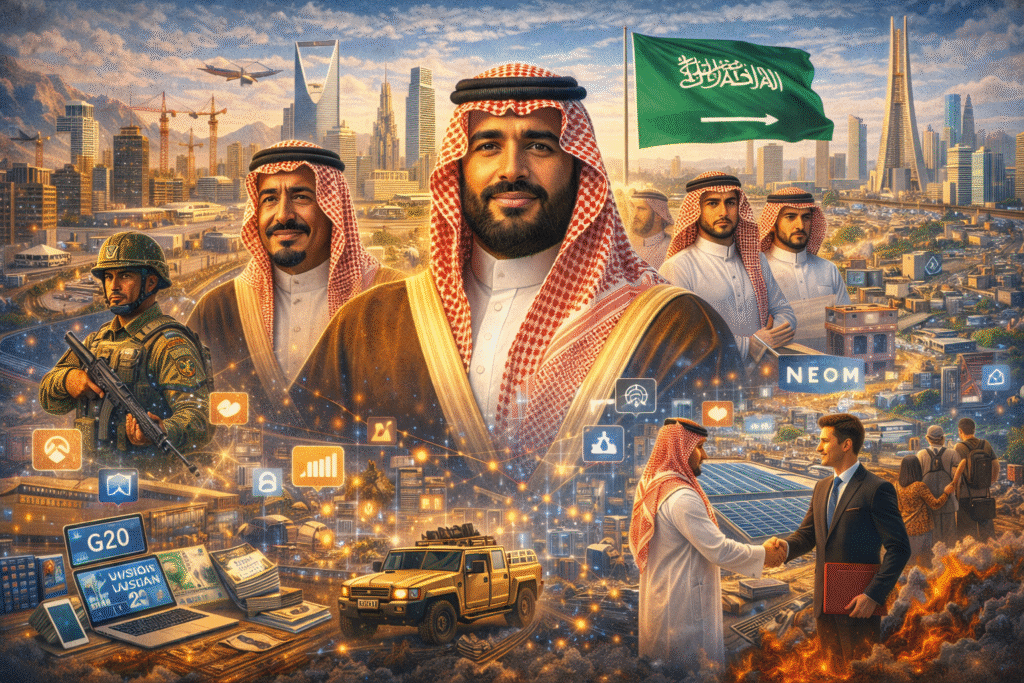
Part 1: Introduction – A Nation Reimagining Itself
Saudi Arabia today is a nation engaged in a profound and unprecedented transformation. Under the banner of Vision 2030, political dynamics are no longer defined by quiet conservatism but by ambitious, top-down re-engineering of the economy, society, and the kingdom’s global role. This new era is centralized, fast-paced, and defined by the decisive leadership of Crown Prince and Prime Minister Mohammed bin Salman (MBS).
Part 2: The Centralization of Power: The MBS Era
The most significant political shift of the last decade has been the dramatic concentration of authority. Power, once diffused among senior princes and religious institutions, is now firmly centralized under Crown Prince Mohammed bin Salman. As the day-to-day ruler and architect of Vision 2030, he controls the key levers of security, economy, and social policy, making him the undisputed center of Saudi politics.
Part 3: Vision 2030: The Blueprint as a Political Tool
Vision 2030 is far more than an economic plan; it is the overarching political narrative and source of legitimacy for the new leadership. It provides a clear, future-oriented mission that justifies rapid social change, massive economic diversification away from oil, and a redefined national identity. Loyalty to the Vision has become a key metric for political standing and career advancement within the state.
Part 4: The Social Revolution: Reforms as Political Strategy
The sweeping social reforms—empowering women drivers, curtailing the religious police, opening cinemas, and promoting entertainment—are deeply political. They are designed to secure the allegiance of the young majority (over 70% under 35), modernize the nation’s image for investment, and fundamentally shift the source of societal norms from the clerical establishment to the state itself.
Part 5: The New Clerical Compact: Subduing Religious Authority
The political influence of the once-powerful Wahhabi clerical establishment has been systematically curtailed. Its role has been redefined from a partner in governance to a state employee. The judiciary is being reformed, and the Committee for the Promotion of Virtue has been stripped of its policing powers. Religion is now framed as a matter of personal faith, with the state asserting itself as the sole arbiter of public order.
Part 6: The Anti-Corruption Purge: Consolidation and Control
The 2017 Ritz-Carlton anti-corruption campaign, while targeting graft, served a crucial political purpose: it broke the economic power of potential rival factions within the royal family and the business elite. It demonstrated the crown prince’s ability to enforce his will, redirected capital toward state priorities, and sent a clear message that patronage and loyalty would now flow through a new, centralized hierarchy.
Part 7: “Fierce Saudi” – A More Assertive Foreign Policy
Saudi foreign policy under MBS is characterized by assertive nationalism, often labeled as “Fierce Saudi.” This is seen in the war in Yemen, the confrontation with Qatar (now resolved), and the pursuit of a regional security architecture independent of the United States. The driving goals are containing Iran, establishing Saudi primacy in the Arab world, and attracting investment and strategic partnerships on Saudi terms.
Part 8: Economic Statecraft: Gigaprojects and Global Influence
Politics is increasingly expressed through economic ambition. Megaprojects like NEOM, the Red Sea Project, and Qiddiya are not just economic ventures; they are political statements of intent and modernity. The sovereign wealth fund, the Public Investment Fund (PIF), has become a primary engine of this transformation, wielding financial power to reshape the domestic economy and project influence abroad.
Part 9: The Succession Question: Settled for a Generation
For the first time in the kingdom’s modern history, the line of succession appears settled for the long term. By appointing his son as Prime Minister and his brother as Defense Minister, King Salman has effectively anointed MBS and his direct lineage as the future of Al Saud rule. This stability at the top provides a clear, if contested, political horizon for Vision 2030’s decades-long goals.
Part 10: Human Rights and the Khashoggi Shadow
The 2018 murder of journalist Jamal Khashoggi created a lasting reputational crisis. Domestically, it underscored the risks of dissent and the power of unaccountable security forces. Internationally, it forced a recalculation by Western partners, balancing strategic interests against human rights concerns. The state has since worked to rehabilitate its image through diplomacy and splashy investments, but the episode remains a reference point for critics.
Part 11: The Evolving Social Contract: Performance Over Piety
The traditional social contract—obedience in exchange for welfare funded by oil wealth—is being rewritten. The new bargain promises citizens not just subsidies, but opportunities, entertainment, and national pride in a diversified, globally engaged economy. In return, the state demands not just political loyalty, but active participation in the Vision and acceptance of rapid social change.
Part 12: The “National” Identity Project
A concerted effort is underway to cultivate a new Saudi national identity. This narrative celebrates pre-Islamic history (e.g., AlUla), promotes sports and cultural achievements, and frames national loyalty as paramount. It aims to create a unified, forward-looking citizenry whose primary allegiance is to the nation-state and its Vision, superseding older tribal or narrowly religious identities.
Part 13: Challenges: Youth Unemployment, Inequality, and Ideological Pushback
The political project faces significant hurdles. High youth unemployment persists despite reforms. The benefits of transformation are unevenly distributed, risking discontent. While muted, conservative pushback against social liberalization simmers. Managing these tensions while maintaining breakneck momentum is a central political challenge for the leadership.
Part 14: Conclusion: Stability Through Transformation?
Saudi politics today is a high-stakes experiment in accelerated change orchestrated from the top. The kingdom seeks stability not through stasis, but through the managed turbulence of economic and social revolution. The success of this strategy hinges on delivering tangible economic results for its youthful population and navigating an increasingly multipolar and volatile geopolitical landscape. The world watches to see if this ambitious transition can be sustained without triggering unforeseen political fractures.
