

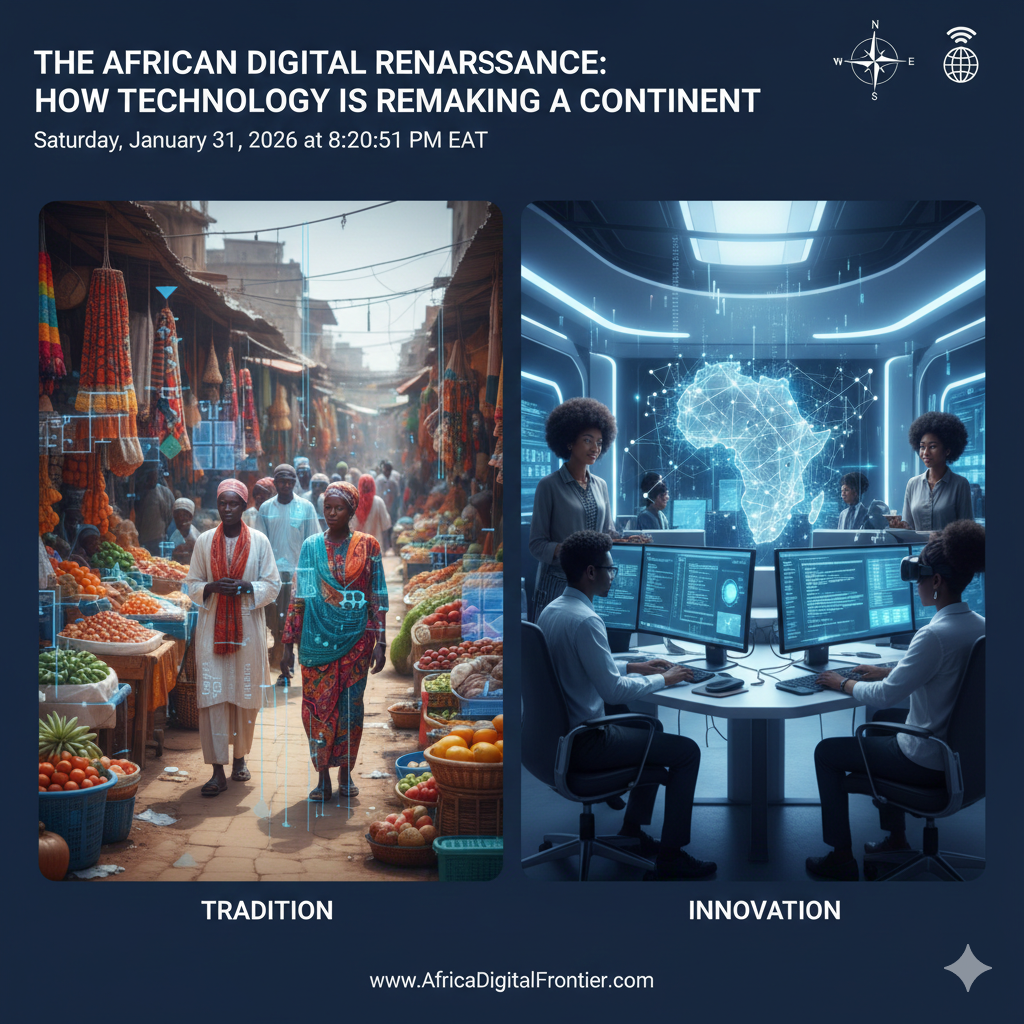
Beneath the familiar narratives of resource extraction and developmental challenges, a quieter, more profound revolution is reshaping Africa. It is a revolution not of brute force, but of bits and bytes, of mobile signals and entrepreneurial hustle. Technology in Africa today is not about playing catch-up; it is a story of creative leapfrogging, where necessity is birthing globally significant innovations. From mobile money ecosystems that predated Silicon Valley’s fintech boom to AI solving agricultural crises, Africa is rapidly transitioning from a consumer of technology to a vital creator and exporter of digital solutions for the 21st century.
The Foundational Leap: Mobile-First as a Forcing Function
Africa’s technological trajectory was forged in the crucible of infrastructural scarcity. The lack of legacy systems—landline networks, brick-and-mortar banking, fixed-line internet—became an unexpected advantage. It forced a mobile-first mindset that has become the continent’s greatest technological strength.
The seminal case is M-Pesa, launched in Kenya in 2007. This was not merely a payments app; it was a socio-economic paradigm shift. By turning the ubiquitous mobile phone into a bank account, it provided financial identity and liquidity to millions. Today, over half a trillion dollars flows through such mobile money systems annually across Sub-Saharan Africa. This foundation has enabled everything from pay-as-you-go solar energy (companies like M-KOPA) to digital microloans, proving that the most impactful technologies are those built for local context, not imported as-is.
This mobile foundation is now the bedrock for a new wave of innovation. With smartphone penetration soaring and data costs falling, Africa’s digital economy is entering a hyper-growth phase.
The Innovation Hubs: Solving for Scale and Scarcity
A constellation of tech hubs—from Lagos’s “Yabacon Valley” to Nairobi’s “Silicon Savannah,” Kigali’s innovation city, and Cape Town’s startup scene—is driving a problem-centric approach to innovation.
- Fintech 2.0: Banking the Unbanked and Beyond: The first wave was mobile money. The second wave is full-stack digital financial inclusion. Nigerian companies like Flutterwave and Paystack (acquired by Stripe) have built the rails for seamless digital payments across the continent, powering e-commerce and enabling global businesses to operate in Africa. Startups like Chipper Cash (Uganda) are making cross-border remittances fee-free and instant, while others use alternative data (phone usage, social networks) to build credit scores for those invisible to traditional banks.
- Agri-Tech: Cultivating Data-Driven Farms: With agriculture employing a majority of Africans, agri-tech is a critical frontier. Platforms like Twiga Foods in Kenya use data to connect smallholder farmers directly to urban retailers, stabilizing prices and reducing waste. Hello Tractor, dubbed “Uber for tractors,” allows farmers to rent farming equipment via an app. Satellite imagery and AI are being used by companies like Aerobotics in South Africa to provide small farms with insights on crop health and yield predictions, a service once reserved for large agribusiness.
- Health-Tech: Bridging the Doctor-Patient Gap: Technology is tackling dire healthcare access issues. Telemedicine platforms, such as Zipline, use drones to deliver blood and vaccines to remote clinics in Rwanda and Ghana. In Nigeria, 54gene is building the world’s first pan-African biobank, using genetic data to ensure drug development includes African DNA, addressing a historic and dangerous bias in global medicine. Apps like mPedigree allow users to verify the authenticity of medicines via a scratch-off code, combating a deadly counterfeit drug trade.
- The Green Tech Imperative: Facing the brunt of climate change, Africa is innovating in sustainability. Beyond pay-as-you-go solar, companies are creating smart microgrids, developing tech for water purification and management, and using IoT sensors for climate-smart agriculture. This positions Africa not just as a victim of climate change, but as a laboratory for vital adaptation and mitigation technologies.
The Enabling Ecosystem: Investments, Policy, and Talent
This innovation surge is being fueled by a rapidly maturing ecosystem.
- Venture Capital Comes of Age: While still modest globally, VC investment in African tech has skyrocketed, surpassing $5 billion in recent years. Major firms like Tiger Global and Sequoia Capital now have dedicated African funds, while homegrown funds like Partech Africa are leading the way. This capital is validating the continent’s startup potential.
- The Policy Pioneers: Proactive governments are creating enabling environments. Rwanda stands out, with its “Smart Rwanda” master plan, national fiber backbone, and drone-friendly regulations making it a testbed for innovation. Egypt and Nigeria have launched fintech sandboxes to regulate emerging sectors without stifling growth.
- The Diaspora Dividend & Talent Boom: The “brain drain” is slowly reversing into a “brain gain.” African diaspora professionals are returning with capital, skills, and global networks to launch startups. Simultaneously, a young, rapidly urbanizing population is hungry for digital skills, fueled by coding bootcamps and tech academies proliferating across major cities.
The Formidable Headwinds: The Digital Divide and Beyond
For all its promise, the African tech revolution faces stark challenges that threaten to create a new kind of inequality.
- The Persistent Digital Divide: The boom is overwhelmingly urban, coastal, and male. Rural areas often lack reliable electricity and affordable broadband. The gender gap in tech access and funding remains wide. This risks creating a two-tier society: a digitally-empowered elite and a disconnected majority, exacerbating existing social fractures.
- Infrastructure Fragmentation: The continent’s 54 countries mean 54 different regulatory regimes, data localization laws, and payment systems. Building a pan-African company requires navigating a labyrinth of compliance issues, making scaling exponentially harder than in a unified market like the US or EU.
- “Silicon Valley” Copycat Syndrome: Some ecosystems risk prioritizing fundraising hype and global investor trends over solving deep, local problems. The most sustainable successes will be those that address fundamental African challenges in finance, food security, health, and logistics.
- Data Sovereignty and Cybersecurity: As economies digitize, they become vulnerable. Questions of who owns African data—hosted on servers in the US or Europe—are pressing. Simultaneously, cybercrime is rising, and defenses are often weak, threatening consumer trust in digital systems.
The Future: An Export of Innovation
The next phase of African tech is not just about serving African markets. It is about exporting made-in-Africa solutions to the world. The models perfected here—ultra-low-cost mobile fintech, resilient off-grid energy systems, AI for informal economies—are increasingly relevant everywhere.
We are already seeing this:
- Nigerian fintech giants processing payments for global brands.
- South African cybersecurity firms protecting networks worldwide.
- Kenyan mobile money systems being licensed across the Middle East and Southeast Asia.
Conclusion: A Continent Writing Its Own Digital Destiny
Technology in Africa today is the most powerful force altering the continent’s trajectory since independence. It is bypassing legacy bottlenecks, creating new economic pathways, and empowering a generation to solve its own problems with ingenuity and speed.
This is not a passive adoption of Western platforms. It is the active creation of a distinct digital identity—one that is mobile-native, community-oriented, and resilient. The challenges of infrastructure, inclusion, and regulation are immense, but the momentum is undeniable.
Africa’s digital story is a powerful reminder that technological progress is not a linear path. Sometimes, the “leapfrog” leads not just to catching up, but to pioneering the way forward for everyone. The world has much to learn from the laboratories of Lagos, Nairobi, and Kigali, where the future of inclusive, pragmatic, and human-centric technology is being built, one line of code at a time.
