

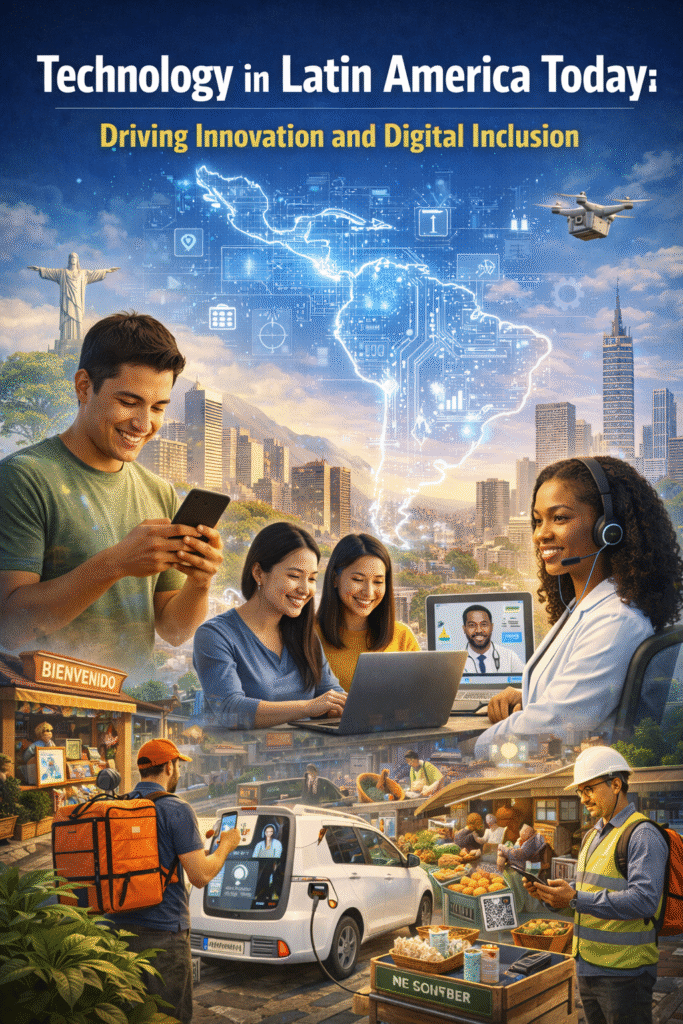
Technology in Latin America today is playing a transformative role in reshaping economies, expanding social inclusion, and connecting the region to the global digital landscape. Although the region faces challenges such as inequality and infrastructure gaps, technology adoption and innovation are accelerating rapidly, driven by a young population, expanding internet access, and a growing startup ecosystem.
Digital Connectivity and Mobile Adoption
Over the past decade, Latin America has seen significant growth in internet and mobile phone usage. Smartphones are the primary gateway to the internet for millions of people, enabling access to digital services such as online banking, education, healthcare information, and e-commerce.
Governments and private companies continue to invest in broadband expansion and 4G/5G networks, particularly in major cities, while efforts are underway to improve connectivity in rural and remote areas.
Fintech and Financial Inclusion
Fintech is one of the strongest technology sectors in Latin America. Countries like Brazil, Mexico, Colombia, and Argentina have become regional fintech hubs. Digital wallets, online banking platforms, and payment apps are helping to include millions of unbanked and underbanked people in the financial system.
By offering services such as low-cost transfers, microloans, and digital credit, fintech companies are empowering individuals and small businesses while reducing reliance on cash-based economies.
Startups and Innovation Ecosystems
Latin America’s startup ecosystem is growing rapidly. Cities such as São Paulo, Mexico City, Buenos Aires, Bogotá, and Santiago are home to innovative startups working in areas like e-commerce, logistics, healthtech, edtech, agritech, and clean technology.
Increased venture capital investment and regional collaboration have helped Latin American startups scale beyond national borders and compete globally.
E-Commerce and the Digital Economy
E-commerce has expanded rapidly across Latin America, accelerated by changing consumer behavior and improved digital payment systems. Online marketplaces and delivery platforms have transformed retail, logistics, and employment, creating new opportunities for entrepreneurs and small businesses.
Digital platforms are also supporting the gig economy, providing flexible income opportunities across transportation, delivery, and freelance services.
Technology in Education and Public Services
Technology is improving access to education through online learning platforms, digital classrooms, and remote training programs. In public services, governments are adopting digital tools to improve transparency, efficiency, and citizen engagement through e-government platforms.
Challenges and Opportunities Ahead
Despite progress, challenges such as digital inequality, cybersecurity risks, limited digital skills, and uneven infrastructure remain. Addressing these issues requires continued investment, digital literacy programs, and supportive regulatory environments.
Conclusion
Technology in Latin America today is a powerful engine for change. By driving innovation, financial inclusion, and economic opportunity, technology is helping the region overcome structural challenges and build a more connected and resilient future. As digital transformation continues, Latin America is poised to play an increasingly important role in the global technology ecosystem.
