

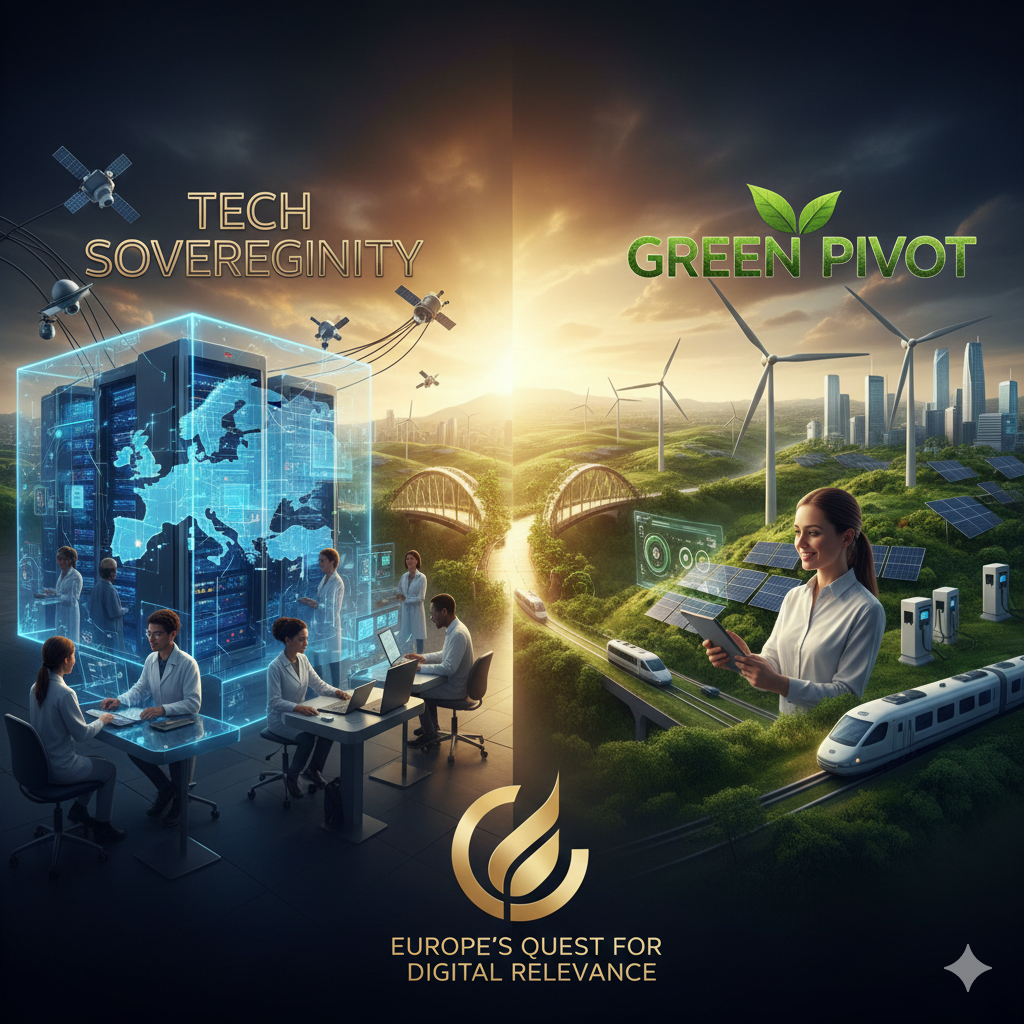
BRUSSELS, Belgium – In the heart of Silicon Valley, the dominant narrative of global technology is one of disruption, scale, and libertarian zeal. Three thousand miles away, in the conference rooms of Brussels and the industrial hubs of Germany, a profoundly different tech vision is being forged. Europe today is not chasing the next addictive social media app; it is engaged in a high-stakes, regulatory-driven project to reshape the very foundations of the digital age. The continent’s tech landscape is defined by a dual mandate: to assert digital sovereignty in a world dominated by American and Chinese giants, and to harness innovation as the primary engine for its ambitious Green Deal. This is technology as an instrument of public policy, of strategic autonomy, and of societal preservation.
The Regulatory Hammer: GDPR, DMA, and the “Brussels Effect”
Europe’s most powerful tech export of the last decade is not a piece of hardware or software, but a piece of legislation: the General Data Protection Regulation (GDPR). Enacted in 2018, GDPR established the global gold standard for data privacy, forcing every multinational corporation to comply with its stringent rules on user consent and data handling. It exemplified the “Brussels Effect”—the EU’s ability to unilaterally shape global markets through its regulatory might.
This strategy has accelerated. In 2023, the Digital Markets Act (DMA) and Digital Services Act (DSA) came fully into force, directly taking aim at the “gatekeeper” power of Big Tech. The DMA mandates interoperability between messaging services, forbids self-preferencing in app stores, and curbs the use of private data across a firm’s services. The DSA imposes vast new content moderation and algorithmic transparency requirements on very large online platforms.
The message is clear: Europe will not try to outbuild the American platform giants on their own terms. Instead, it will re-engineer their operating environment within its borders, prioritizing fair competition, user rights, and democratic oversight over unbridled growth. This regulatory-first approach fosters a different kind of tech ecosystem—one more favorable to privacy-focused startups, B2B enterprise software, and “ethical tech”—but critics argue it also risks stifling the very innovation Europe seeks to champion.
The Sovereignty Imperative: Chips, Clouds, and AI
Haunted by over-reliance on US cloud providers and Asian semiconductors, Europe is on a quest for strategic autonomy. The 2022 EU Chips Act mobilized over €43 billion in public and private investment to double Europe’s share of global semiconductor production to 20% by 2030. The goal is not to make every kind of chip, but to secure leadership in specialized, power-efficient semiconductors crucial for its automotive and industrial machine sectors.
Similarly, the Gaia-X project aims to create a federated, sovereign European cloud data infrastructure, a direct response to the dominance of AWS, Microsoft Azure, and Google Cloud. While progress is complex and slow, it underscores a fundamental shift: digital infrastructure is now viewed as critical geopolitical infrastructure, as vital as energy grids or ports.
In artificial intelligence, Europe is pursuing its own distinct path with the EU AI Act, the world’s first comprehensive AI law. Categorizing AI applications by risk, it bans unacceptable uses (like social scoring) and imposes strict transparency and human oversight requirements on high-risk systems (like CV-scanning tools). This “risk-based” framework aims to foster trustworthy AI, but the global tech industry watches nervously, concerned that heavy compliance costs could, again, disadvantage European players.
The Green Tech Engine: Innovation in the Climate Crucible
Europe’s most potent catalyst for technological innovation is its legally binding commitment to achieve net-zero carbon emissions by 2050. The European Green Deal is not just an environmental plan; it is a massive industrial and tech investment program.
- Deep-Tech for Energy: The continent is a leader in next-generation green hydrogen production, advanced battery chemistry for storage, and smart grid technology. Startups and research institutes are pioneering carbon capture and utilization (CCU) and exploring fusion energy.
- Circular Economy Tech: Innovation is flourishing in materials science for recyclability, AI-powered industrial process optimization to reduce waste, and platforms for product-as-a-service and sharing models that decouple growth from resource consumption.
- Sustainable Mobility: Beyond Tesla’s German Gigafactory, European legacy automakers are undergoing a forced, multi-billion-euro transformation into EV and software companies. This is spawning a vast ecosystem in battery tech, charging infrastructure, and connected vehicle software.
Here, Europe’s traditional strengths—deep engineering expertise, strong public-private research consortia (like Fraunhofer in Germany), and patient capital—are aligned with a clear, mission-driven goal.
The Startup Ecosystem: Strengths, Gaps, and “Scale-Up” Anxiety
Europe boasts vibrant, world-class tech hubs: London (fintech, AI), Berlin (B2B SaaS, mobility), Paris (deep tech, AI), Stockholm (gaming, fintech), and Amsterdam (agri-tech, mobility). It produces a wealth of talent and groundbreaking startups. The perennial challenge is scale-up.
The continent still suffers from a more fragmented market (27 different languages and regulations), a less mature venture capital landscape for late-stage funding, and a cultural aversion to the risk-taking necessary for hyper-growth. While there are notable “unicorns” like Sweden’s Klarna or Germany’s Celonis, the pipeline from innovative startup to global category leader is thinner than in the US or China. Initiatives like the European Innovation Council are attempting to bridge this gap with “blended finance” combining grants and equity.
The Geopolitical and Social Fractures
Europe’s tech ambitions are not formed in a vacuum. The war in Ukraine has been a stark wake-up call, accelerating investment in dual-use tech (drones, cyber defense, satellite communications) and forcing a rapid decoupling from Russian energy, supercharging the green transition.
Socially, the continent grapples with familiar but acute challenges: the digital divide between urban and rural areas, fears over job displacement from automation, and contentious debates around platform workers’ rights that pit its social market model against the gig economy.
Conclusion: The Purpose-Driven Tech Superpower
Europe is not aiming to become “the next Silicon Valley.” Its vision for technology is fundamentally different: less about moving fast and breaking things, and more about building carefully and governing wisely. It is an experiment in whether a major economic power can define the rules of the digital world, champion a human-centric and ethical approach to innovation, and directly harness technology to solve its greatest societal challenge—the climate crisis.
Success is not guaranteed. The regulatory path risks bureaucratic sluggishness. The sovereignty quest requires unprecedented coordination and investment. The green transition demands continuous political will.
Yet, in an age of tech backlash and planetary emergency, Europe’s model—flawed, complex, and often frustratingly slow—offers a compelling alternative. It posits that the future of technology should be shaped not just by engineers and investors, but by citizens, regulators, and the imperative of sustainability. Whether this purpose-driven approach can produce globally competitive tech champions, while preserving democratic values and the planet, is one of the most consequential questions of our time. Europe has placed its bet, and the world is watching to see if it pays off.
