

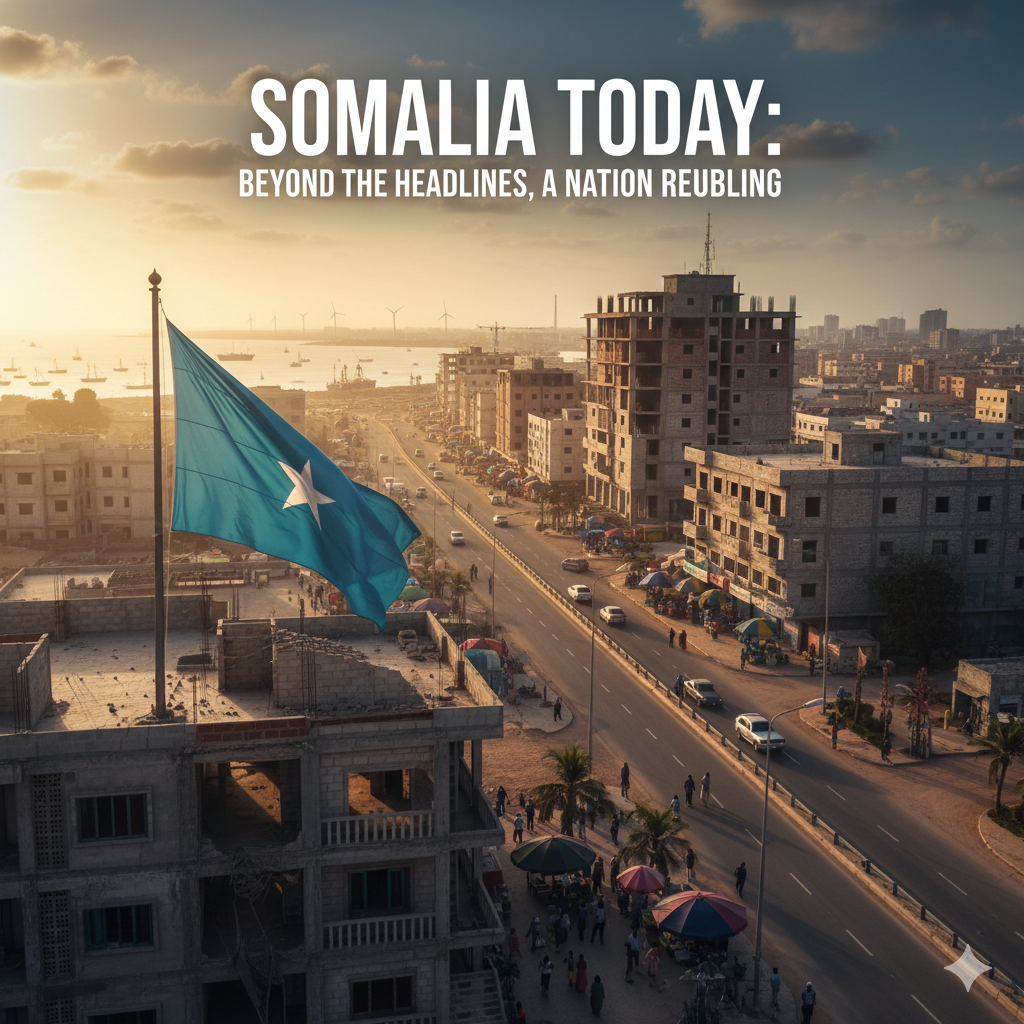
When the world hears “Somalia,” the narrative is often monolithic, dominated by images of conflict, piracy, and famine. While challenges remain profound and real, this persistent lens obscures a far more complex and dynamic reality. Somalia Today is a story of resilience, of a society grappling with its past while stubbornly piecing together a future. It is a tale not of a failed state, but of a reconstituting one, where daily life, business, and culture pulse with a energy that defies easy categorization.
To understand Somalia now, one must hold two truths simultaneously: the severe political and security challenges, and the undeniable signs of grassroots revival and economic potential.
The Persistent Shadows: Security, Politics, and Climate
Any honest assessment must begin with the enduring hurdles. The security situation, particularly in parts of south-central Somalia, remains precarious. The threat from the militant group Al-Shabaab persists, requiring a continued and costly presence of the African Union Transition Mission (ATMIS) and Somali National Army forces. While major urban centers like Mogadishu are more secure than a decade ago, asymmetric attacks are a grim reality, shaping city life with checkpoints and blast walls.
Politically, the nation operates under a fragile federal model. Tensions between the Federal Government in Mogadishu and emergent Federal Member States often center on resources, power-sharing, and the nature of sovereignty itself. The recent completion of a long-delayed indirect election in 2022, leading to the presidency of Hassan Sheikh Mohamud (his second non-consecutive term), was a step forward, but the path to direct, universal suffrage remains a future goal. The constitutional review process and the integration of Somaliland—which has seen itself as independent since 1991—into any unified national framework are existential questions that loom large.
Furthermore, Somalia stands on the front line of the global climate crisis. Recurrent and devastating cycles of drought and flooding have pushed millions to the brink, creating a dire humanitarian emergency. The 2022-2023 drought, the worst in decades, displaced over a million people and brought parts of the country to the edge of famine. This environmental catastrophe exacerbates every other challenge, from food security to political stability.
The Unseen Pulse: Mogadishu’s Rise and an Economic Rebirth
Yet, walk the streets of Mogadishu’s Hamar Weyne district, and a different story unfolds. A construction boom is visibly reshaping the skyline. Cranes dot the coastline, where new hotels, apartment blocks, and office buildings rise from the rubble. This is funded largely by a powerful driver of change: the Somali diaspora.
Returning with capital, education, and international experience, the diaspora is the lifeblood of the economic revival. They are investing not just in real estate, but in sectors once thought untenable: technology, finance, and hospitality.
- Tech & Telecoms: Somalia has one of Africa’s most competitive telecoms markets. Companies like Hormuud and Somtel provide widespread 4G coverage, and mobile money is ubiquitous—Somalia was a pioneer in this field long before it became mainstream elsewhere. This digital infrastructure has birthed a small but growing startup scene, with apps addressing local logistics, remittance tracking, and e-commerce.
- The Remittance Backbone: The hawala system, through companies like Dahabshiil, remains the nation’s financial nervous system. An estimated $2 billion in remittances flows into Somalia annually, dwarfing foreign aid and keeping families afloat, funding education, and seeding small businesses. It is the ultimate testament to the transnational Somali network.
- A Cultural Renaissance: Amidst the construction, art and culture are re-emerging. Bookshops and cafes are opening in Mogadishu. Musicians are performing publicly again. Poetry, the bedrock of Somali culture, is experiencing a new wave. Local media, though often partisan, is vibrant and fiercely free. These are not just amenities; they are acts of normalcy and resistance.
The Regional Dimensions: Geopolitics and Opportunity
Somalia’s strategic location, with the longest coastline in mainland Africa, places it at the center of regional geopolitics. The Gulf rivalry between Qatar/Turkey and the UAE/Saudi Arabia has played out in its political corridors and investment portfolios. Meanwhile, the Horn of Africa is recalibrating: Ethiopia’s quest for port access, the tenuous Ethiopia-Somaliland memorandum of understanding, and renewed diplomatic engagement all highlight Somalia’s pivotal, if delicate, position.
Off its coast, the blue economy presents a tantalizing future. With rich fishing grounds, potential for offshore energy, and critical shipping lanes, Somalia’s waters could be a source of immense wealth—if piracy can be kept at bay and sustainable, legal frameworks developed.
Somalia Today: A Mosaic of Contradictions
So, what is the true picture?
It is a young student in Hargeisa, coding an app for a global market.
It is a mother in Baidoa, displaced by drought, waiting for WFP rations.
It is a diaspora entrepreneur in Mogadishu, opening a modern restaurant.
It is a farmer in the Juba valley, watching another season’s crops fail.
It is a poet in Kismayo, using verse to critique power and preach peace.
It is an AMISOM soldier from Uganda, patrolling a dusty road outside Baraawe.
Somalia Today is all of this. It is a nation of staggering contradictions, where profound vulnerability coexists with irrepressible tenacity. The narrative of perpetual crisis is not just outdated; it is an injustice to the millions of Somalis who are building, creating, and persisting every single day.
The path ahead is treacherous. Reconciling political divisions, delivering inclusive security, and mitigating climate disaster are monumental tasks. International support must shift from solely humanitarian aid to smarter investment in infrastructure, governance, and climate adaptation.
But to see only the danger is to miss the defiance. Somalia is not a blank slate of despair; it is a complex tapestry being rewoven, thread by thread, by its own people. The story of Somalia Today is not one of a country waiting to be saved, but of a nation engaged in the exhausting, courageous, and unfinished work of saving itself. To follow its journey is to witness one of the most compelling narratives of resilience in our world today.
