

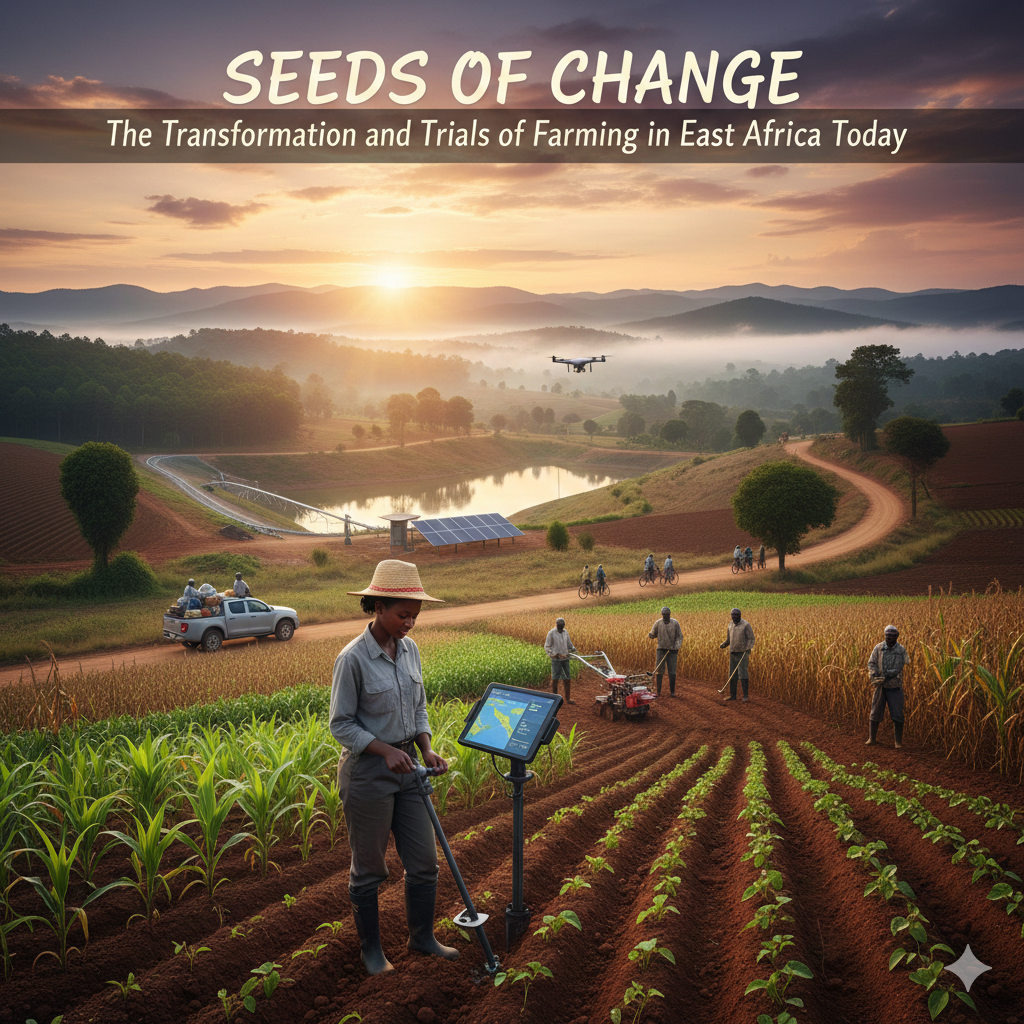
The red earth of a shamba in Kenya, the terraced slopes of the Ethiopian highlands, the vast plains of the Serengeti—these are the iconic landscapes of East African agriculture. For centuries, farming here has been a story of subsistence, tradition, and resilience against the elements. Today, that story is being radically rewritten. Farming in East Africa is no longer just about survival; it is a dynamic, high-stakes sector at the heart of the region’s economic ambitions, demographic pressures, and battle against climate change. It is a narrative defined by a potent cocktail of innovation, deep-seated challenges, and a race to redefine what it means to cultivate this ancient land.
The New Dawn: Innovation and Market-Driven Farming
A quiet revolution is sprouting alongside the maize and beans. A new generation of farmers, entrepreneurs, and investors are transforming the sector from the ground up.
- The Rise of Agri-Tech: Mobile technology is the single biggest game-changer. Platforms like M-Farm in Kenya or Twiga Foods deliver real-time market prices via SMS, breaking the monopoly of often-exploitative middlemen. Mobile money services like M-Pesa allow for instant payments for produce and easy access to micro-insurance products that pay out in the event of drought. Drones are being used to map fields and apply pesticides with precision, while simple SMS-based extension services deliver vital agronomic advice to smallholders in remote areas. This digital layer is connecting the once-isolated farmer to information, finance, and markets.
- Climate-Smart Agriculture (CSA) as Imperative: With rain-fed agriculture highly vulnerable, farmers are adopting CSA practices not as a choice, but a necessity. Drought-resistant crop varieties (like improved maize and sorghum), conservation agriculture (minimal tillage, crop rotation), and small-scale irrigation technologies (drip kits, solar-powered pumps) are gaining traction. In Kenya’s arid counties, farmer-led adoption of drought-tolerant crops has been critical for food security. This represents a fundamental shift from purely traditional practices to evidence-based, adaptive farming.
- High-Value Exports and Contract Farming: Beyond staple crops, East Africa is cultivating its position in the global market. The region is a leading exporter of cut flowers (from the shores of Lake Naivasha in Kenya), high-quality coffee (Ethiopia, Rwanda), tea (Kenya, Uganda), and fresh vegetables (asparagus, snow peas) flown nightly to European supermarkets. This export-oriented model often operates through contract farming, where companies provide inputs, training, and a guaranteed buy-back price to smallholders, integrating them into formal value chains and boosting incomes.
- The Youth and Urban Farming: Faced with rural land scarcity and attracted by urban markets, young East Africans are redefining farming. Hydroponics and vertical farming in cities like Nairobi and Kampala are producing high-value greens for restaurants and supermarkets with minimal water and space. This tech-savvy, business-oriented approach is changing the perception of farming from a back-breaking last resort to a viable, innovative career.
The Persistent Thorns: Structural Challenges at the Root
Despite this momentum, East African agriculture remains anchored by profound, systemic challenges that threaten its potential.
- The Land Question: Access to and ownership of land is the sector’s most volatile issue. Fragmentation through generations has left many families with plots too small for commercial viability. Formal land titling is incomplete, leading to disputes and limiting farmers’ ability to use land as collateral for loans. In regions like the Ethiopian highlands or parts of Kenya, population pressure is pushing cultivation onto marginal, erosion-prone land, degrading the very resource livelihoods depend upon.
- Climate Volatility as the New Normal: The historic rhythm of rainy and dry seasons is shattered. Farmers now face unpredictable, extreme weather: prolonged droughts that wither crops, followed by intense, flooding rains that wash away topsoil. The 2020-2023 Horn of Africa drought, the worst in decades, pushed millions into acute food insecurity. Recovering from such shocks is increasingly difficult, trapping communities in a cycle of vulnerability. Climate change is not a future threat; it is the central, daily reality of farming.
- Inputs, Infrastructure, and the Middleman: The cost of quality seeds, fertilizer, and pesticides remains prohibitively high for many. Poor rural infrastructure—bumpy, impassable roads—means farmers lose up to 30% of their harvest to post-harvest spoilage before it even reaches a market. The lack of affordable, modern storage facilities forces them to sell at harvest time when prices are lowest. While tech is helping, the physical infrastructure deficit remains a massive brake on productivity and profit.
- Policy and Political Economy: Agricultural policy is often inconsistent or poorly implemented. Export bans on staple foods during domestic shortages, while politically tempting, disrupt markets and discourage production. Subsidy programs for inputs are prone to mismanagement and often fail to reach the neediest farmers. Furthermore, the political clout of large-scale export interests can sometimes overshadow the needs of the smallholder majority, skewing national priorities.
The Great Contradiction: Food Insecurity in a Farming Region
The most painful paradox is that East Africa, a region whose economy and culture are rooted in agriculture, continues to suffer from acute food insecurity and malnutrition. Conflict in South Sudan, northern Ethiopia, and parts of DR Congo (which borders the EAC) disrupts farming cycles, destroys assets, and creates displacement, severing people from their land. Even in peaceful areas, high food prices put nutritious diets out of reach for the poor. Stunting (impaired growth due to chronic malnutrition) affects a staggering proportion of children, undermining the human capital of the next generation. This highlights that increasing production alone is insufficient; issues of access, affordability, and dietary diversity are equally critical.
Cultivating the Future: Pathways to Resilience
The future of East African farming hinges on integrated solutions that address its complex reality.
- Scaling What Works: The priority must be taking successful, localized innovations to scale. Nationwide adoption of drought-resistant seeds, expansion of mobile-based extension services, and aggressive investment in rural feeder roads and decentralized solar-powered cold storage units would have transformative effects.
- Value Addition and Agro-Processing: Moving beyond raw commodity exports is essential. Local processing of coffee into roasted beans, fruits into juices and jams, and grains into flour captures more value, creates rural jobs, and reduces post-harvest loss. This requires investment in medium-scale agro-processing facilities and reliable energy to power them.
- Land Tenure Reform and Youth Inclusion: Modernizing land registries and promoting community-based land lease models can provide security and enable consolidation for efficiency. Concurrently, targeted programs to provide credit, training, and market access to young “agri-preneurs” are vital to sustain the sector.
- Regional Trade Integration: Breaking down non-tariff barriers within the East African Community (EAC) is crucial. When drought strikes Kenya, surplus maize from Uganda or Tanzania should be able to flow freely across the border. A truly integrated regional food market is the best buffer against localised production shocks.
Conclusion: Between the Hoe and the Smartphone
Farming in East Africa today exists in a space between the timeless swipe of the hoe and the instant ping of a mobile payment. It is a sector grappling with its past—land pressures, colonial crop legacies—while urgently navigating an uncertain climatic future. The energy and innovation are palpable, from the tech hubs of Nairobi to the terraced fields of Rwanda. Yet, this potential is encased in a brittle shell of vulnerability.
The path forward is not about choosing between traditional knowledge and modern science, or between subsistence and export crops. It is about synergies: blending drought-resistant seeds with indigenous water conservation knowledge, linking smallholder cooperatives directly to digital markets, and crafting policies that empower the farmer as an entrepreneur, not just a beneficiary. The success of this endeavor will determine more than economic statistics; it will decide the nutritional fate of millions, the stability of rural societies, and the environmental health of one of the world’s most vital regions. In the seeds sown today lie the harvest—or the hunger—of tomorrow.
