

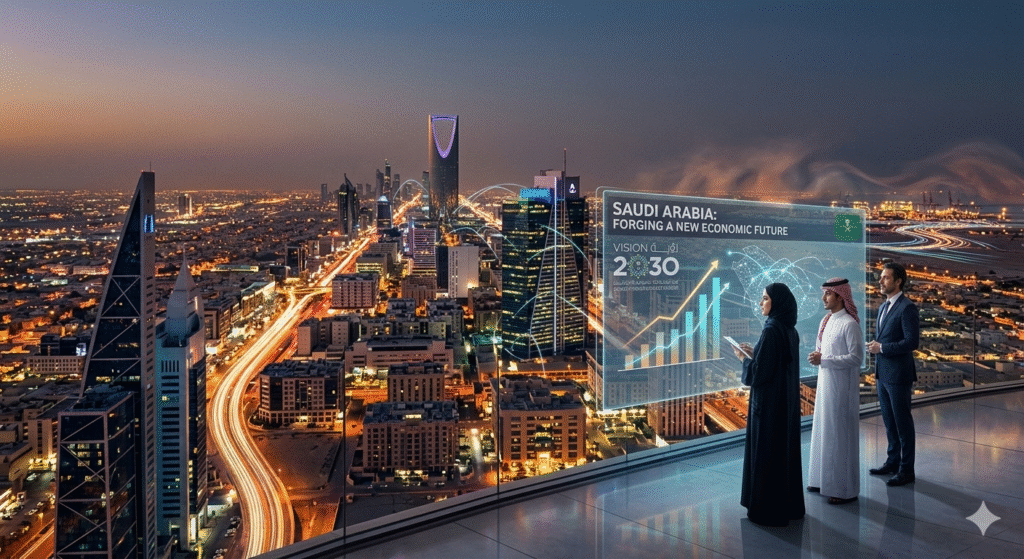
As February 28, 2026, draws to a close, the Kingdom of Saudi Arabia finds itself simultaneously confronting a major regional security crisis and advancing one of the most ambitious economic transformations in modern history. The past 24 hours have witnessed Iranian missile strikes near the capital Riyadh, triggering a strong diplomatic response from Riyadh, while the kingdom’s landmark Vision 2030 reform agenda undergoes its most significant strategic pivot since its launch a decade ago. This is Saudi Arabia today: a nation asserting regional leadership amid escalating conflict while methodically reshaping its economic foundations for a post-oil future.
The Security Crisis: Condemning “Blatant Iranian Aggression”
The most immediate and dramatic development of the past 48 hours is Saudi Arabia’s forceful response to Iranian military action targeting the kingdom and its neighbors. On Saturday, February 28, explosions were reported near the Saudi capital of Riyadh as part of a major Iranian counterattack following coordinated US-Israeli strikes on Iranian military infrastructure . Iran’s Islamic Revolutionary Guard Corps launched missiles at US military bases and other targets across the Gulf region, including in Qatar, Bahrain, Kuwait, and the United Arab Emirates .
The Saudi response was swift and unequivocal. In an official statement, the Saudi Foreign Ministry condemned what it called a “blatant Iranian aggression” and a “flagrant violation of the sovereignty” of the United Arab Emirates, Bahrain, Qatar, Kuwait, and Jordan . The ministry expressed the Kingdom’s “full solidarity” with the affected countries and declared its readiness to deploy “all its capabilities” in support of any measures they undertake .
The statement warned of “serious consequences from continued breaches of state sovereignty and international law,” urging the international community to condemn the attacks and take firm action against what it described as threats to regional security and stability . This unified Gulf response—with multiple countries condemning the Iranian strikes—represents a significant moment of regional cohesion against external aggression .
The security situation has also disrupted civilian life. Saudi Arabian Airlines (Saudia) announced the cancellation of a number of flights due to regional developments and the closure of certain airspaces, urging travelers to verify flight status before heading to airports . King Khalid International Airport in Riyadh issued a similar advisory, directing passengers to contact their airlines directly for the latest updates .
The Economic Transformation: Vision 2030’s Strategic Pivot
Beneath the immediate security concerns, Saudi Arabia is in the midst of a fundamental economic recalibration. This week, the kingdom concluded its 2026 Budget Forum in Riyadh, offering an in-depth look at the government’s spending priorities and development pathways . The forum, attended by ministers, officials, and economists, underscored that the budget has evolved from “just numbers” into a strategic tool for fostering growth, diversifying the economy, and safeguarding national gains .
Finance Minister Mohammed Al-Jadaan emphasized that fiscal policy reflects the nature of the national economy, noting that non-oil activities now contribute 56% to GDP—a milestone in the diversification effort . He stressed that “spending efficiency does not necessarily mean reducing expenditure” and that financial discipline has become a widespread culture embraced by Saudi professionals across sectors .
Reshaping Priorities: From Giga-Projects to High-Impact Sectors
This week also brought news of a significant strategic pivot in Vision 2030 itself. After a decade of implementation, Riyadh is reshaping its reform agenda around new priorities, scaling back some ambitious construction projects while doubling down on tourism, manufacturing, logistics, technology, and energy .
The shift reflects fiscal realities: Saudi Arabia has been running budget deficits since 2022 as spending on diversification initiatives outpaces revenues dented by anaemic oil prices . Officials describe sustained shortfalls as a deliberate choice to continue supporting investment, projecting the deficit to shrink to 3.3% this year from 5.3% in 2025 . The kingdom’s total financing needs for 2026 are estimated at about $58 billion .
Concrete examples of this recalibration are already visible. The planned 170-kilometer-long skyscraper at the heart of the NEOM project has been scaled back to just 2.4 kilometers . In late January, construction of The Mukaab—a massive cube-shaped skyscraper planned as the centerpiece of Riyadh’s New Murabba district—was suspended as officials reassessed financing and feasibility . Instead, Crown Prince Mohammed bin Salman announced the King Salman Gate project adjacent to Mecca’s Grand Mosque, adding 900,000 indoor and outdoor prayer spaces—a shift toward religious tourism infrastructure .
Finance Minister Al-Jadaan confirmed in a Bloomberg interview this week that the government is working on a new five-year plan focused on “doubling down on tourism, manufacturing, logistics and energy,” with technology as a focal area . The Public Investment Fund, the main investor in Vision 2030 projects, has been pushing for this shift away from costly real estate toward industries promising better near-term returns .
Economic Indicators: Progress Amid Challenges
The 2026 Budget Forum revealed impressive progress across multiple sectors. Minister of Economy and Planning Faisal Alibrahim highlighted that 74 sectors have grown by more than 5% annually over the past five years, with 37 of 81 non-oil activities recording growth of around 10% . Pharmaceutical localization has increased from 20% to 35%, and military localization has grown from 4% to over 20%, reflecting strong private sector response .
Tourism is emerging as a standout success. Princess Haifa Al Saud, Vice Minister of Tourism, announced that tourism spending reached SAR 275 billion, with more than 116 million domestic and international visitors . European tourist arrivals increased by 14%, while tourists from East Asia and the Pacific rose to 15%. The kingdom aims to reach 150 million tourists by 2030 .
The sports sector is also growing rapidly, with the market currently valued at SAR 32 billion and expected to reach SAR 80 billion by 2030 . Notably, 70% of sports events in the kingdom are now operated by Saudi citizens .
Social indicators show continued progress. Women’s participation in the labor market has risen to 34%, while Saudi unemployment has declined to 6.8% . Health coverage has reached 94.7%, placing the kingdom among the highest globally, and deaths from infectious diseases have dropped by 50% . Education received SAR 202 billion in the 2026 budget, with 66% of Saudi scholarship students now studying at the world’s top 50 universities .
Opening to Foreign Investment
This week also marked the implementation of a significant legal reform: Saudi Arabia’s new Law on Real Estate Ownership by Non-Saudis, which took effect on January 21, 2026 . The law replaces a restrictive purpose-based regime with a zoning-driven framework, allowing non-Saudis to own real estate within designated Geographical Zones .
This reform comes against a backdrop of rapid market growth: Saudi real estate revenues are estimated at $132 billion in 2024 and projected to reach $201 billion by 2030 . The new law distinguishes between foreign-incorporated entities, Saudi companies with foreign ownership, and listed vehicles, creating new options for acquisition and holding structures . It introduces a real estate transaction fee of up to 5% on transfers involving non-Saudis, in addition to the existing 5% Real Estate Transfer Tax, raising new considerations for investors .
The Human Rights Dimension: Critiques Persist
Amid these economic transformations, international human rights organizations continue to voice concerns. DW reported this week that despite reforms, “authoritarianism and repression in Saudi Arabia continue” . Executions increased in 2025, and various people have been sentenced to decades in prison for social media activity .
Ahmed Benchemsi of Human Rights Watch told DW that while women can now drive and are encouraged to join the workforce, their “freedom is limited, their rights are conditional and their autonomy is tightly controlled.” Women can still be penalized for “disobeying” their husbands, and divorce can be blocked or child custody taken away . He concluded that “real gender equality is still far off” .
Julia Legner of the human rights watchdog ALQST characterized Vision 2030 initiatives as “oversized, top-down initiatives, driven by the PIF and tightly controlled by Mohammed bin Salman, that exclude large parts of the Saudi society” .
These critiques highlight the tension between the kingdom’s ambitious modernization agenda and its continued authoritarian governance structure—a contradiction that international observers note even as they acknowledge the scale of economic transformation underway.
Regional Leadership in a Time of Crisis
Saudi Arabia’s response to the Iranian attacks reflects its broader regional posture. By condemning the strikes and offering support to affected neighbors, Riyadh is asserting its role as a guarantor of Gulf stability . This unified Gulf response—with Qatar, Kuwait, and other states also condemning the attacks—demonstrates a level of regional coordination that would have been unthinkable just a few years ago, before the 2023 China-brokered rapprochement between Saudi Arabia and Iran .
Yet that rapprochement is now being tested. Iran’s decision to strike targets across the Gulf—including reportedly near Riyadh itself —represents a significant escalation that challenges the diplomatic understandings reached in 2023. How Saudi Arabia navigates this tension—between its desire for regional stability and its obligation to defend its sovereignty—will shape the Gulf’s security architecture for years to come.
Conclusion: A Nation at a Crossroads
As February 28, 2026, draws to a close, Saudi Arabia stands at a dual crossroads. In the security realm, it faces its most serious military challenge in years, with Iranian missiles striking near its capital and a coordinated regional response taking shape. In the economic realm, it is executing the most significant strategic pivot in Vision 2030’s history, scaling back some ambitions while sharpening focus on sectors that promise sustainable growth.
The contrast could not be starker: explosions near Riyadh one day , and the next, officials in the same city unveiling plans to attract 150 million tourists and grow the sports economy to SAR 80 billion . This duality—crisis management alongside long-term transformation—defines Saudi Arabia today.
The kingdom’s response to both challenges will determine its trajectory for years to come. In the security domain, Riyadh must balance deterrence with de-escalation, defending its sovereignty while avoiding a broader regional war. In the economic domain, it must maintain momentum on diversification while managing fiscal constraints and addressing the concerns of a young population that has grown up under the promise of Vision 2030 .
For now, Saudis are adjusting to a new reality: flights canceled, airspace monitored, and a region on edge . Yet beneath the immediate crisis, the work of building a new economy continues—one factory, one tourist, one reform at a time. The coming weeks will reveal whether Saudi Arabia can navigate both challenges simultaneously, emerging stronger on the other side.
