

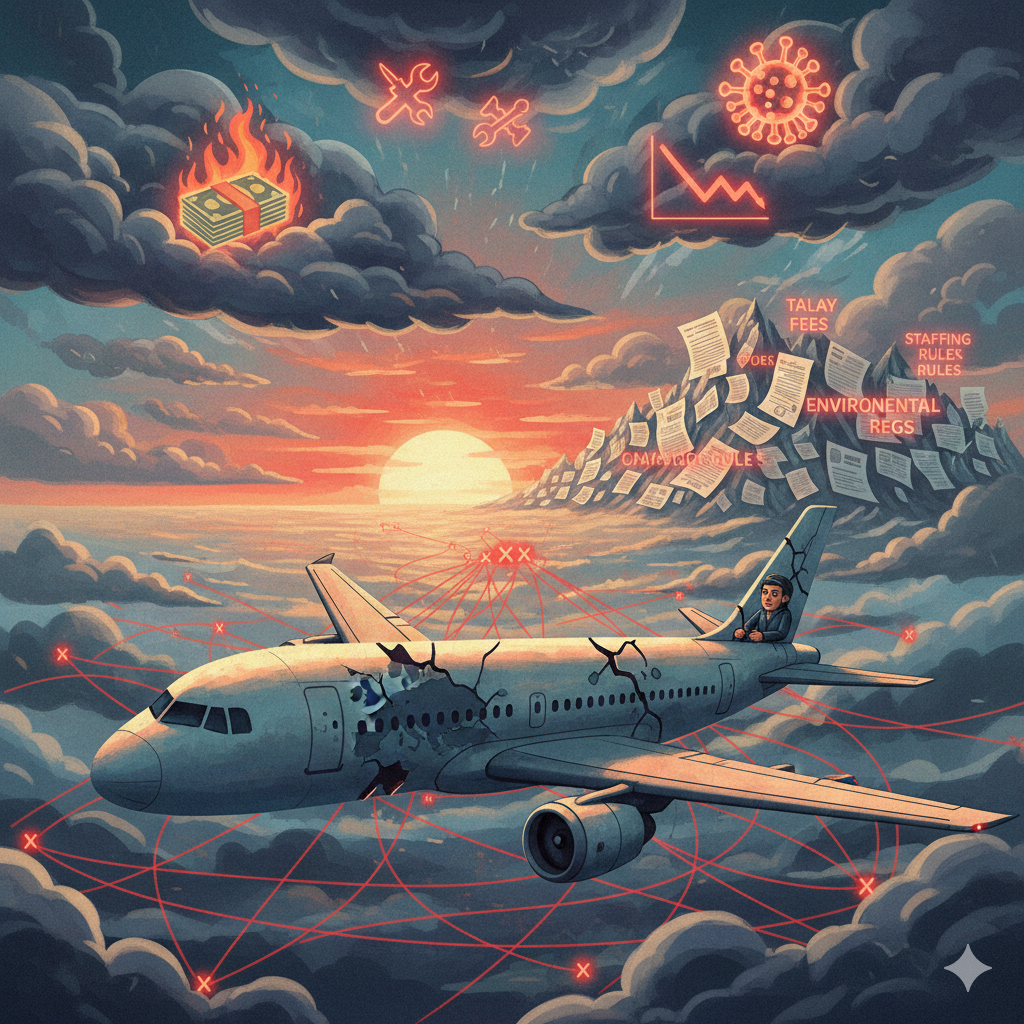
Storm Clouds Over Europe: Major Problems Facing Airlines Today
Europe is home to some of the world’s most established airlines and busiest airspaces. From legacy carriers like Lufthansa, Air France-KLM, and British Airways to powerful low-cost operators such as Ryanair, easyJet, and Wizz Air, Europe plays a central role in global aviation. However, despite high passenger demand and strong travel recovery after the COVID-19 pandemic, European airlines are currently facing serious and complex challenges that threaten profitability, reliability, and long-term sustainability.
1. Rising Operating and Fuel Costs
One of the most pressing problems for European airlines is the sharp rise in operating costs, especially fuel. Jet fuel prices remain volatile due to global oil market instability, geopolitical conflicts, and supply chain disruptions. Since fuel accounts for up to 30% of airline operating expenses, even small price increases have a major financial impact.
In addition to fuel, airlines face increasing airport charges, air traffic control fees, and aircraft maintenance costs. Major hubs such as Heathrow, Frankfurt, Paris Charles de Gaulle, and Amsterdam Schiphol have raised fees to finance infrastructure upgrades and recover pandemic-era losses, placing extra pressure on airlines.
2. Chronic Staff Shortages
Staff shortages continue to disrupt European aviation. During the pandemic, thousands of pilots, cabin crew, engineers, and ground staff were laid off or accepted early retirement. As travel demand rebounded faster than expected, airlines struggled to rehire and retrain qualified personnel.
This shortage has led to flight delays, cancellations, and reduced schedules, particularly during peak summer travel seasons. Airlines such as British Airways, Lufthansa, and easyJet have repeatedly cut flights due to insufficient crews. Competition for skilled workers has also pushed up wages, increasing labor costs.
3. Air Traffic Control (ATC) Delays
Europe suffers from some of the most congested airspace in the world. Fragmented national air traffic control systems, limited staffing, and frequent strikes contribute to persistent delays. ATC strikes in countries like France, Spain, and Italy regularly disrupt flights across the continent.
Unlike the United States, Europe does not have a fully unified airspace. The long-discussed Single European Sky initiative aims to streamline air traffic management, but political and national interests have slowed its implementation. As a result, airlines burn more fuel on inefficient routes, increasing costs and emissions.
4. Environmental Regulations and Sustainability Costs
European airlines face the world’s strictest environmental regulations. The European Union Emissions Trading System (EU ETS) requires airlines to pay for carbon emissions, while new green policies encourage the use of sustainable aviation fuel (SAF).
Although environmentally beneficial, these policies significantly increase costs. SAF is currently several times more expensive than conventional jet fuel, and supply remains limited. Airlines must absorb these costs or pass them on to passengers through higher fares, which can reduce demand—especially on short-haul routes.
5. Intense Competition from Low-Cost Carriers
Europe’s airline market is highly competitive, dominated by aggressive low-cost carriers such as Ryanair, easyJet, and Wizz Air. These airlines operate with lower costs, simpler fleets, and flexible labor contracts, allowing them to offer extremely low fares.
Legacy airlines struggle to compete on price while maintaining premium services, long-haul networks, and unionized workforces. As a result, full-service carriers face shrinking margins on short-haul routes and increasingly rely on long-haul travel for profits.
6. Financial Pressure and Debt
Many European airlines accumulated massive debt during the pandemic to survive prolonged travel restrictions. Although passenger numbers have largely recovered, rising interest rates have made debt repayment more expensive.
Some airlines, such as Air France-KLM and Lufthansa Group carriers, received government bailouts that came with strict conditions, including fleet reductions and environmental commitments. Smaller airlines, without state support, face higher bankruptcy risks or consolidation pressures.
7. Aircraft Delivery Delays and Maintenance Issues
Global aircraft shortages have created major problems for European airlines. Delivery delays from Airbus and Boeing have forced airlines to keep older aircraft in service longer than planned. Older planes are less fuel-efficient and more maintenance-intensive, increasing costs and operational risks.
Additionally, shortages of spare parts and engine issues—particularly with certain next-generation engines—have grounded aircraft across Europe. This has led to capacity shortages, lease costs for replacement aircraft, and reduced schedule reliability.
8. Airport Capacity Constraints
Europe’s major airports are operating near or above capacity. Expansion projects face environmental opposition, regulatory hurdles, and community resistance. As a result, slot availability remains limited at key airports, restricting airline growth.
Secondary airports offer relief but may lack sufficient demand, reducing profitability. Slot shortages also favor established airlines, making it harder for new entrants to compete.
9. Geopolitical and Security Challenges
The war in Ukraine and ongoing geopolitical tensions have reshaped European airspace. Flights must avoid certain regions, forcing longer routes that increase fuel burn and travel time. Airlines operating routes to Asia are particularly affected.
Security concerns and changing visa policies also influence travel demand, especially in Eastern Europe and neighboring regions.
10. Impact on Passengers and the Industry
These combined challenges translate into higher ticket prices, more delays, and reduced reliability for passengers. For tourism-dependent economies, disruptions in air travel affect hotels, trade, and employment.
At the same time, airlines must balance financial survival with environmental responsibility and service quality—an increasingly difficult task in a cost-sensitive market.
Conclusion: A Difficult but Transformative Period
European airlines are navigating one of the most complex periods in modern aviation history. While demand remains strong, structural inefficiencies, environmental pressures, labor shortages, and rising costs continue to weigh heavily on the industry.
The future of European aviation will depend on smarter regulation, investment in technology, cooperation on airspace reform, and sustainable growth strategies. Without coordinated solutions, Europe’s skies will remain crowded not only with aircraft—but with challenges.
If you want, I can also:
- Add a European airline-focused picture
- Simplify this for students
- Rewrite it for news, blog, or exam use
- Create Africa vs Asia vs Europe comparison
Just tell me ✈️
