

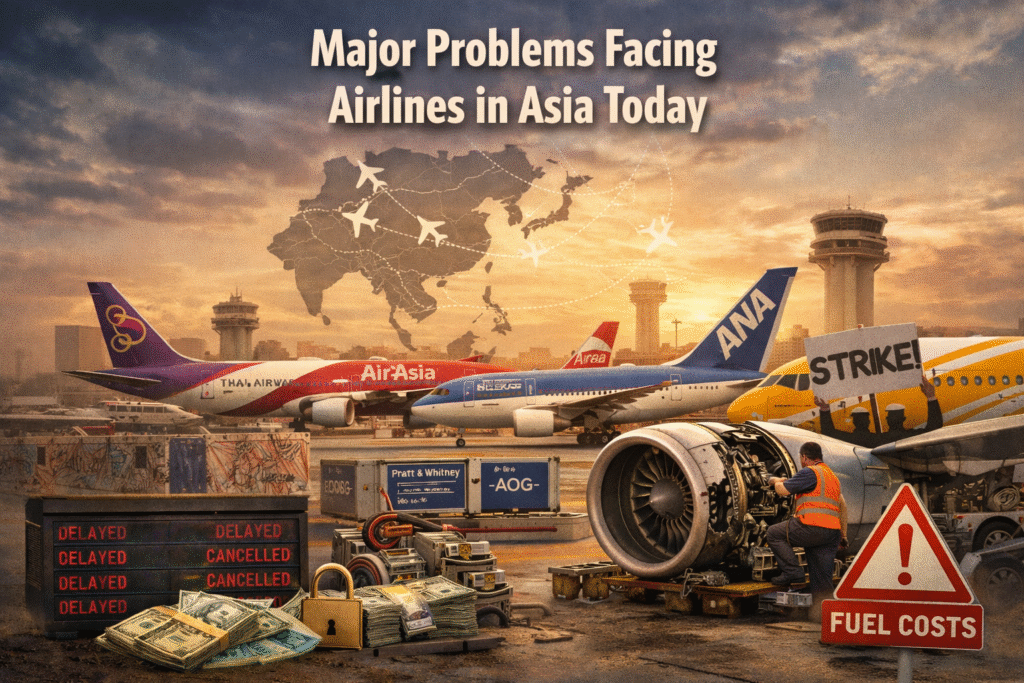
Turbulence in the East: Major Problems Facing Airlines in Asia Today
Asia hosts one of the fastest-growing aviation markets in the world. Home to major global hubs such as Singapore, Hong Kong, Dubai (often grouped with Asia), and Tokyo, the region also contains some of the world’s largest low-cost airlines. However, despite strong passenger demand and population growth, airlines across Asia are grappling with serious operational, financial, and structural challenges that threaten profitability and long-term sustainability.
1. Rising Operating Costs
One of the most pressing problems facing Asian airlines today is rapidly rising operating costs. Jet fuel accounts for 30–40% of an airline’s total operating expenses, and volatile global oil prices have significantly increased fuel bills. For airlines in countries that rely heavily on fuel imports—such as Japan, South Korea, and the Philippines—currency depreciation has further inflated costs.
In addition, airport fees, air navigation charges, and handling costs are increasing across major Asian hubs. Highly congested airports like Singapore Changi, Tokyo Narita, and Delhi Indira Gandhi International charge premium landing and parking fees, placing pressure especially on smaller and low-cost carriers.
2. Aircraft Shortages and Supply Chain Disruptions
Asian airlines are also facing severe aircraft delivery delays and parts shortages. Global manufacturing issues at Boeing and Airbus have slowed the delivery of new planes, forcing airlines to keep older aircraft in service longer. Older fleets consume more fuel and require higher maintenance spending, reducing efficiency.
Spare-parts shortages have grounded aircraft across Asia. Airlines in India, Indonesia, and Vietnam have reported flight cancellations due to delayed engine parts, particularly for Pratt & Whitney engines. This issue has disrupted schedules, lowered passenger confidence, and reduced revenue during peak travel seasons.
3. Financial Strain and Debt Accumulation
Many Asian airlines are still recovering from the financial damage caused by the COVID-19 pandemic. Airlines borrowed heavily to survive prolonged travel bans, and today they carry substantial debt burdens. High interest rates have made debt servicing more expensive, reducing funds available for fleet renewal and expansion.
Flag carriers such as Thai Airways, Malaysia Airlines, and China Eastern Airlines required government bailouts to avoid collapse. While demand has returned, profitability remains fragile, and many airlines are prioritizing survival over growth.
4. Overcapacity and Intense Competition
Asia’s aviation market is highly competitive, particularly due to the rapid expansion of low-cost carriers (LCCs). Airlines such as AirAsia, IndiGo, Scoot, Cebu Pacific, and VietJet compete aggressively on price, often selling tickets at very low margins.
While this benefits consumers, it creates overcapacity on popular routes, driving fares down and making profitability difficult. Full-service carriers struggle to compete with LCC pricing, while LCCs themselves face thin margins and high sensitivity to fuel price fluctuations.
5. Regulatory and Political Challenges
Aviation in Asia is heavily influenced by government policies and political decisions. Many countries maintain strict aviation regulations, limiting route access, foreign ownership, and airline mergers. This restricts market liberalization and reduces opportunities for consolidation.
Geopolitical tensions have also disrupted air travel. Airspace restrictions related to conflicts and diplomatic disputes—such as those involving Russia, China, and parts of the Middle East—have forced airlines to fly longer routes, increasing fuel consumption and operating costs.
6. Airport Congestion and Infrastructure Limitations
Rapid growth in passenger numbers has overwhelmed airport infrastructure in many parts of Asia. Major airports in India, Indonesia, Thailand, and the Philippines experience chronic congestion, leading to delays, cancellations, and increased operational costs.
While new airports and expansions are under construction, infrastructure development often lags behind demand. Secondary cities remain underserved, limiting regional connectivity and economic development.
7. Workforce Shortages and Rising Labor Costs
Asian airlines face a growing shortage of trained pilots, engineers, and cabin crew. During the pandemic, many aviation professionals left the industry, and rehiring and retraining staff has proved expensive.
Labor unions in countries such as Japan, South Korea, and India are demanding higher wages and better working conditions to match rising living costs. Strikes and labor disputes have occasionally disrupted operations, adding uncertainty to airline planning.
8. Environmental Pressures and Sustainability Costs
Environmental concerns are becoming increasingly important for airlines operating in Asia. Governments and international organizations are introducing stricter emissions regulations and sustainability targets.
Sustainable aviation fuel (SAF), while environmentally beneficial, remains expensive and scarce in Asia. Airlines face pressure to invest in greener technologies while still struggling to achieve profitability—a difficult balance in a cost-sensitive market.
9. Uneven Recovery Across the Region
While countries such as Japan, India, and Singapore have seen strong recoveries in travel demand, others—particularly smaller Southeast Asian and Central Asian markets—are recovering more slowly. This uneven rebound affects network planning and reduces revenue potential for regional airlines.
Chinese airlines, despite operating in one of the world’s largest domestic markets, face challenges from economic slowdowns, regulatory controls, and reduced international demand.
10. Impact on Passengers and Regional Growth
These challenges directly affect passengers through higher fares, flight delays, reduced route options, and inconsistent service quality. For economies reliant on tourism and trade, weakened airline performance slows economic recovery and limits global connectivity.
Conclusion: A Region at a Critical Juncture
Asia’s airline industry stands at a critical point. While long-term growth prospects remain strong due to population growth and rising middle-class incomes, airlines must navigate a complex mix of financial, operational, and regulatory challenges.
To ensure sustainability, Asian airlines need stronger regional cooperation, smarter cost control, fleet modernization, and supportive government policies. Without these reforms, the world’s fastest-growing aviation market risks prolonged turbulence in its skies.
