

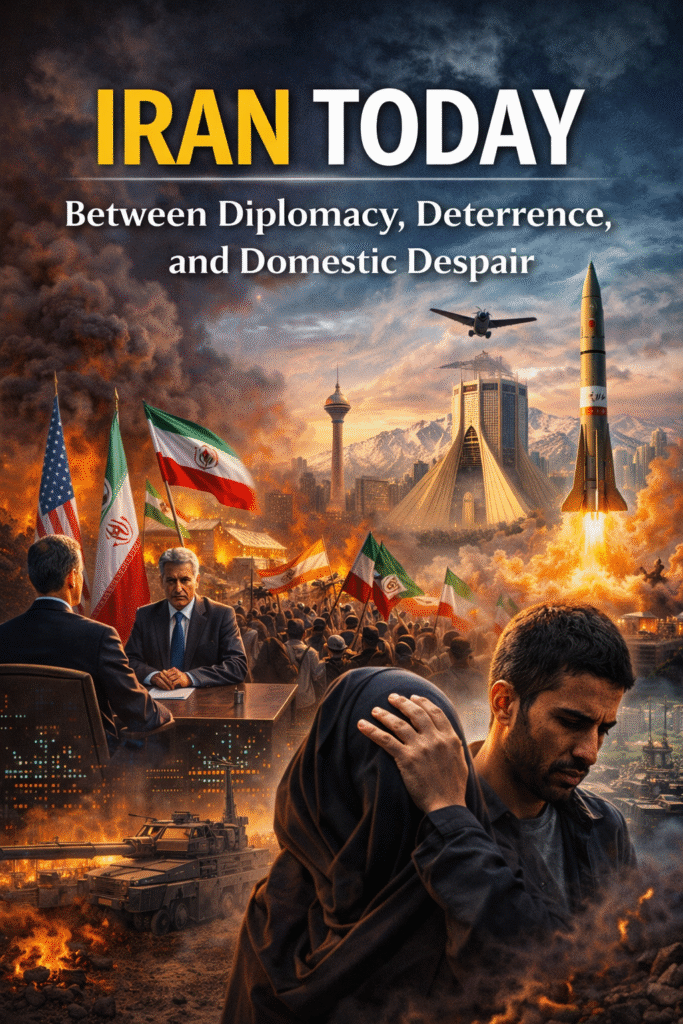
As February 2026 draws to a close, the Islamic Republic of Iran stands at a crossroads of existential proportions. The nation is simultaneously engaged in delicate nuclear diplomacy with its archrival, bracing for a potentially devastating military strike, and grappling with an economic crisis that has pushed millions of its citizens to the brink of survival. The contrast could not be starker: in Geneva, diplomats speak of “guiding principles” and “constructive talks”; in Tehran’s bazaars and suburban homes, families debate whether they can afford yogurt and whether they have any future left in their homeland.
This is Iran today: a country where the clock is ticking on multiple fronts, and where the decisions of the next few weeks will shape the destiny of 85 million people for decades to come.
The Diplomatic Tightrope: Negotiating Under the Shadow of Bombs
The most immediate story dominating Iran’s headlines is the resumption of nuclear negotiations with the United States. After an eight-month suspension following the devastating Iran-Israel war of June 2025—during which U.S. forces struck three Iranian nuclear facilities—the two sides have returned to the table through Omani mediation .
Two rounds of talks have now taken place. The first, held in Muscat on February 6, was described by Iranian Foreign Minister Abbas Araghchi as occurring in “a positive atmosphere” . The second round in Geneva on February 17 produced what Araghchi characterized as “more serious” and “more constructive” discussions, with the parties reaching a general agreement on a set of “guiding principles” to serve as a basis for beginning work on the text of a potential agreement .
Araghchi’s message to the world has been consistent and firm. “I am in Geneva with real ideas to achieve a fair and equitable deal,” he wrote on X ahead of the Geneva talks. “What is not on the table: submission before threats” .
Yet beneath the diplomatic language lies a chasm of distrust. Iran’s Deputy Foreign Minister Majid Takht-Ravanchi captured the dynamic succinctly: “The ball is in America’s court. They have to prove they want to have a deal with us” . From Tehran’s perspective, Washington’s simultaneous military buildup contradicts its professed commitment to diplomacy.
The Military Shadow: Carriers, Drills, and a 15-Day Deadline
While diplomats talk, the military machines are mobilizing. President Donald Trump has ordered a massive buildup of American forces in the region, including the aircraft carrier USS Gerald R. Ford—the world’s largest—which has been deployed from the Caribbean to join the USS Abraham Lincoln . According to monitoring sources, several dozen F/A-18 and F-35 carrier-based fighters are now positioned within striking distance of Iran’s coast .
The scale of the buildup is unprecedented since the Iraq War. CNN sources report that the US administration has received detailed options for military action, ranging from targeted strikes to large-scale bombing of government, military, and nuclear facilities . The Wall Street Journal describes the formation of the largest US air group since the invasion of Iraq .
Most alarmingly, Axios reported on February 20 that Trump has been presented with military options that involve directly targeting Supreme Leader Ayatollah Ali Khamenei and his son Mojtaba, who is seen as a potential successor . According to the report, such an option would involve “taking out the ayatollah and his son and the mullahs.” Sources emphasize that no final decision has been made, but the very existence of such plans underscores the gravity of the moment .
The timeline is tightening. On February 19, Trump reportedly set a deadline of 10 to 15 days for Tehran to reach an agreement on a new nuclear deal . The message is unmistakable: negotiate, or face the consequences.
Iran has responded with a show of force of its own. The Islamic Revolutionary Guard Corps launched naval drills in the Strait of Hormuz beginning February 16, testing intelligence and operational capabilities in the waterway through which 20 percent of the world’s oil passes . Sailors transiting the region received radio warnings that the northern lane of the Strait would be subject to live-fire exercises . This is the second such warning in recent weeks, following an exercise in late January that drew a strongly worded warning from U.S. Central Command .
Tensions have already turned deadly. On February 4, a U.S. Navy fighter jet shot down an Iranian drone approaching the USS Abraham Lincoln in the Arabian Sea. The U.S. military also reported that Iran harassed a U.S.-flagged and U.S.-crewed merchant vessel sailing in the Strait of Hormuz .
The International Dimension: Russia, China, and the Vienna Troika
As the US-Iran confrontation intensifies, other major powers are maneuvering to prevent an uncontrolled escalation. On February 18, the permanent representatives of Russia, China, and Iran held a meeting in Vienna with IAEA Director General Rafael Grossi .
Mikhail Ulyanov, Russia’s permanent representative to international organizations in Vienna, told Izvestia that the “troika’s” diplomats are coordinating efforts to promote a political and diplomatic settlement. “Special emphasis was placed on the need for an exclusively political and diplomatic settlement of all existing problems,” Ulyanov said .
For Russia, Iran’s stability carries strategic importance beyond the nuclear file. Moscow is involved in constructing the Bushehr nuclear power plant and developing logistics infrastructure for the North-South transport corridor, which would connect Russia with markets in the Middle East and South Asia. A new round of military escalation threatens these projects .
The IAEA dimension is equally critical. The direct meeting between Araghchi and Grossi in Geneva marked a significant step after Iran suspended cooperation with the agency following the June war . Grossi has warned that Iran’s stockpile of uranium enriched to 60 percent could theoretically allow it to build as many as ten nuclear bombs, should it decide to weaponize its program—though he emphasizes this does not mean Iran possesses such a weapon .
The Economic Meltdown: Payment Plans for Groceries
While diplomats and generals dominate the headlines, the reality for ordinary Iranians is one of grinding economic desperation. The rial, which sent angry merchants onto the streets when it reached 1.4 million to the dollar at the end of 2024, has now weakened to 1.6 million .
The human consequences are devastating. Annual food inflation was already at 72 percent when protests erupted across the country in December. Prices continue to skyrocket: one Iranian man reported overhearing his mother and her friend discussing the price of two bundles of spinach—the equivalent of about $28 .
A young man who recently traveled to Iran from the U.K. to spend time with family said he saw prices of some goods double in the month he was gone. Browsing an online shopping app one day, he noticed an offer to buy yogurt in installments. “Have we really sunk that low?” he asked himself .
The International Monetary Fund had projected Iran’s economy would grow by an anemic 1 percent in 2026—the slowest rate in the Middle East. Economists now project the economy will contract . Uncertainty over whether Trump will choose diplomacy or military action has frozen investment and economic activity. Adnan Mazarei, a senior fellow at the Peterson Institute and former IMF official, describes a “general situation of wait and see” that ensures “investment is going to go down, even below what was expected” .
Some of the government’s attempts to address the crisis have only deepened the pain. In December, President Masoud Pezeshkian introduced reforms including eliminating a special exchange rate for imports, effectively cutting a 75 to 80 percent subsidy on basic goods .
The country is also in the grip of severe water and energy crises, despite its vast oil and gas wealth. As economist Djavad Salehi-Isfahani of Virginia Tech puts it: “There’s a lot to be said about a stagnant economy that functions, where there’s no growth, but people’s living standards remain about the same. I think at this point, Iranians would be lucky to have that” .
The Domestic Front: Repression and Resignation
The economic crisis has already triggered the largest street protests the Islamic Republic has ever faced. In December and January, shopkeepers in the Tehran bazaar closed their stores and poured into the streets, setting off similar demonstrations across the country .
The regime’s response was brutal. Human rights groups estimate that at least 7,000 people were killed and tens of thousands arrested in the crackdown . The protests fizzled quickly, and the governing elites solidified behind the regime. No visible crack appeared in the security forces. The judiciary went on the offensive, arresting activists .
Reformist President Pezeshkian went along with the official narrative, claiming the killings were done by gangs sponsored by America and Israel. He couldn’t even prevent the arrest of the leadership of the Iranian Reformist Front, which had helped him win the presidency .
Yet beneath the surface calm, defiance persists. Iran’s civil society is not resigned; having come out in four large waves of demonstrations since 2017, those who protested are unlikely to be cowed into submission without an improvement in their lot . Some responded to calls from exiled opposition figure Reza Pahlavi to take to the streets on January 8 and 9, with videos showing protesters carrying his dynasty’s banner .
The regime’s internal opposition includes formidable figures: Mostafa Tajzadeh, a former interior minister who has spent more than 10 years in prison; Narges Mohammadi, a Nobel peace laureate reportedly held in draconian conditions; and Mirhossein Mousavi, a former prime minister under house arrest since 2011 . But like their counterparts abroad, they lack the organization to seize power.
The Wage Question: A Contained Crisis
Beneath the dramatic headlines of diplomacy and repression lies a quieter but equally significant story: the politics of wages in the Islamic Republic. A new academic study published this month in the International Journal of Middle East Studies sheds light on the complex dynamics of the Supreme Labor Council (SLC), the body responsible for setting Iran’s national minimum wage .
The study challenges the popular narrative that the regime is waging a “war on wages.” In fact, formal labor leaders, employer delegates, and government officials almost uniformly advocate for higher minimum pay. One labor leader recently claimed that “the official rate is one of the lowest wages in the world.” After agreeing to an almost 50 percent increase, an employer delegate emphasized that “a workforce that is at peace has better productivity and efficiency” .
Even Supreme Leader Khamenei has weighed in, calling for increasing the share of wages in production costs “in a way that does not harm the employer” and arguing that wage-earners can realize the “resistance economy” through cooperation with employers .
Yet these good intentions founder on the rocks of economic reality. The SLC’s decisions affect about 65 percent of Iranian society, but inflation erodes wage gains “as rapidly as the February snow on the mountains surrounding Tehran” . The result is an “unruly wage containment state”—a system where elites use centralized price-setting to manage popular demands, but where systemic conflict and outside interference prevent any sustainable solution .
The Regional Ripple Effects
Iran’s crisis is not occurring in a vacuum. Regional actors are watching with varying degrees of concern and calculation.
Saudi Arabia, which normalized relations with Iran in 2023 under Chinese mediation, is wary of a broader war that could destabilize the Gulf. Yet Riyadh has also deepened its security coordination with Washington .
Israel’s position is the most hawkish. Prime Minister Benjamin Netanyahu rushed to Washington last week to urge Trump to ensure any deal includes steps to neutralize Iran’s ballistic missile program and end its funding for proxy groups such as Hamas and Hezbollah . For Israel, a narrow nuclear deal that leaves Iran’s regional influence untouched is unacceptable.
Turkiye and other regional states have recently intervened to help ease tensions and revive diplomatic channels . The UAE, Qatar, Egypt, Pakistan, and Oman have all engaged in recent phone consultations with Iranian officials .
The Path Forward: Change from Within or Without?
As the deadline ticks down, analysts are divided on what comes next. Leonid Tsukanov, an orientalist cited by Izvestia, believes the risks of escalation have increased significantly, as the Geneva talks failed to yield a breakthrough on key issues such as Iran’s missile program and regional influence .
Yuri Mavashev, a lecturer at RANEPA, describes the current tension as “the highest possible.” With the United States and Israel warning allies to evacuate citizens and Israeli emergency services on high alert, the region is braced for impact .
Yet some see a different path. An opinion piece in The National argues that even if America bombs, “change for Iran is destined to come from within.” The author suggests that regime elites could sideline the 87-year-old Khamenei or simply wait for him to die naturally before bringing about fundamental change—including a new deal with the US, a non-aggression agreement with Israel, and liberalization of the regime .
Candidates for such a transition include pragmatic figures like former president Hassan Rouhani, as well as military figures in powerful positions such as Ali Shamkhani, head of the Defence Council, and Bagher Ghalibaf, the Speaker of Parliament .
Conclusion
Iran today is a country holding its breath. In Geneva, diplomats draft “guiding principles” while in Washington, military planners update target packages. In the bazaars of Tehran, merchants calculate whether they can afford to keep their shops open, while in the corridors of power, factions jockey for position in a succession that could come at any moment.
The next 15 days will determine which path Iran takes: toward a negotiated settlement that could bring sanctions relief and economic recovery, or toward a military confrontation that would devastate the region and plunge an already suffering population into deeper misery.
For ordinary Iranians, the calculus is brutally simple. As one man browsing an online shopping app put it, when he saw an offer to buy yogurt in installments: “Have we really sunk that low?”
The answer to that question—and the fate of 85 million people—now hangs in the balance.