

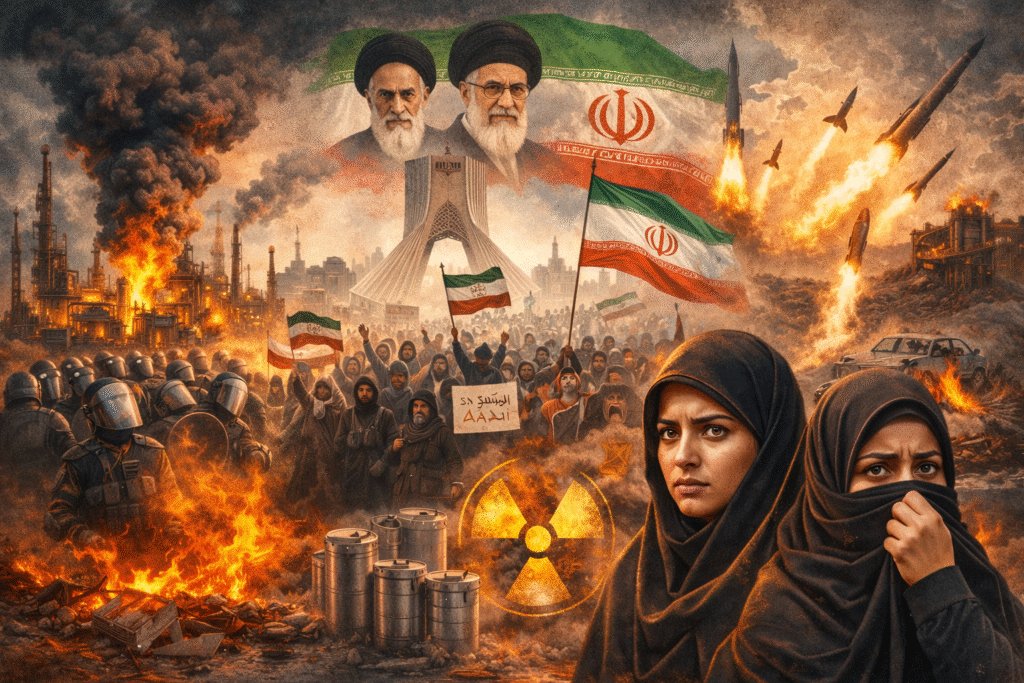
As February 2026 draws to a close, the Islamic Republic of Iran stands at one of the most perilous junctures in its four-decade history. The past 72 hours have brought dramatic developments that encapsulate the multiple crises converging on the nation: Israeli airstrikes have rocked Tehran and other major cities, the entire country’s airspace has been closed, and the shadow of potential wider war looms larger than at any time since the Iran-Iraq War. Yet beneath these dramatic headlines lies a deeper story—of a regime battered by massive protests, an economy in freefall, and a society questioning its future.
This is Iran today: a nation bracing for impact, its people caught between the fear of war and the desperation of survival.
Under the Shadow of Bombs
The most immediate and dramatic development of the past 24 hours is the Israeli attack on Iranian territory. In the early hours of Saturday, February 28, multiple strong explosions rocked Tehran, with blasts also reported in Isfahan, Qom, Karaj, and Kermanshah . Israel’s defence minister announced that Tel Aviv had launched “preemptive” strikes against Iran, while Tehran confirmed it had closed its entire airspace until further notice . Iraq followed suit, closing its airspace as well .
The strikes represent a dramatic escalation in the long-running shadow war between Israel and Iran. They follow months of rising tensions, including the June 2025 US-Israeli strikes that damaged Iran’s nuclear programme . They also come just days after the third round of indirect nuclear negotiations between Tehran and Washington ended inconclusively in Geneva, with Oman announcing “significant progress” but no breakthrough .
The United States has amassed two aircraft carrier strike groups, over 150 combat aircraft including F-35 stealth fighters, and has reinforced its bases in Jordan and Israel . The USS Gerald R. Ford, the world’s largest aircraft carrier, has arrived off Israel’s coast . European countries, including Britain, France, Germany, and Italy, have urgently advised their citizens to leave Iran, warning that an escalation could result in flight cancellations and prolonged airspace closures .
For ordinary Iranians, this means a nation holding its breath. Schools and businesses have closed, and the streets of Tehran are reportedly quiet. The regime has not yet announced its response, but Supreme Leader Ayatollah Ali Khamenei has reportedly been transferred to a secure location . The coming hours and days will determine whether this escalates into a full-scale regional war.
The January Uprising: A Regime Shaken
Yet even before this week’s military confrontation, the Islamic Republic was grappling with its most serious domestic challenge in years. Beginning on December 28, 2025, protests erupted across all 31 provinces of Iran, initially sparked by economic grievances but quickly expanding into a broader challenge to the regime’s legitimacy .
The scale was unprecedented. Monitors recorded protests in areas typically considered loyal to the state, including among minority ethnic groups such as Kurds . The demands ranged from economic reforms to calls for an end to Iranian support for armed groups in the Middle East—and even, among some protesters, for the restoration of the monarchy through Reza Pahlavi, the exiled son of the last Shah .
The regime’s response was brutal. Iranian authorities shut down internet access on January 8, a tactic previously employed in 2019 and 2022 that preceded extensive state violence . Security forces remained loyal, with no reports of defections . Supreme Leader Khamenei acknowledged that “several thousand” people had been killed, blaming the US and Israel for inciting the protests . Rights organisations give higher figures: the Norway-based Iran Human Rights organisation reports at least 3,428 protesters killed as of January 22, with around 40,000 arrested .
Most alarmingly, the UN human rights chief Volker Turk warned on February 27 that dozens more people risk execution after the first death sentence linked to the protests was issued this week . “I am horrified by reports that at least eight people, including two children, have been sentenced to death in connection with the protests,” Turk told the UN Human Rights Council, adding that another 30 people appear to be at risk of the same sentence .
Analysts assess that the protests largely ended around mid-January, but the regime emerges significantly weakened . As Chatham House analysis argues, Iran has a “political order that has lost its capacity to adapt,” and the protests will be far from an “aberration” .
The Economic Meltdown: A Currency in Freefall
Underpinning both the protests and the regime’s vulnerability is an economy in profound crisis. The Iranian rial reached a record low against the US dollar in December 2025, halving in value between July 2024 and March 2025 . Annual inflation has exceeded 30 percent for five consecutive years, with food price inflation above 70 percent .
The World Bank projects that Iran’s economy will shrink in both 2025 and 2026, with annual inflation rising toward 60 percent . UN sanctions were reimposed in September 2025 after Britain, France, and Germany triggered the “snapback” mechanism, citing Iran’s “significant non-performance” with the 2015 nuclear deal . These sanctions target Iran’s nuclear and missile production, adding to existing US and European measures.
The economic pain has concrete consequences for ordinary Iranians. The government announced changes to the subsidy system in response to the protests, but broader reforms remain elusive . Energy and water shortages were sufficiently severe in 2025 that President Masoud Pezeshkian suggested moving the capital from Tehran .
Compounding these challenges, Iran’s critical oil exports to China—its primary lifeline—are facing disruption. China’s purchases of Iranian crude declined by approximately 115,000 to 220,000 barrels per day in February compared to January . Chinese refiners are turning to Russian oil instead, prioritizing “supply stability over marginal price differences” given Iran’s uncertain trajectory amid escalating military threats . The disruption follows a US maritime blockade targeting Venezuelan tankers and the detention of Venezuelan president Nicolás Maduro by US commandos on January 3 .
Regional Position: The Axis Weakening
Iran’s regional position has also deteriorated dramatically. Between 2023 and 2025, the “axis of resistance”—the network of Tehran-backed armed groups across the Middle East—has been significantly weakened . Iran lost a key ally when Bashar al-Assad fled Syria in 2024, marking the end of its civil war .
In Gaza, Hamas is to disarm under the October 2025 agreement, though the group has not committed to doing so . In Lebanon, Hezbollah faces renewed international and local pressure to disarm, with the Lebanese Armed Forces slowly extending control over the south . In Iraq, the US has urged urgency in disarming the Popular Mobilisation Forces, though Iraqi politicians suggest disarmament can only occur after US troop withdrawal in September 2026 .
Only the Houthis in Yemen remain an exception, having retained power and influence despite US, UK, and Israeli strikes . But the overall picture is one of strategic reversal.
There is one bright spot: relations with Arab states have improved. Saudi Arabia and Iran restored diplomatic ties in 2023 following Chinese mediation, and Chatham House analysis notes that Arab states no longer view Iran as the main source of regional instability . But this diplomatic opening offers little immediate relief from the military and economic pressures Tehran faces.
Between Diplomacy and War
Throughout February, Iran engaged in intensive indirect negotiations with the United States in Geneva, mediated by Oman . Three rounds of talks were held, with the most recent concluding on February 26. Omani Foreign Minister Badr al-Busaidi announced “significant progress” and said negotiations would resume soon following consultations in capitals . But reports indicated that Washington insisted on “zero enrichment” and the transfer of all uranium enriched to 60 percent—demands Tehran rejected .
President Donald Trump had given Tehran a deadline of 10 to 15 days to make a deal or face “really bad things” . On February 27, he said he had not made a final decision on US strikes but added he was “not happy” with the situation, and that military force, including regime change, remained an option .
That threat has now been partially realized with Israel’s strikes. Whether the United States will join the operation remains unclear, though reports suggest US involvement . Iran has repeatedly warned it will retaliate against US military facilities in the region if attacked .
The Human Dimension
Behind these geopolitical dramas are 85 million people living through unprecedented uncertainty. Internet access remains limited since the January shutdown, with Elon Musk’s Starlink attempting to restore connectivity . Foreign news agencies are banned from working in Iran, and journalists face targeted threats . The death penalty is being used at levels not seen in years—at least 1,500 people were executed in 2025, according to Iran Human Rights .
Some Iranians continue to resist quietly. Protests in areas populated by minority ethnic groups, such as Kurds, persisted even after the main unrest subsided . The regime’s ability to address the economic grievances that sparked the protests remains highly uncertain.
What Comes Next
As February 28 unfolds, the trajectory remains unclear. Will Israel’s strikes be a limited operation, or the opening salvo in a wider war? Will Iran retaliate directly, or through its proxy networks? Can diplomacy resume amid the smoke of explosions?
What is clear is that the Islamic Republic enters this moment weaker than at any time in its history. Its economy is crippled, its regional position eroded, its domestic legitimacy questioned by millions who have taken to the streets. The security forces remain loyal for now, but as one analyst notes, even if the regime were to fall, the alternatives—including further clerical or military rule, state collapse, or sectarian violence—offer no easy solutions .
For the Iranian people, the calculus is brutally simple. As the UN human rights chief warned, “I am extremely alarmed about the potential for regional military escalation and its impact on civilians, and I hope the voice of reason prevails” . In Tehran, in Isfahan, in Qom, in cities across the nation, that hope hangs by a thread.