

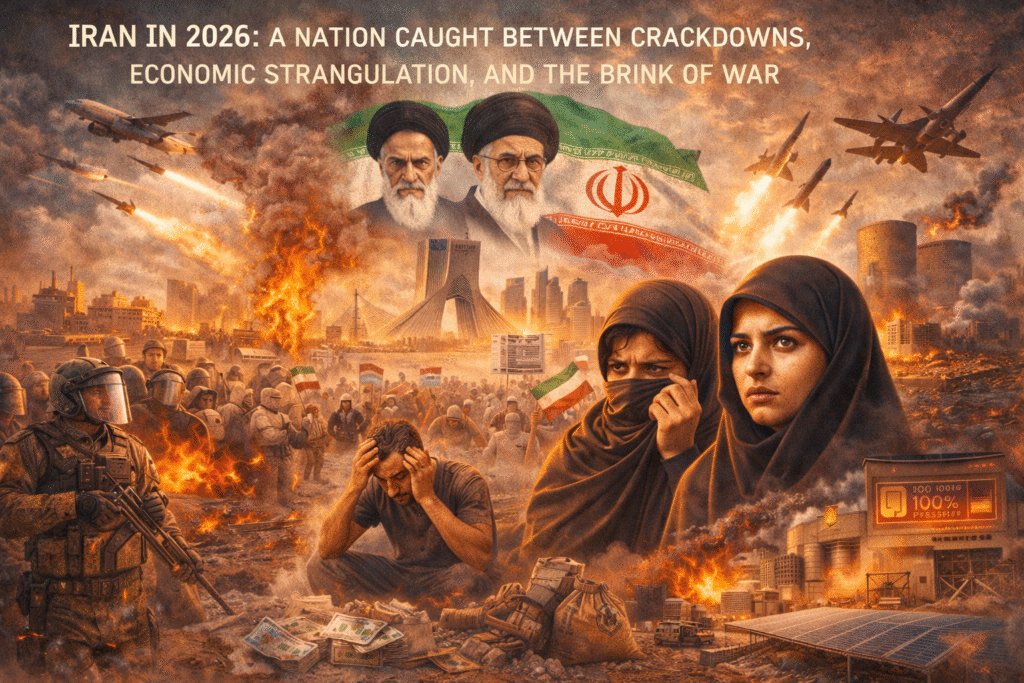
The situation in Iran today is perhaps more volatile than at any point since the 1979 revolution. As the first quarter of 2026 draws to a close, the Islamic Republic finds itself besieged by a “perfect storm” of interconnected crises. The country is only just emerging from the bloodiest domestic crackdown in its history, its economy is in freefall, and the looming threat of direct military confrontation with the United States has never been more palpable. This is the reality of life in Iran today: a nation holding its breath, waiting to see whether diplomacy or disaster will define its immediate future .
The Ghost of Protests Past
Just weeks ago, the world watched as Iran was engulfed by a wave of unprecedented protests. What began on 28 December 2025 as a strike by Tehran’s bazaar merchants—ignited by the historic collapse of the national currency—quickly spiraled into a nationwide uprising . Unlike previous demonstrations, the 2026 protests saw a unique and potent alliance form on the streets. Analysts describe it as an alliance of “empty stomachs and full minds” —the working poor fighting for survival standing alongside a once-comfortable middle class and a tech-savvy Generation Z that has been deprived of any tangible future .
The scale was immense, with monitors recording protests in all 31 provinces, including areas traditionally considered loyalist strongholds . The slogans reflected a profound shift. While economic survival was the immediate trigger, the demands quickly escalated from cries for bread to a rejection of the system itself. Reports from within Iran’s own Interior Ministry suggest a staggering level of societal disillusionment, with a majority of citizens reportedly desiring a secular political system and a significant portion of the population shunning religion—a direct challenge to the theocratic foundation of the state .
The regime’s response was swift and brutal. Security forces remained loyal, and a near-total internet blackout was imposed from 8 January, plunging the country into digital darkness . This tactic, used in previous crackdowns, made it impossible to verify events on the ground. Human rights organizations now estimate the death toll to be devastatingly high. While Supreme Leader Ali Khamenei’s government has acknowledged “several thousand” dead, the Norway-based Iran Human Rights organization puts the figure at over 3,400 protesters killed, with estimates from other agencies running as high as 6,000 or more . Tens of thousands were arrested, and the judiciary has signaled its intent to pursue charges carrying the death penalty .
By mid-January, the streets were quiet, but it was the quiet of submission, not satisfaction .
Economic Reality: The rial, Rice, and Ruin
If politics was the spark, the economy remains the kindling. The underlying grievances that fueled the protests have not subsided; in fact, they have worsened. The Iranian rial continues its death spiral, recently hitting a new low of approximately 1.65 million to the U.S. dollar—a staggering devaluation from 32,000 at the time of the 2015 nuclear deal .
This currency collapse translates into a daily horror story for ordinary Iranians. Inflation is officially running above 46%, but for essential food items, the numbers are far more grim. In the past month alone, the price of red meat in Tehran has jumped from $10 to $17 per kilo, while the cost of milk has doubled . The middle class, once the bedrock of stability, has been effectively “de-classed.” Professionals such as engineers and doctors find that their salaries can no longer cover the cost of a modest apartment or even a new laptop, pushing them below a poverty line that is rising faster than they can keep up .
The economic desperation has given rise to dystopian scenes. To cope with the impossibility of affording staple goods, Iranians are checking social media multiple times a day for price updates or shopping late at night for produce that is marked down before it spoils. Payment plans for basic groceries, like yogurt, have become a common sight on shopping apps . The manufacturing sector is in deep contraction, with a Purchasing Managers’ Index (PMI) hitting a seven-month low of 43, indicating that businesses are preparing for further output cuts and layoffs . As one industrial manager noted, pessimism is now higher than during the pandemic .
The Sword of Damocles: U.S. Threats and Nuclear Diplomacy
Adding to the suffocating sense of anxiety is the international arena. The return of Donald Trump to the U.S. presidency has brought with it the revival of a “maximum pressure” campaign, but this time, the threat is not just economic. Trump has amassed significant naval and air assets in the region, warning that if Iran violently cracks down on protesters, “the United States of America will come to their rescue” . More ominously, he has drawn a red line on Iran’s nuclear program, stating a clear preference for a diplomatic deal but warning that its absence could lead to “a very bad day” for Iran .
This threat has thrown Iranian society into a state of suspended animation. Citizens are not only battling inflation but are also preparing for the possibility of war. Reports from Tehran indicate a run on emergency supplies such as flashlights, portable gas ovens, and tape for securing windows against potential explosions . The uncertainty is paralyzing economic activity even further, as investors and businesses adopt a “wait and see” approach, unsure if their country will be bombed next week .
Paradoxically, this existential threat has also opened a narrow window for diplomacy. Iran and the U.S. are currently engaged in indirect nuclear talks in Geneva. Iranian Foreign Minister Seyed Abbas Araghchi has called this a “historic opportunity” to reach a fair deal, while Supreme Leader Ali Khamenei has reportedly given guidance to pursue this diplomatic effort . However, the positions remain entrenched. Iran insists its missile program and right to enrich uranium are non-negotiable “red lines,” while the U.S. demands verifiable guarantees that Iran cannot build a nuclear weapon .
A Weakened Axis and Regional Isolation
Tehran’s ability to project power, once a key pillar of its security doctrine, has been severely degraded. The “Axis of Resistance”—a network of proxies including Hezbollah, Hamas, and the Houthis—has been significantly weakened following years of conflict and targeted strikes . The Assad regime in Syria, a vital ally, has fallen, severing a critical land bridge for supplying Hezbollah . Meanwhile, Arab states that once feared Iran’s influence are no longer viewing it as the primary source of regional instability, further isolating the Islamic Republic diplomatically .
In a dramatic escalation, Iran recently launched retaliatory strikes against Saudi Arabia’s Aramco facility in Ras Tanura following the death of its leaders in joint U.S.-Israel strikes. This has drawn sharp condemnation from Gulf states and the U.S., who jointly labeled Iran’s actions a “dangerous escalation” . Such moves risk transforming Iran’s regional isolation into a full-blown military confrontation with a unified coalition of Gulf nations.
Conclusion: The Longing for Normalcy
Beneath the headlines of missile strikes and nuclear brinkmanship lies the quiet, desperate struggle of the Iranian people. Sociologists speak of a “Great Downgrade” where time has become the enemy—a force that erodes savings and pushes the dream of a better life further out of reach . The government’s attempts to manage the crisis, such as cutting subsidies, only add to the public’s pain .
The protests may have subsided, but the embers of discontent remain hot. University campuses have seen small-scale demonstrations even in recent weeks, a sign that the animosity toward the regime has not faded . The fundamental question facing Iran in 2026 is whether the regime can survive by simply crushing dissent. The economy requires sanctions relief to survive, but sanctions relief requires nuclear concessions. Nuclear concessions weaken the regime’s deterrent power, inviting more foreign pressure. It is a vicious cycle from which there appears to be no easy escape.
For the people of Iran, the hope is not for revolution or war, but for something far more radical: a return to “normalcy.” Yet, as the rial tumbles and the warships gather, normalcy feels like a luxury the nation can no longer afford .
