

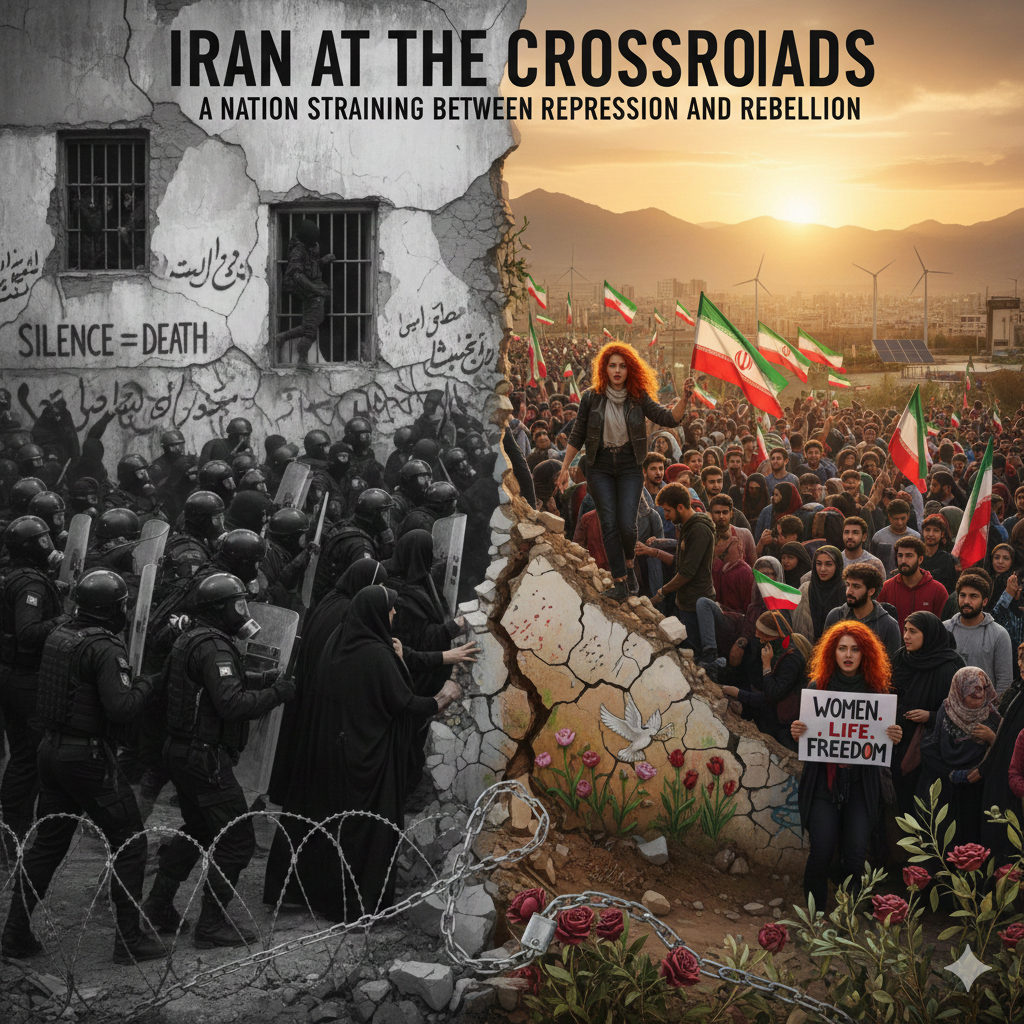
TEHRAN, Iran – The Islamic Republic of Iran stands at one of the most precarious junctures in its 44-year history. Beneath a surface of clerical control and military parades lies a nation seething with profound discontent, economic despair, and a palpable yearning for change. The death of 22-year-old Mahsa Amini in September 2022, after her arrest by the morality police for allegedly violating hijab laws, did not create this crisis; it ignited a tinderbox that had been building for decades. Today, Iran is a country of stark dualities: a theocratic state tightening its grip through brute force, and a society—particularly its youth and women—increasingly willing to risk everything to defy it.
The “Woman, Life, Freedom” Revolution and Its Aftermath
The nationwide uprising that followed Amini’s death marked a watershed. Led courageously by women and youth, the slogan “Woman, Life, Freedom” (Zan, Zendegi, Azadi) transcended earlier, more economically-focused protests. It represented a direct, frontal assault on the ideological pillars of the Islamic Republic itself—its enforcement of mandatory hijab, its gender apartheid, and its suffocating social controls. For months, the world watched as young Iranians, especially schoolgirls, tore off their headscarves, confronted security forces, and demanded fundamental rights.
The state’s response was characteristically brutal. A vicious crackdown led by the Islamic Revolutionary Guard Corps (IRGC) and Basij militia resulted in over 500 deaths, thousands of injuries, and at least 20,000 arrests. Show trials have handed down draconian sentences, including execution for protestors on charges of “waging war against God.” Yet, the regime’s victory is Pyrrhic. While it has reasserted physical control of the streets through terror, it has annihilated any remaining social contract with a massive segment of its population. The chants heard in the protests—“We don’t want the Islamic Republic!”—revealed a depth of delegitimization unseen since the 1979 revolution.
A Society in Revolt: The Forces of Change
The drivers of this societal rebellion are powerful and interconnected:
- A Youthful Demographic Revolt: Over 60% of Iran’s population is under 30. This generation, digitally native, globally connected, and raised entirely under theocracy, views the regime’s ideology as anachronistic and oppressive. They are not fighting for a reformed Islamic Republic; they are envisioning a secular, democratic future.
- Women’s Rights as the Vanguard: The women’s movement has shifted from seeking reforms within the system to openly challenging its foundational laws. The simple, courageous act of appearing in public without a hijab has become the most widespread form of daily civil disobedience, a silent revolution unfolding on metros, in cafes, and on city streets, despite escalating penalties.
- Economic Desperation as an Accelerant: Societal anger is supercharged by an economic catastrophe. Crippling U.S.-led sanctions, combined with epic mismanagement and systemic corruption, have strangled the economy. The rial has lost over 90% of its value in a decade, inflation hovers near 50%, and poverty is rampant. The middle class has been eviscerated, and even the regime’s traditional working-class base feels the sting of rising prices and unemployment, eroding its support.
The Regime’s Fortress: Coercion and Regional Ambition
Faced with this internal existential threat, the regime has doubled down on its core strategies for survival:
- Domestic Repression and Ideological Purity: The state is pursuing a two-pronged approach: intensified surveillance and punishment, coupled with a renewed push for ideological conformity. The morality police have returned to the streets with renewed vigor. New laws impose stricter penalties for hijab violations, including cutting off internet access and banning from public services. Universities are purged of “un-Islamic” thought, and the judiciary serves as a blunt instrument of political control.
- The “Axis of Resistance” and Nuclear Brinkmanship: Externally, the regime seeks leverage and legitimacy through its regional proxy network (Hezbollah, Houthis, Iraqi militias) and its advanced nuclear program. Enriching uranium to near-weapons-grade levels is a calculated gamble to extract concessions from the West and project strength to a domestic audience, framing the Islamic Republic as a defiant global player standing up to American hegemony.
- The Unwavering Role of the IRGC: The Revolutionary Guards are no longer just a military branch; they are the regime’s economic, political, and security linchpin. With vast control over key industries through shadowy conglomerates, command of the most loyal militias, and a near-monopoly on violence, the IRGC is the ultimate guarantor of the system. Its interests are now inseparable from the survival of the theocratic state.
A Tattered International Standing
On the global stage, Iran is increasingly isolated yet defiant. The 2015 nuclear deal (JCPOA) is effectively dead, with diplomacy stalled. The regime’s military support for Russia in Ukraine has drawn further Western condemnation and sanctions. Its harsh crackdown has led to expulsion from the UN Commission on the Status of Women, a symbolic but significant rebuke.
Relations with Arab neighbors remain a complex mix of tension and tactical dialogue. While a China-brokered détente with Saudi Arabia has reduced proxy war risks, underlying geopolitical rivalry persists. The regime walks a tightrope, seeking economic lifelines from Moscow and Beijing while its people look culturally and aspirationally towards the West.
The Path Forward: Stalemate or Seismic Shift?
The future of Iran hinges on the volatile interplay between three forces: the regime’s capacity for repression, the society’s endurance and courage, and the catastrophic economic pressure.
In the short term, a bloody stalemate seems likely. The regime has the guns, the prisons, and the will to cling to power. It has survived decades of pressure and shows no sign of internal fracture at the very top. Supreme Leader Ali Khamenei, 84, has likely ensured a hardline succession, preventing a more pragmatic figure from emerging.
Yet, the status quo is untenable. The economy cannot recover under current sanctions and mismanagement. The youth will not suddenly embrace theocracy. Each act of repression breeds deeper hatred. The societal transformation is irreversible; you cannot force a generation that has tasted freedom back into the box.
The most probable trigger for change remains not a foreign invasion, but an internal rupture—a crisis of succession after Khamenei’s death, a split within the security apparatus, or another spontaneous uprising born from a fresh spark. The “Woman, Life, Freedom” movement proved the Islamic Republic’s ideology is a corpse walking; it is only a matter of time before the political structure catches up.
Conclusion: A Revolution Unfinished
Iran today is a nation of breathtaking courage and profound suffering. It is a land where schoolgirls stare down armed militias, and where artists, journalists, and activists fill prisons for dreaming of a normal life. The Islamic Republic, for all its artillery and ideological rigidity, is engaged in a losing war against the human spirit of its own people.
The outcome is not preordained. The path towards democracy is fraught and likely long. But the events of the past years have shattered the regime’s aura of permanence. The chants of “Woman, Life, Freedom” echo not just in the streets of Tehran, but in the conscience of the world, announcing that the people of Iran have already begun writing the next chapter of their history. The old theocratic order, sustained by fear for so long, now lives in fear of its own children. The struggle for Iran’s soul has entered its final, most decisive phase.