

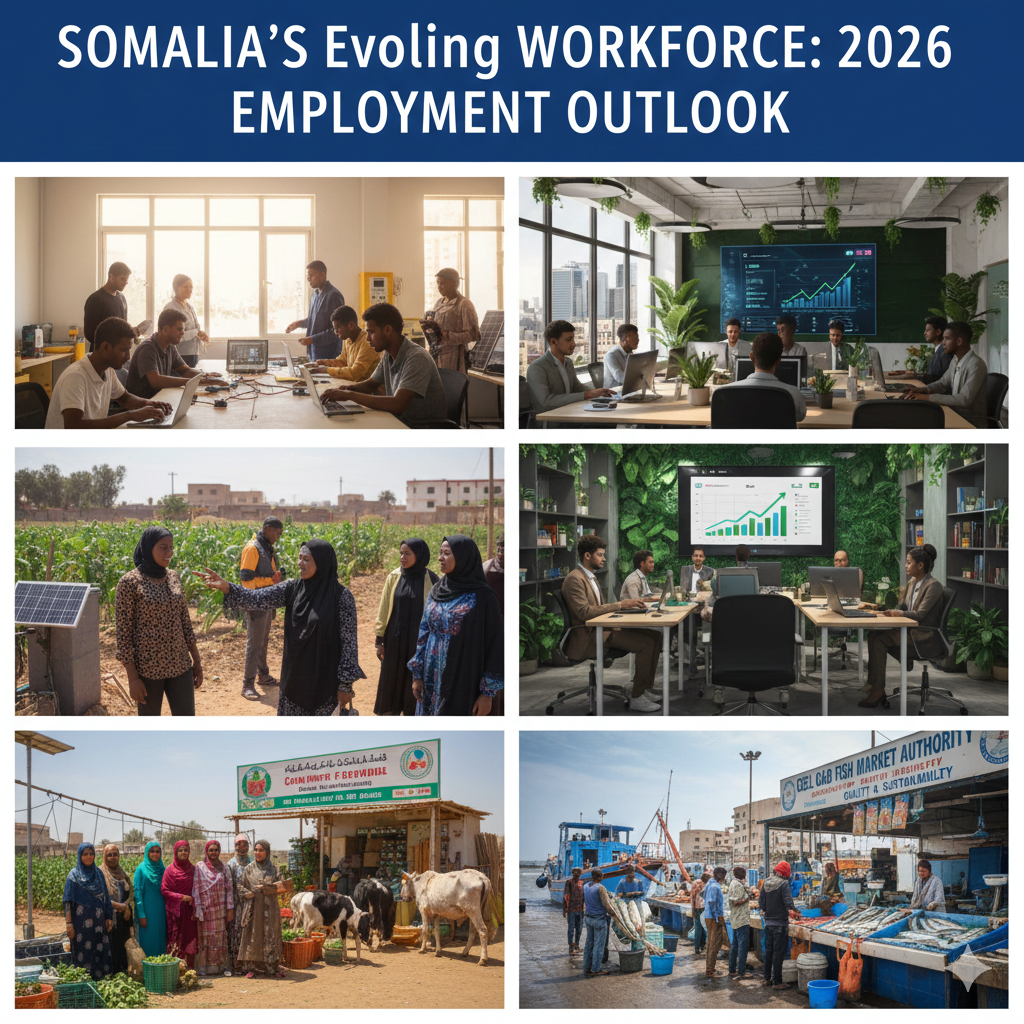
Beyond the Headlines: The Quiet Revolution in Somalia’s Job Market
For a nation long defined by conflict and crisis, Somalia is quietly writing a new narrative—one not of war, but of work. In the bustling cafés of Mogadishu, the road construction sites of Baidoa, and the vocational training centers of the Southwest State, a profound transformation is taking place. As February 2026 draws to a close, Somalia’s job market is a study in stark contradictions: sky-high unemployment exists alongside remarkable resilience, and formal sector scarcity coexists with a vibrant, informal economy driven by a generation refusing to wait for opportunities to come to them.
With over 80 percent of the population under the age of 35 and an estimated 70 percent unemployment rate among youth, the challenge is monumental . Yet, from this pressure cooker of demographic reality, innovation is emerging. This is the state of employment in Somalia today.
The Scale of the Challenge
To understand Somalia’s jobs crisis, one must first grasp its dimensions. The country remains one of the poorest in the world, with 67 percent of Somalis living on less than $1.90 per day . The economy, still largely agro-pastoral, accounts for over 80 percent of the labor force but is highly vulnerable to climate shocks—droughts, floods, and rising temperatures that threaten traditional livelihoods .
Tens of thousands of young people enter the labor market each year, yet formal employment opportunities are scarce. Most jobs are clustered in government, international NGOs, and a handful of large companies . The result is that informal work makes up more than 80 percent of employment, leaving the majority of workers without contracts, protections, or predictable income .
For those who do find formal employment, compensation varies dramatically by sector. In 2026, a software engineer in Mogadishu might earn around $2,000 per month, while a customer support representative earns approximately $800, and a marketing specialist commands roughly $1,200 . These figures, driven largely by international NGO activity and the telecom sector, represent the upper echelon of a job market that most young Somalis never enter.
Cafés as Catalysts: The Informal Economy’s Innovation Hub
Perhaps the most striking development in Somalia’s job market is happening not in government offices or corporate headquarters, but in the coffee shops of Mogadishu’s Hodan District. Here, young people gather each morning with laptops and phones, not merely to socialize, but to work .
Safiya, a 27-year-old business graduate, arrives at her local café daily to study digital marketing and apply for freelance work online. “Even if I don’t get replies to my applications, I keep learning something new,” she explains. “It keeps me moving” .
These cafés have become microsystems of ambition and peer support—informal offices where young Somalis build skills, share knowledge, and nurture startups. Ahmed, 24, left college when tuition became unaffordable but now works on a delivery-app idea with a friend. “We’re not waiting for the government to hire us; we’re creating the system through startups,” he says. “This café is our office, classroom and safety net” .
This phenomenon mirrors similar trends in other emerging economies, where young people create structure and purpose in the absence of formal opportunities. Economist Abdirahman Warsame of the Heritage Institute sees untapped potential: “Young Somalis are creative and resilient. They build networks where the system fails. If linked to structured programmes, this energy could transform the economy” .
From Displacement to Dignity: Infrastructure as Employment
While the youth of Mogadishu code and collaborate in cafés, hundreds of kilometers away in Baidoa, a different kind of employment revolution is underway. Here, the International Labour Organization (ILO), in partnership with the Baidoa District Authority and the Ministry of Public Works, is implementing an ambitious employment-intensive infrastructure project .
The approach is elegantly simple: instead of importing heavy machinery, the project employs local workers—including internally displaced persons, returnees, and host community members—to rebuild roads using labor-intensive methods. The impact extends far beyond the pavement.
At least 30 percent of all jobs under the project are reserved for women, challenging traditional gender norms in a society where construction work has long been male-dominated . Ruqiya Mohamed Noor, a 32-year-old widow and mother of eight, walks five kilometers each day from an IDP camp on the outskirts of Baidoa to work at a road construction site. After receiving ILO training, she progressed from spreading gravel to skilled stone cobbling .
For Ruqiya, the impact has been transformative. “For the first time since my husband’s death, I can independently support my children,” she says. Her earnings now cover food, education, and healthcare . She is one of hundreds benefiting from a project expected to generate more than 300,000 workdays of short-term employment across Southwest Somalia .
Safety and Dignity: A New Standard for Work
What distinguishes these infrastructure projects is not merely the jobs they create, but the quality of those jobs. On the Baidoa road sites, workers receive protective equipment—goggles, gloves, masks—and training in occupational safety. Clear signs in Somali mark hazards, and supervisors enforce safety protocols .
For Osman Ali Salaat, a stone chiseller with more than a decade of experience, this attention to worker protection is unprecedented. “In the past, injuries were just part of the job,” he reflects. “Now supervisors remind us that our health matters. We are trained to lift stones safely and avoid injuries. It makes you feel valued” .
Perhaps most innovative is the project’s grievance mechanism: a locked suggestion box on site where workers can anonymously raise concerns. When young worker Yusuf Abdi noticed that the worksite water supply wasn’t being refilled, he wrote a note. The next day, a new water tank arrived .
This commitment to transparency and accountability builds trust and demonstrates that decent work is possible even in challenging environments. As Abdikadir Mohamed, an engineer with the Ministry of Public Works, observes: “Yes, we are building a quality road that will last for years. But we are also building a model. Infrastructure that is fair, safe and inclusive. That is the real legacy” .
Skills for the Future: Greening Somalia’s Workforce
Recognizing that short-term employment must be paired with long-term skills development, international partners are investing heavily in vocational training. The Skills for Employability, Inclusion and Productivity (SEIP) project, supported by the African Development Bank and the Global Center on Adaptation, aims to strengthen technical and vocational education and training (TVET) across Somalia .
With $7.67 million in funding, the project targets 1,300 youths for training in business development and market-relevant TVET skills, with 500 graduates placed in apprenticeships and internships . Critically, the curriculum includes climate adaptation skills—training young Somalis for the green economy.
This forward-looking approach recognizes that climate change is not just an environmental challenge but an economic one. Extreme heat, drought, and flooding threaten Somalia’s key economic sectors, particularly agriculture. By equipping youth with adaptation skills, the project aims to align economic development with climate resilience .
A parallel initiative, the “Green Growth – Empowering Youth for a Green Future” project, extends this work across Ethiopia, Rwanda, and Somalia, targeting 18,400 disadvantaged youth, with a focus on young women and persons with disabilities . By revising TVET curricula to include green skills and creating private-sector partnerships for internships, these programs are building a pipeline of workers prepared for the jobs of tomorrow.
The Road Ahead: Challenges and Opportunities
Despite these promising developments, Somalia’s employment landscape remains precarious. Abdifatah Mohamed, Director of Employment Policy at the Ministry of Labour and Social Affairs, identifies a critical gap: “Investment in mid-level enterprises is needed. Without it, graduates either wait endlessly or drift into informal work” .
The UNHCR’s Somalia Strategy for Livelihoods and Economic Inclusion 2025-2027 acknowledges the scale of the challenge, noting that forcibly displaced populations and host communities face similar barriers: limited access to financial services, weak infrastructure, and vulnerability to climate shocks .
Yet within these challenges lie opportunities. The same demographic pressures that create unemployment also represent a potential demographic dividend. Somalia’s young population, if properly skilled and employed, could drive economic transformation. The informal economy, already absorbing the majority of workers, could be supported and formalized rather than ignored.
As the afternoon light softens in that Mogadishu café, Safiya closes her laptop with a reflection that captures the spirit of a generation: “We don’t have many choices, but we still show up. We still believe tomorrow can be better” .
In Baidoa, Mogadishu, and communities across Somalia, that belief is being translated into action—one road paved, one skill learned, one small business launched at a time. The journey is long, but the direction is clear.