

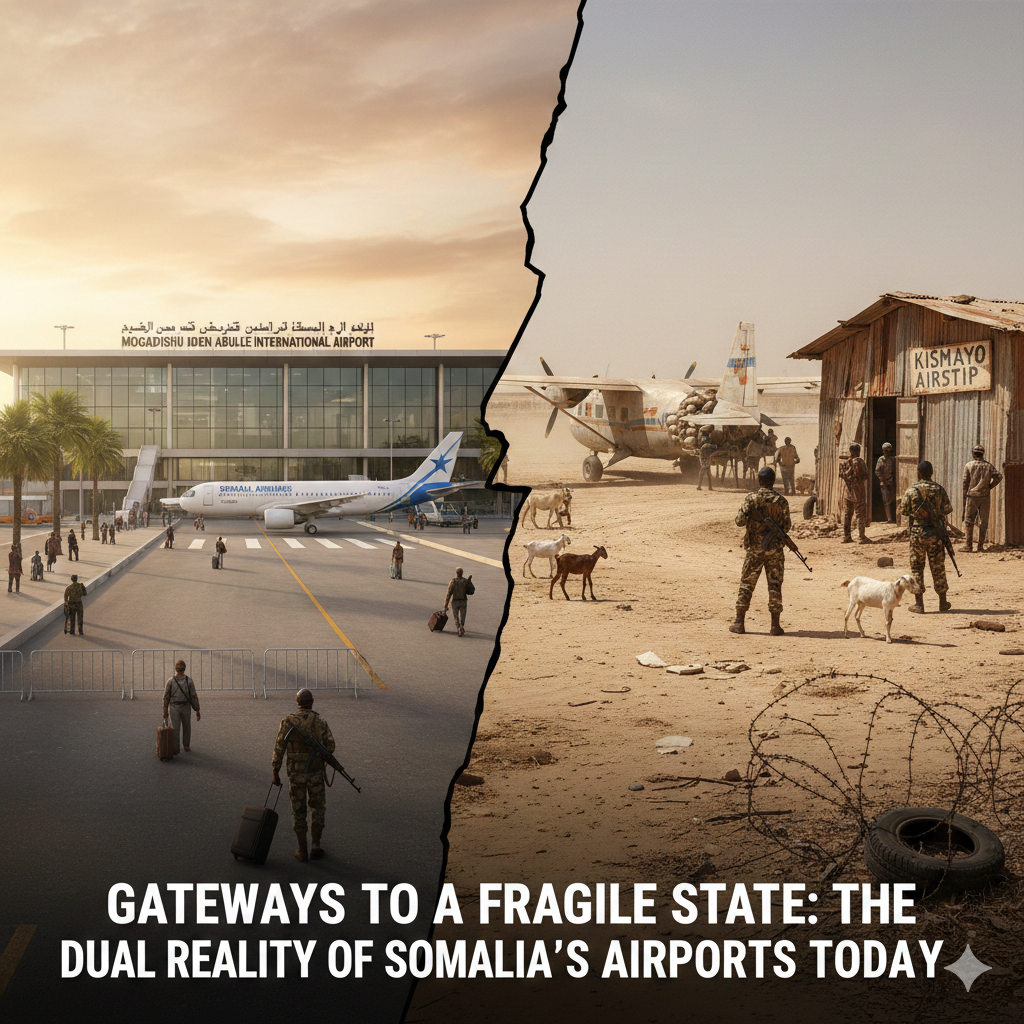
MOGADISHU, Somalia – In a nation where terrestrial travel is a gauntlet of checkpoints, clan territories, and militant threats, the sky offers a different kind of passage. Somalia’s airports are more than transportation hubs; they are critical arteries of survival, sovereignty, and economic life in a fragmented state. They exist in a stark duality: lifelines for humanitarian aid and economic connection, and high-value targets in a complex security landscape. From the refurbished tarmac of Mogadishu’s Aden Adde International to the contested airstrips of regional capitals, Somalia’s aviation infrastructure tells the story of a country struggling to rebuild its connections to the world while warily eyeing the horizons for danger.
Mogadishu’s Aden Adde International: The Beleaguered Capital’s Lifeline
Aden Adde International Airport (MGQ) is the nation’s most vital and vulnerable point of entry. Its modern terminal, rebuilt with Turkish support after decades of ruin, symbolizes tentative progress. Ringed by towering blast walls, miles of security fencing, and multiple checkpoints manned by African Union (ATMIS) and Somali forces, the airport operates like a fortified island.
It serves three parallel economies:
- The Humanitarian and Diplomatic Airlift: This is the airport’s primary function. UN agencies, international NGOs, and diplomatic missions rely exclusively on air travel for personnel and light cargo. A fleet of armored UN planes and private charter companies like African Express Airways and Jubba Airways maintain a constant shuttle to Nairobi (Wilson Airport), constituting Somalia’s most reliable connection to the outside world.
- The Commercial & Diaspora Gateway: Despite the peril, commercial flights operate. flydubai, Turkish Airlines, and Ethiopian Airlines provide crucial links to the Gulf, Turkey, and regional hubs. These flights are packed with Somali entrepreneurs, diaspora members visiting family, and officials. The arrival hall is a microcosm of the global Somali nation, a cacophony of reunions and commerce.
- The Military Logistic Hub: The airport complex houses the main base for ATMIS forces and several foreign military contingents, including the United States and Turkey. Its runways handle military transport planes delivering equipment and supplies, making it a perpetual strategic target.
Security is an all-consuming obsession. The “Airport Road” has been the site of devastating complex attacks by Al-Shabaab. Vehicles approach via zigzagging checkpoints, and passengers undergo multiple screenings before even entering the terminal. This “fortress model” ensures operation but at an extraordinary cost and with constant tension.
The Regional Capitals: Hubs of De Facto Authority
Beyond Mogadishu, airports are powerful symbols of regional authority and economic ambition.
- Hargeisa Egal International Airport (HGA): In the breakaway republic of Somaliland, Hargeisa’s airport operates with a level of order and ambition unseen in the south. With a modern terminal funded by diaspora investment, it boasts direct flights to Dubai, Addis Ababa, and several European cities via carriers like Ethiopian Airlines and Daallo Airlines. Somaliland markets its relative stability through this airport, using it to attract investment and make its case for international recognition. Security is tight but less visibly militarized than in Mogadishu.
- Bosaso Airport (BSA) & Garowe Airport (GGR): In the commercial powerhouse of Puntland, Bosaso’s airport facilitates trade with the Gulf and serves as a key node for livestock exports. Garowe, the administrative capital, has a smaller, well-secured airport vital for government and NGO movement. These airports are controlled by Puntland’s security forces and reflect its semi-autonomous, business-oriented governance.
- Kismayo Airport (KMU): Control of this airport in the fertile Jubaland region is a prize. Currently under the Somali Federal Government and allied Kenyan ATMIS forces, it is a lucrative source of revenue from landing fees and a strategic asset for influencing the region’s politics. Its status is often in flux, mirroring the shifting alliances on the ground.
The Airstrip Economy: Lifeblood of the Interior
For much of rural Somalia, access is defined not by international terminals but by dusty, unpaved airstrips. These strips, often just cleared stretches of land, are the absolute lifelines for remote communities, aid delivery, and local administration.
- Humanitarian Access: For the World Food Programme (WFP) and other aid groups, these airstrips are the only way to deliver vital supplies to regions cut off by insecurity or washed-out roads. Flights on small cargo planes like the Cessna Caravan are scheduled and rescheduled based on volatile security assessments.
- Commercial & Smuggling Routes: A vibrant, informal network of small aircraft connects these strips for commerce. They transport khat (the stimulant leaf) from Ethiopia, electronics, medicines, and people. The regulation of these flights is minimal; they operate in a grey zone, often paying “facilitation fees” to local authorities or militias for safe passage.
- Mobile Money in the Sky: In a telling sign of adaptation, it is common for passengers on these internal flights to pay for their tickets via mobile money (e.g., EVC Plus) directly to the pilot or a broker on the tarmac, bypassing any formal ticketing system.
Security: The Overriding Imperative and Greatest Challenge
Every aspect of Somali aviation is dominated by the security question. Al-Shabaab has repeatedly demonstrated its ability to target airports with mortars, suicide bombers, and complex assaults. Their goal is to sever the state’s aerial lifelines, undermine government legitimacy, and strike high-profile international targets.
The security model is therefore multi-layered and externalized:
- Perimeter Defense: A robust, armed outer perimeter, usually managed by ATMIS or private security contractors.
- Intermediate Screening: Multiple vehicle and passenger checkpoints, often using NGOs like SalamAid to handle humanitarian worker processing.
- Aviation Security (AVSEC): A fledgling Somali unit, trained by international partners like the EU and US, is slowly taking on more responsibility for passenger and baggage screening within the terminal, a key step toward sovereignty.
The presence of private military contractors (PMCs) providing security, air traffic control, and logistics is ubiquitous but controversial, highlighting the state’s limited capacity.
Economic Engine and Sovereignty Symbol
Despite the challenges, airports are economic powerhouses. They generate revenue from landing fees, passenger taxes, and rental space. They enable the diaspora remittance economy, allowing millions in cash and goods to enter the country. For the Federal Government, controlling Mogadishu’s airport is a non-negotiable pillar of sovereignty. For regional states, their airports are tools for economic development and political legitimacy.
The Future: Between Integration and Fragmentation
The trajectory of Somalia’s airports hinges on the nation’s political future.
- A Unified Federal Vision: Progress would see a nationally integrated civil aviation authority, standardized security protocols, and scheduled domestic flights connecting major cities, fostering economic and social integration.
- Continued Fragmentation: The current status quo entrenches airports as assets of disparate authorities—Mogadishu (FGS), Hargeisa (Somaliland), Bosaso (Puntland)—each with its own international connections, reinforcing political divides.
Conclusion: Landing Zones for Hope and Contention
Somalia’s airports are not merely runways and terminals. They are the fragile synapses of a nation trying to reconnect its parts. They are where global aid lands, where the diaspora returns with hope and investment, and where the government projects a semblance of normalcy. Yet, they are also fortified compounds, surrounded by a nation in conflict, where every arriving flight is assessed for risk and every departing flight carries away those who can afford to leave.
The sound of an aircraft engine over Mogadishu or Hargeisa is a sound of profound contradiction: it signals both connection and siege, opportunity and extreme risk. As long as Somalia’s future is contested on the ground, its airports will remain what they are today: the most critical, and most perilous, pieces of real estate in the Horn of Africa—islands of controlled space in an uncertain sea, where every landing is a act of defiance and every takeoff a prayer for safe passage.