

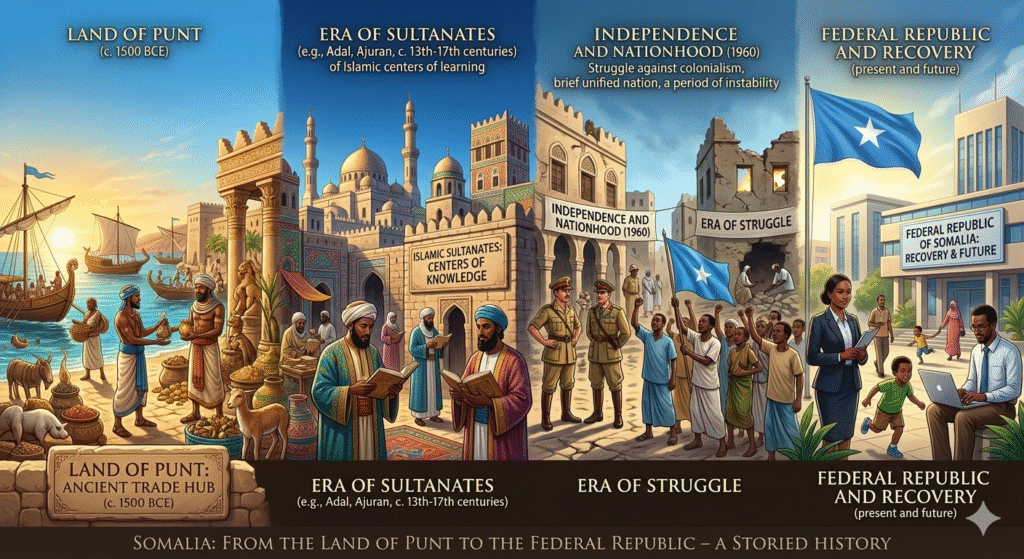
Somalia, often called the “Nation of Poets,” has a history as rich and complex as its oral traditions. Strategically positioned on the Horn of Africa, this land has been a crossroads of civilizations for millennia. Its story stretches from the ancient realm of Punt, through the rise of powerful medieval sultanates, to the traumas of colonialism, the promise of independence, the chaos of civil war, and the ongoing, fragile efforts at rebuilding. To understand Somalia today is to trace the enduring legacy of its past—a past defined by commerce, conflict, and remarkable resilience.
The Ancient Foundations: Punt, the “Land of the Gods”
Long before the rise of Islam or the arrival of European colonizers, the region now known as Somalia was a fabled land of immense wealth. Known to the ancient Egyptians as the Land of Punt—or “Ta Netjeru,” meaning “Land of the Gods”—it was a source of exotic goods like myrrh, frankincense, gold, and ivory. Pharaonic records, including the famous reliefs on the temple of Queen Hatshepsut at Deir el-Bahri (c. 1470 BCE), depict expeditions to Punt, which was ruled by King Parahu and Queen Ati. These contacts, which date back to at least the second millennium BCE, suggest a sophisticated civilization with which Egypt had a lucrative and enduring relationship.
This period of antiquity also saw the legendary Macrobian Kingdom, which, according to the Greek historian Herodotus, was a powerful tribal kingdom known for the longevity, stature, and wealth of its people. Herodotus recounts that the Persian Emperor Cambyses II sent ambassadors bearing gifts to the Macrobian king, who responded not with submission, but with a challenge: an unstrung bow, daring the Persians to draw it if they wished to invade his land. The Macrobians were said to have been so wealthy that they used golden chains for their prisoners.
Following the decline of these early kingdoms, a network of prosperous ancient city-states emerged along the Somali coast, such as Opone, Malao, Mosylon, and Sarapion. Flourishing from around 300 BCE to 600 CE, these hubs were integral to the Indo-Greco-Roman trade network. Somali sailors and merchants, using a sturdy local vessel known as the beden, connected the Mediterranean world with the markets of Arabia, Persia, and India. They traded frankincense, myrrh, and cinnamon, a product they famously kept the true source of—distant Indonesia and Ceylon—a secret to control the lucrative market. These city-states, often described in the Greco-Roman travelogue the Periplus of the Erythraean Sea, were decentralized, each governed by its own local chief.
The Medieval Golden Age: Islam and the Great Sultanates
The arrival of Islam in the 7th century CE was a transformative event. Muslim refugees from Mecca sought shelter in the port of Zeila (in present-day Somaliland) as early as the hijra (migration) in 622 CE, and the faith was quickly embraced by the coastal communities. The Masjid al-Qiblatayn in Zeila, with its two mihrabs, is one of the oldest mosques in Africa, dating to the 7th century.
Islam became a unifying force that facilitated the rise of powerful Somali sultanates. The Sultanate of Mogadishu rose to prominence in the 10th century, becoming a major trading empire that minted its own currency and dominated the regional gold trade. Its cosmopolitan influence stretched across the Indian Ocean. By the 13th century, the Ajuran Sultanate emerged as a dominant power in southern Somalia. Ruled by the House of Garen, the Ajuran were unique in the Horn of Africa as a ‘Hydraulic Empire,’ centralizing control by monopolizing the water resources of the Shebelle and Jubba rivers. This allowed them to develop complex irrigation systems, dykes, and dams, creating a productive agricultural base. The Ajuran state was highly centralized, with a powerful army that successfully resisted Oromo expansions from the west and, in a series of fierce battles, repelled Portuguese incursions from the east during the 16th century, preserving Somali autonomy on the Indian Ocean.
Further north, other sultanates thrived. The Warsangali Sultanate controlled vast territories in the northeast. The Sultanate of Ifat and its successor, the Adal Sultanate, based in the port city of Zeila, were powerful polities that engaged in a long and consequential rivalry with the Christian Ethiopian Empire to the west. These medieval states, though never unified under a single central government, established a legacy of sophisticated governance, Islamic scholarship, and commercial dominance that defined the Somali peninsula for centuries.
The Scramble for Africa: Colonial Partition and Its Legacy
The late 19th century brought a dramatic upheaval. The European “Scramble for Africa” carved up the Horn, dividing the Somali people among three major European powers: Britain, Italy, and France (the latter securing the territory that would become Djibouti). The colonial era was marked by strategic rather than economic interests. Britain established the British Somaliland Protectorate in the north in 1887, primarily to secure a source of food supplies for its garrison in Aden and protect trade routes to India. Investment in the region was minimal. Italy, on the other hand, gradually acquired control of the southern and eastern coasts, initially through treaties with local sultans and later through military campaigns against resistant polities like the Majeerteen Sultanate and the Sultanate of Hobyo. In 1927, these territories were consolidated as Italian Somaliland.
The colonial economies were extractive and focused on agriculture. In the south, the Italians developed large-scale banana, cotton, and sugar plantations along the Shebelle River, using irrigation systems to produce export crops. A protected Italian market was created to absorb Somali bananas, but this sheltered approach left Somali agriculture uncompetitive on the global stage. In the north, British investment remained negligible; its largest expenditure for decades was suppressing the resistance of the Dervish movement. Despite the low level of investment, colonialism introduced a salaried class and a small urban bourgeoisie in the south, a group that would later form the nucleus of the nationalist movement.
Crucially, this colonial partition split the Somali nation into five different regions—British Somaliland, Italian Somaliland, French Somaliland, the Ogaden (incorporated into Ethiopia), and the Northern Frontier District (part of Kenya)—seeding a pan-Somali nationalist aspiration that would complicate the post-independence era.
The Birth of a Republic and the Fall into Civil War
The mid-20th century brought the tide of decolonization. After a brief period of British military administration during World War II, Italian Somaliland returned to Italian administration in 1950 as a United Nations Trust Territory, with a ten-year mandate to prepare for independence. Meanwhile, on June 26, 1960, British Somaliland gained its independence, becoming the short-lived State of Somaliland. Just five days later, on July 1, 1960, the two territories voluntarily united to form the Somali Republic, a merger of the former British and Italian colonies. This act was a unique achievement in post-colonial Africa, bringing together two territories under different colonial administrations to forge a single nation-state.
The early years of the republic were marked by a fragile parliamentary democracy. In 1967, Abdirashid Ali Sharmarke was elected president in what was hailed as the first peaceful transfer of power in Africa. This experiment in democracy was brutally cut short on October 15, 1969, when President Sharmarke was assassinated by one of his own bodyguards.
Seizing the ensuing political vacuum, the army, led by Major-General Mohamed Siad Barre, staged a bloodless coup on October 21, 1969. Barre suspended the constitution, banned political parties, and declared Somalia a socialist state, renaming it the Somali Democratic Republic. His regime initially introduced popular reforms, such as the adoption of a Latin script for the Somali language in 1972, which boosted literacy. However, his rule grew increasingly authoritarian and repressive.
The defining event of the Barre era was the Ogaden War of 1977-78. Emboldened by superpower rivalry, Somalia invaded Ethiopia to reclaim the Ogaden region, home to a large ethnic Somali population. The gamble backfired spectacularly when the Soviet Union, which had initially supported Somalia, abruptly switched sides and allied with Ethiopia, airlifting Cuban troops to defeat the Somali army. This defeat was a catastrophic turning point. It weakened Barre’s regime, inflamed clan tensions as he played groups against one another to survive, and led to an influx of refugees and armed insurgent groups. By the 1980s, the country was in the throes of a full-blown insurgency, most notably the Somali National Movement (SNM) in the north, which the regime brutally suppressed, bombing the city of Hargeisa in 1988.
On January 27, 1991, Barre was finally ousted from Mogadishu by armed opposition groups. But there was no new order to replace him. The coalition of factions that had defeated him immediately turned on each other, plunging Somalia into a devastating civil war. In the north, the SNM declared the independence of the Republic of Somaliland on May 18, 1991, reverting to the borders of the former British protectorate.
A Fragile Path to Reconstruction
The 1990s and 2000s were a period of intense suffering and state collapse. A US-UN intervention (UNITAF/UNOSOM) in 1992-93 aimed to alleviate famine but ended in a humiliating withdrawal after the “Black Hawk Down” incident in Mogadishu. The country was without a central government for nearly a decade, ruled by competing clan-based warlords. A significant turning point came in 2000, when a peace conference was held in Arta, Djibouti. This landmark meeting brought together clan elders, intellectuals, and civil society for the first time, establishing the Transitional National Government (TNG) and ending nearly ten years of statelessness. As Djibouti’s Foreign Minister recently noted, this conference marked a rebirth where Somalis began to take ownership of their reconciliation, a spirit that remains a symbol of hope.
A series of subsequent transitional governments and peace talks, including the key 2002 Eldoret conference in Kenya, eventually led to the establishment of the Federal Government of Somalia (FGS) in 2012. This marked the end of the transitional period and the beginning of a federal system. While the FGS has struggled to assert its authority over all of Somalia, it represents a fragile but enduring political framework. Today, Somalia continues its long and difficult journey. It battles the ongoing threat from the Al-Shabaab militant group, works to build functional federal institutions, and faces periodic humanitarian crises from drought and conflict. The 25th anniversary of the Arta conference, commemorated in late 2025, served as a powerful reminder of both the distance traveled and the challenges that remain. The history of Somalia is a testament to a people who, despite immense adversity, continue to seek unity, peace, and a return to their historic role as a vibrant center of culture and commerce.
