

Introduction: The Landscape of East African Agriculture in 2026
East Africa’s agricultural sector stands at a critical crossroads in 2026. The region, home to some of the continent’s most productive farming systems and fastest-growing economies, is simultaneously grappling with severe climate shocks and witnessing unprecedented private sector investment. Agriculture remains the backbone of East African economies, employing the majority of the population and contributing significantly to GDP across Kenya, Tanzania, Uganda, Ethiopia, Rwanda, and beyond.
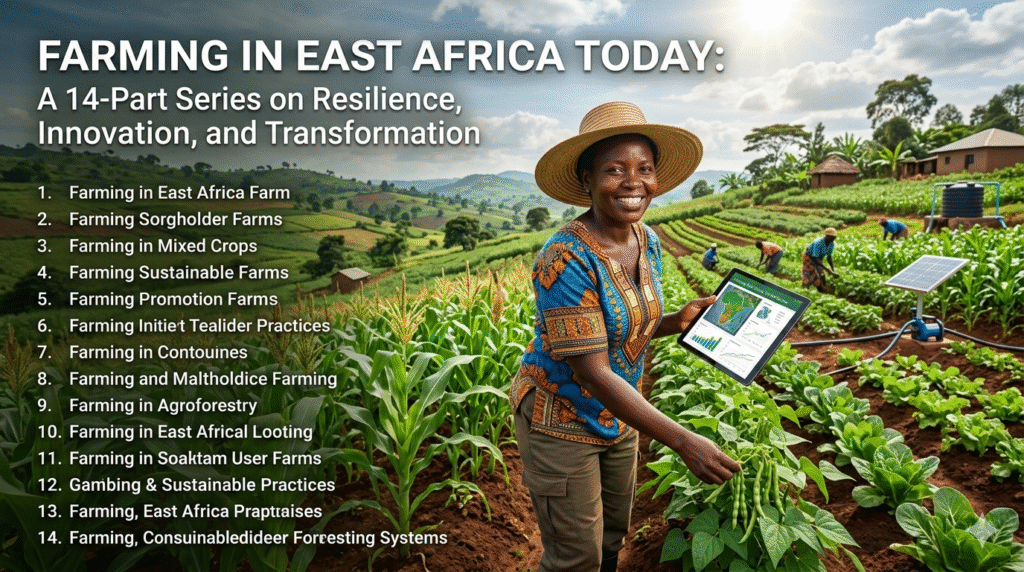
This 14-part series explores the multifaceted reality of farming in East Africa today—from the drought-stricken pastoral lands of the Horn to the high-tech greenhouses of Nairobi’s outskirts, from traditional smallholder plots to multi-million-dollar commercial farms. Each installment examines a different dimension of the region’s agricultural landscape, drawing on the latest data, expert analysis, and on-the-ground reporting to paint a comprehensive picture of a sector in transformation.
Part 1: The Climate Crisis — Drought, Floods, and the New Normal
East Africa is currently in the grip of a severe and protracted drought that is reshaping farming and pastoralism across the region. According to the EU’s Joint Research Centre, drought conditions have persisted since September 2025, exacerbated by scarce rainfall and temperatures soaring more than 2°C above average in parts of northeastern Kenya, southern Ethiopia, and southwestern Somalia .
The impact on agriculture has been devastating. Soil moisture levels are critically low, vegetation is severely stressed, and crop failures are widespread across Arid and Semi-Arid Lands (ASAL) regions . The Famine Early Warning Systems Network (FEWS NET) reports emergency-level food insecurity across the three countries as of January 2026, with 4.6 million people already affected and over 135,000 displaced in Somalia alone .
Yet the climate crisis is not uniform. Even as drought parches some areas, others face destructive floods. In January 2026, heavy rains and flash floods affected over 655,000 people across Southern Africa, with Mozambique particularly hard hit . Tanzania presents a microcosm of this volatility, simultaneously experiencing drought conditions in some areas and local flooding in others .
The paradox extends to forecasts. The IGAD Climate Prediction and Applications Centre (ICPAC) predicts increased rainfall for March–May 2026, which could offer relief . But as the EU Science Hub notes, seasonal forecasts are marked by “high uncertainty,” with different scenarios potentially leading to very different impact conditions . For East African farmers, the only certainty is unpredictability.
The human cost is mounting. Rising livestock mortality, record-high cereal prices, and increasing acute malnutrition in children paint a grim picture . With over 33 million people facing critical food insecurity across IGAD countries, the climate crisis has become a humanitarian emergency demanding immediate, scaled-up support .
Part 2: Market Dynamics — Staple Food Prices in Flux
East Africa’s staple food markets in early 2026 tell a story of divergence and volatility. According to AGRA’s January 2026 Food Security Monitor, prices across the region are responding to a complex interplay of seasonal harvest patterns, cross-border demand, and currency fluctuations .
Maize, the region’s most important staple, shows starkly different trends across borders. In South Sudan, prices fell sharply—dropping 21% to $720 per metric tonne—due to improved inflows. Yet Uganda saw prices rise 8%, and Tanzania recorded a 2% increase as post-harvest supplies tightened. Kenya and Ethiopia registered modest gains, while Rwanda experienced a slight easing on seasonal availability .
Rice markets tell a similar story of fragmentation. Prices surged in Uganda (6%) and Kenya (2%) amid firm regional demand and high import costs. Yet Tanzania and South Sudan recorded declines of 3% and 6% respectively, driven by currency depreciation and improved supply flows .
Bean markets softened across much of the region, with Rwanda (-6%), Uganda (-2%), and Tanzania (-7%) all benefiting from improved harvest availability. Kenya bucked the trend, with prices for yellow beans rising 5% and red beans 4% due to tight domestic stocks and reliance on imports .
Wheat showed mixed movements: Kenya recorded a 3% increase on high import costs and miller demand, while Ethiopia saw a 4% decline following harvest inflows .
Underlying these price movements is a concerning pattern. While main-season harvests have concluded in most countries and second-season crops are developing, drought pockets continue to affect eastern Kenya, Somalia, central Uganda, and central-northern Tanzania. These rainfall deficits are straining soil moisture, degrading pasture quality, and increasing vulnerability in agropastoral zones—raising serious concerns about production stability in the months ahead .
Part 3: Livestock and Animal Feed — A Ksh 3 Billion Bet on Kenya’s Farmers
In one of the largest private-sector investments in East African agriculture in recent years, global animal nutrition company De Heus Kenya opened a Ksh 3 billion ($23 million) animal feed manufacturing facility in Athi River on February 18, 2026 .
The new factory represents a significant bet on Kenya’s livestock sector, which contributes an estimated 12% of national GDP and supports millions of livelihoods. With an annual production capacity of 200,000 metric tonnes—expandable to 260,000—it ranks among the largest feed mills in East Africa .
The investment addresses a fundamental constraint on livestock productivity: feed costs account for up to 70% of total production expenses, making feed quality and availability critical determinants of farm performance . By manufacturing feed locally, De Heus aims to shorten supply chains, improve traceability, and tailor nutrition to Kenyan farming systems—helping farmers achieve more consistent results while reducing exposure to global supply disruptions.
The facility will produce a comprehensive range of products: compound feeds, concentrates, premixes, and specialty feeds for poultry, pigs, ruminants, and aquaculture . Beyond manufacturing, the company provides technical advisory services to farmers on feed utilization, ration formulation, and animal nutrition management—services designed to translate feed quality into measurable productivity gains.
The economic impact extends beyond the factory gates. The facility is expected to create approximately 250 direct jobs and up to 1,000 indirect jobs across transport, logistics, packaging, distribution, and raw material supply chains. Critically, De Heus plans to source key raw materials—including maize and soybeans—from Kenyan farmers, supporting local grain markets and rural incomes .
Speaking ahead of the launch, Managing Director Wiehan Visagie emphasized the strategic vision: “This factory is about building reliable systems for farmers. By manufacturing feed locally, we are addressing long-standing challenges such as inconsistent quality and dependence on imports, while supporting farmers to improve productivity and profitability” .
The launch ceremony drew Kenya’s agriculture leadership, including Cabinet Secretary Mutahi Kagwe and Principal Secretary for Industry Dr. Juma Mukhwana—underscoring the government’s recognition of private-sector investment as central to food security and agricultural transformation .
Part 4: Export Horizons — Indonesia, Italy, and Greece Emerge as New Markets
East Africa’s agricultural exports are finding new homes. While China, the UAE, and South Africa remain dominant buyers, a growing share of export growth in late 2025 came from smaller but fast-expanding markets in Asia and Europe .
Data from the East African Community’s Quarterly Statistics Bulletin reveals that exports to Indonesia jumped sharply, lifting the Southeast Asian economy into the EAC’s top ten export destinations for the first time. Italy and Greece also recorded strong gains, reflecting rising European demand for East African commodities .
Total exports from the eight-member bloc rose 32.3% year-on-year to $19.6 billion in the third quarter of 2025, outpacing import growth and helping narrow the region’s trade deficit to $1.0 billion from $3.4 billion a year earlier .
The export gains to emerging markets were driven largely by agricultural products. Base metals, precious stones, and mineral fuels played a role, but traditional agricultural exports—coffee and tea—remained central. Europe’s rising purchases were supported by shipments of minerals and processed agricultural goods, while Asia’s demand was linked to industrial inputs and energy-related products .
Yet the region’s export basket remains heavily skewed toward raw and semi-processed commodities, leaving it vulnerable to price volatility and global demand shocks . The rise of Indonesia, Italy, and Greece points to a slow but meaningful broadening of export demand—a shift that could help cushion the region against external shocks if sustained.
Intra-African trade is also gaining ground, rising to $10.1 billion—32.2% of total trade—in the quarter, as the EAC deepens regional integration under the African Continental Free Trade Area (AfCFTA) framework . For East African farmers, these diversified markets offer new opportunities—and new challenges in meeting quality standards and consistency requirements.
Part 5: Power for Food — Renewable Energy Meets Regenerative Agriculture
In the Kenyan counties of Nandi and Uasin Gishu, an innovative partnership is exploring the intersection of renewable energy and regenerative agriculture. The Power for Food Partnership, funded by SNV and implemented by Kilimo Trust, runs from October 2025 through December 2028, with a bold vision: “To achieve renewable energy-driven resilient food systems, where people have equitable opportunities to thrive sustainably” .
The project’s objective is multifaceted: restore soil health, enhance resilience to climate shocks, and increase farmers’ access to renewable energy solutions for irrigation, storage, and processing—while linking them to structured markets .
Central to the approach is the LEARN pathway, implemented by Kilimo Trust, which uses adaptive, evidence-driven learning to validate what works for Regenerative Agriculture (RA) and Productive Use of Renewable Energy (PURE) at the local level. The pathway prioritizes practical research, demonstration, and participatory knowledge generation to close evidence gaps and support decision-making by technology users .
On-the-ground activities are ambitious and concrete:
- Forming 80 Farmer Field Schools (FFS) and Farmer Business Schools, each with at least 30 participants
- Recruiting and training 8 Master Trainers from sub-county agriculture and energy departments
- Facilitating 80 FFS facilitators to deliver RA/PURE training to 2,400 participants
- Establishing 6 Reference farms at Agricultural Training Centers and TVETs
- Facilitating 7 business-to-business meetings between PURE/RA innovators and FFS/FFBS
- Organizing 14 farmer field days reaching 500 attendees each with best practices
The project’s theory of change recognizes that technology alone is insufficient. As the implementers note, “While adopting regenerative agriculture and renewable energy solutions, greater investment in sustainable enterprises, and stronger evidence bases are important markers of progress; the true measure of impact lies in creating the enabling conditions that allow these solutions to become mainstream” .
For smallholder farmers in the region, this integrated approach—combining soil health, renewable energy, and market access—offers a pathway out of subsistence agriculture toward resilient, profitable farming systems.
Part 6: Irrigation’s Untapped Potential — Al Dahra’s $100 Million Bet on Tanzania
Tanzania holds some of Africa’s most underutilized agricultural potential—and international investors are taking notice. In February 2026, Emirati agribusiness giant Al Dahra signed a memorandum of understanding with the Tanzania Investment and Special Economic Zones Authority (TISEZA) to develop large-scale agricultural projects .
The numbers are striking. Al Dahra plans to invest up to $100 million to develop 10,000 hectares of farmland, with an option to expand to 20,000 hectares. TISEZA will facilitate land identification, provide regulatory support, and offer investment incentives .
The scale of Tanzania’s untapped potential justifies the investment. According to the Ministry of Agriculture, the country has 44 million hectares of arable land—but only about 10.8 million hectares (24%) are currently under cultivation. Even more striking: Tanzania’s total irrigation development potential is estimated at 29.4 million hectares, of which less than 5% is currently utilized .
Al Dahra brings extensive agribusiness expertise. The company operates across the full value chain, from production to marketing, handling grains (rice and wheat), fruits (citrus, dates, grapes, apples, olives), and animal feed across several continents, including Africa .
Al Dahra CEO Arnoud van den Berg emphasized the strategic vision: “Tanzania offers exceptional agricultural potential, and together with TISEZA, we aim to introduce advanced, sustainable and resilient farming models that support the development of modern farming infrastructure, acquisition of state-of-the-art agricultural technologies, and implementation of smart agritech systems in Tanzania” .
The investment represents a vote of confidence in Tanzania’s agricultural transformation agenda—and a recognition that irrigation is the key to unlocking the country’s vast arable lands. For a region grappling with climate volatility, expanding irrigated agriculture is not just an economic opportunity; it is a climate adaptation imperative.
Part 7: Water Wisdom — Building Climate-Resilient Agriculture Through Training
Across East Africa, a quiet revolution in water management is underway. In January 2026, the WATDEV project—Climate Smart Water Management and Sustainable Development for Food and Agriculture in East Africa—launched a intensive training course focused on sustainable water management and climate-resilient agriculture .
The course, organized by Italy’s National Research Council (CNR-IPSP) and CIHEAM Bari, targets researchers, technologists, and professionals from Egypt, Ethiopia, Kenya, and Sudan. Its objective: strengthen technical and scientific skills in sustainable water resource management while enhancing the resilience of agri-food systems to climate change .
The curriculum reflects the cutting edge of agricultural science. Three intensive modules cover:
- High-capacity research platforms: Introduction to digital infrastructures for field and controlled-environment phenotyping, data management according to FAIR principles, and AI tools to support analytical processes and decision-making .
- Field instrumentation and data collection: Practical demonstrations of portable instruments and sensors for validating remote and proximal sensing data, image processing techniques, and vegetation indices for crop and water monitoring .
- Statistical analysis, predictive models, and wastewater reuse: Application of statistical methods and machine learning models, plus strategies for safely reusing treated urban wastewater for irrigation .
The program adopts a Training of Trainers approach, amplifying impact by enabling participants to disseminate acquired skills within their institutions and communities. Upon completion, participants receive certificates recognizing their new competencies .
The WATDEV project operates within a broader cooperation framework. Funded by the EU’s DeSIRA Programme, with technical coordination by the Italian Agency for Development Cooperation (AICS) and scientific coordination by CIHEAM Bari, it integrates advanced research, modeling, technological innovation, and capacity building .
For East African farmers facing increasingly uncertain rainfall, this investment in human capital—training the researchers and technicians who will support them—is as critical as any infrastructure project. Knowledge, once acquired, cannot be washed away by flood or withered by drought.
Part 8: Dairy Development — Strengthening Regional Value Chains
Dairy farming is a lifeline for millions of East African smallholders—and a priority sector for international partnerships. The Netherlands Food Partnership (NFP) has identified the dairy sector as a key focus for 2026, with its Dairy East Africa Partnership working to align Dutch expertise with East African priorities .
The partnership exemplifies a broader shift in development cooperation: moving from donor-recipient relationships toward collaborative alliances that connect public, private, research, and civil society actors around locally-led priorities .
For East African dairy farmers, the challenges are well-documented: low productivity, poor feed quality, limited access to veterinary services, and fragmented markets. Yet the opportunities are equally significant. Rising urbanization and a growing middle class are driving demand for milk and dairy products across the region.
The Dairy East Africa Partnership focuses on practical interventions: strengthening sustainable and inclusive dairy systems, improving access to quality inputs, and connecting farmers to formal markets . By leveraging Dutch expertise in animal nutrition, genetics, and value chain development, the partnership aims to boost productivity while ensuring that smallholders share in the benefits.
Kenya’s dairy sector, in particular, has attracted significant attention. With supportive government policies and a vibrant private sector, the country has developed one of Africa’s most dynamic dairy industries. Yet even here, productivity gaps persist—and the potential for growth remains substantial.
As climate volatility intensifies, dairy farming offers pastoralist communities an opportunity to diversify their livelihoods and build resilience. But realizing that potential requires sustained investment in veterinary services, feed availability, and market infrastructure—exactly the kind of systemic support that partnerships like Dairy East Africa aim to provide.
Part 9: Rice Frontiers — Unlocking Inland Valley Potential
Rice consumption is soaring across East Africa, driven by urbanization and changing dietary preferences. Yet the region produces only a fraction of what it consumes, relying heavily on imports to meet demand. That may be changing .
Researchers are increasingly eyeing inland valleys as Africa’s future food baskets. These underutilized areas hold enormous potential for rice production—if their development can be managed sustainably. As Rice Today reports, unlocking this potential requires integrated approaches that balance productivity with environmental protection .
Multi-stakeholder innovation platforms are emerging as a key strategy. By emphasizing active interaction between smallholder farmers, small and medium enterprises, researchers, and policymakers, these platforms aim to build rice agribusiness from the ground up. The approach recognizes that technological solutions alone are insufficient; what matters is creating systems that enable farmers to access inputs, finance, and markets .
Climate change adds urgency to the effort. Irrigated rice production in East Africa is projected to increase slightly due to CO2 fertilization and less severe temperature impacts—but these gains depend on effective water management and the development of heat-tolerant varieties .
Conservation agriculture has a vital role to play. With sub-Saharan Africa’s population projected to double by 2050, maintaining soil health while intensifying production is not optional—it is essential .
Women’s empowerment has been chosen as a key dimension for assessing social sustainability in rice value chains . In East Africa, women perform the majority of rice cultivation tasks—from planting to processing—yet often lack access to land, credit, and extension services. Addressing these gender disparities is not just a matter of equity; it is a productivity imperative.
Can Africa become the next global rice production frontier? The answer depends on developing hybrid rice technology capacity, strengthening national partners, engaging the private sector, and supporting farmers with the knowledge and tools they need . East Africa, with its abundant land and growing demand, could lead the way.
Part 10: Horticulture and Sustainable Inputs — The Bio-Revolution
Horticulture is one of East Africa’s most dynamic agricultural subsectors, generating export earnings and employment while supplying domestic markets with fresh produce. But the sector faces a sustainability challenge: heavy reliance on synthetic inputs threatens soil health, water quality, and long-term productivity .
The Sustainable Agri-Input Partnership, part of NFP’s 2026 collaboration agenda, is working to scale up the use of safe bio-inputs in horticulture and arable farming. While currently focused on West Africa, the model has clear relevance for East Africa’s horticultural sector .
Bio-inputs—including biopesticides, biofertilizers, and soil amendments derived from natural sources—offer multiple benefits. They reduce farmers’ dependence on imported synthetic chemicals, lower production costs over time, improve soil health, and meet growing consumer demand for sustainably produced food.
The partnership brings together researchers, private sector actors, and farmer organizations to develop and disseminate bio-input technologies. By creating functional markets for these products—ensuring quality, availability, and affordability—the initiative aims to mainstream biological solutions in African agriculture .
For East Africa’s horticultural exporters, meeting European Union phytosanitary standards is a constant challenge. Bio-inputs, properly managed, can help farmers comply with maximum residue limits while maintaining productivity. For domestic markets, they offer a pathway to healthier food and more resilient farming systems.
The transition to bio-inputs will not happen overnight. It requires investment in research and development, regulatory reform, extension services, and farmer training. But with consumer awareness growing and governments seeking sustainable intensification pathways, the bio-revolution in East African horticulture may be closer than it appears.
Part 11: Seed Systems — The Foundation of Food Security
Every farming system begins with seed. Yet across East Africa, farmers’ access to quality seed of improved varieties remains severely constrained. SeedNL, a partnership included in NFP’s 2026 collaboration agenda, is working to change that .
SeedNL focuses on strengthening enabling environments and improving investment readiness through country partnerships. The premise is straightforward: without functional seed systems—capable of breeding, multiplying, and distributing quality seed to farmers—agricultural transformation is impossible .
The challenges are multiple. Public breeding programs often lack resources and market orientation. Private seed companies struggle with limited capital and weak distribution networks. Farmers, particularly in remote areas, cannot access improved varieties. And counterfeit seed undermines trust in the system.
Climate change adds urgency. As temperatures rise and rainfall patterns shift, farmers need varieties adapted to new conditions—drought-tolerant maize, flood-resistant rice, heat-tolerant beans. Developing and deploying these varieties requires sustained investment in breeding programs and seed systems.
SeedNL’s approach recognizes that solutions must be locally led. Rather than imposing external models, the partnership works with national partners to identify priorities and develop context-appropriate interventions. The goal is not just to deliver seed, but to build lasting capacity .
For East African farmers, improved seed offers one of the highest-return investments available. A single seed can embody decades of research—incorporating traits for yield, pest resistance, drought tolerance, and nutritional quality. Getting that seed into farmers’ hands is the foundation upon which all other agricultural investments depend.
Part 12: Insects — The Next Frontier in Sustainable Farming
In Kenya and Ethiopia, an unlikely agricultural innovation is taking wing: insect farming. The Insect Farming East Africa initiative, supported by NFP, is strengthening associations and advancing adoption pathways for insect-based livestock feed .
The logic is compelling. Insects—particularly black soldier fly larvae—can be raised on organic waste, require minimal land and water, and produce high-quality protein for animal feed. For farmers struggling with feed costs that consume up to 70% of production expenses, insect farming offers a potential game-changer .
The initiative focuses on two interconnected goals: strengthening producer associations to give insect farmers collective voice and bargaining power, and developing adoption pathways that integrate insect farming into existing agricultural systems .
Early adopters report promising results. Farmers using insect-based feed note improved growth rates in poultry and fish, reduced mortality, and lower feed costs. The environmental benefits are equally significant: insect farming diverts organic waste from landfills, reduces pressure on wild fish stocks for fishmeal, and produces fertilizer as a co-product.
Yet scaling insect farming faces hurdles. Regulatory frameworks in most East African countries do not yet address insects as feed. Consumer acceptance requires education. And production systems—from breeding colonies to processing facilities—need investment and technical support.
The Insect Farming East Africa partnership aims to address these challenges through coordinated action. By bringing together researchers, entrepreneurs, farmers, and policymakers, the initiative seeks to create the enabling conditions for insect farming to move from niche innovation to mainstream practice.
For a region facing feed deficits, environmental pressures, and climate volatility, insects offer a glimpse of a more sustainable agricultural future.
Part 13: International Partnerships — The Netherlands’ 2026 Collaboration Agenda
Underpinning much of East Africa’s agricultural innovation is a web of international partnerships. The Netherlands Food Partnership’s (NFP) 2026 collaboration agenda provides a window into how these relationships are evolving .
NFP’s approach is explicit: “Partnerships start from locally articulated needs and priorities, matched with relevant Dutch expertise where it adds value” . In 2026, the partnership will be active in 22 countries, with six focus countries including Kenya and Ethiopia.
The agenda is organized around three priorities:
- Country-driven partnership exploration: Identifying actionable needs and leads for new partnerships in focus countries. In East Africa, this includes initiatives on insect farming (Kenya and Ethiopia), salinity management, and water-for-food integration .
- Sector-driven coalitions for transformation: Building coalitions where local demand and Dutch expertise align. Priority sectors include dairy, horticulture, poultry, and sustainable agri-inputs—with the Dairy East Africa Partnership exemplifying this approach .
- Thematic partnerships for food system challenges: Sustaining momentum on cross-cutting issues like biodiversity, food system finance, infrastructure, and cold chain solutions to reduce food loss and waste .
Key moments in 2026 will shape these partnerships: the African Food Systems Forum in Rwanda (September), the UN Water Conference in UAE (December), and World Food Day 2026, which NFP aims to mark as a flagship moment bringing together 600+ participants .
For East African farmers, these international partnerships translate into tangible support: better seeds, improved feeds, access to markets, and training in sustainable practices. The challenge—as NFP’s executive director Ivo Demmers notes—is to move from “whether change is needed” to “how we make it happen: faster, more fairly, and at scale” .
Part 14: The Road Ahead — Feeding East Africa in a Warming World
As this 14-part series has documented, farming in East Africa today is defined by paradox. The region is simultaneously experiencing devastating drought and destructive floods. It hosts both subsistence farmers struggling to survive and commercial operations attracting multi-million-dollar investment. Its farmers face record-high food prices even as some markets soften .
The common thread is transformation. East African agriculture is changing—driven by climate pressures, market forces, technological innovation, and policy reform. The question is whether these changes will add up to a food system capable of feeding the region’s growing population while providing livelihoods for millions of smallholders.
The challenges are formidable. Climate models project increasing volatility, with more frequent droughts and floods. Conflict and displacement continue to undermine production in parts of the region. Food insecurity affects over 33 million people across IGAD countries . And the structural constraints that have long held back African agriculture—poor infrastructure, limited access to finance, weak extension systems—remain largely unresolved.
Yet the opportunities are equally real. Private sector investment is flowing into feed manufacturing, large-scale irrigation, and export-oriented production . International partnerships are strengthening seed systems, promoting sustainable inputs, and building capacity in water management . Farmers are adopting regenerative practices, exploring insect farming, and accessing renewable energy .
The path forward requires action on multiple fronts:
- Investment in irrigation: With less than 5% of cultivated land irrigated in countries like Tanzania, expanding water control is essential for climate resilience .
- Strengthened regional markets: Reducing non-tariff barriers and improving transport corridors can help smooth price volatility and move food from surplus to deficit areas .
- Support for smallholders: Most East African farmers operate on small plots with limited resources. Improving their access to quality inputs, credit, and markets must remain central to agricultural policy .
- Climate adaptation at scale: From drought-tolerant seeds to water-harvesting techniques, proven adaptation strategies exist. The challenge is bringing them to millions of farmers .
- Policy coherence: As debates over regulating veterinary medicines in Kenya illustrate, inconsistent policies can undermine progress. Aligning regulations across sectors and borders is essential .
The farmers profiled in this series—the pastoralist in Karamoja watching his cattle gather at a drought-stricken dam, the dairy farmer in Kenya’s Rift Valley weighing the cost of feed against the price of milk, the rice grower in Tanzania’s inland valley hoping for rain—are not waiting for solutions. They are adapting, innovating, and persevering in conditions of profound uncertainty.
The question for policymakers, investors, and development partners is whether they can match that perseverance with the sustained support needed to build a food system worthy of East Africa’s potential. The stakes could not be higher: the food security of millions, the livelihoods of entire communities, and the resilience of one of the world’s most dynamic regions hang in the balance.
