

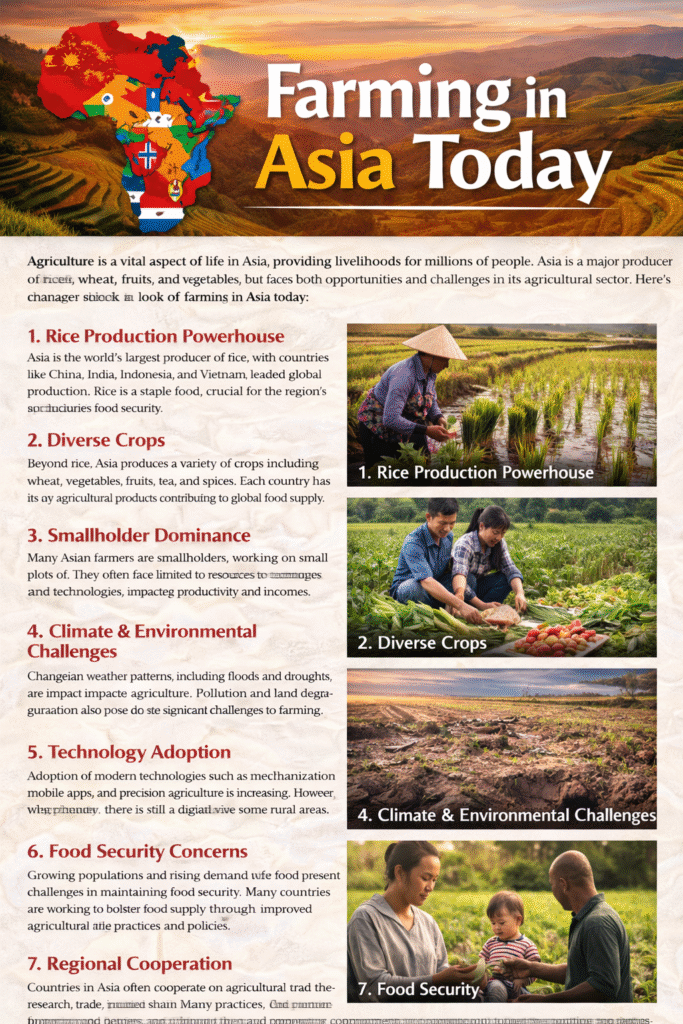
Farming has always been central to life in Asia, and it remains one of the most important economic activities across the continent today. Asia is home to the majority of the world’s farmers and produces a large share of global food supplies, including rice, wheat, vegetables, fruits, and livestock products. Although agriculture continues to support millions of livelihoods, farming in Asia is undergoing major changes due to population growth, technological advancement, climate change, and shifting economic priorities.
Importance of Agriculture in Asia
Agriculture plays a vital role in Asian economies, particularly in developing countries. It provides employment for a large portion of the population and ensures food security for both rural and urban communities. In many Asian nations, farming contributes significantly to national income and export earnings. Beyond economics, agriculture is deeply connected to culture, tradition, and rural life, shaping social structures and customs across generations.
Major Crops and Farming Systems
Asia produces a diverse range of agricultural products due to its varied climate zones. Rice is the most important staple crop, especially in East, Southeast, and South Asia. Wheat, maize, barley, and millet are also widely grown. Cash crops such as tea, coffee, rubber, sugarcane, cotton, spices, and palm oil are crucial for domestic use and international trade. Livestock farming, aquaculture, and fisheries play a significant role in food production, particularly in coastal and river regions.
Smallholder Farmers and Rural Communities
Most Asian farmers are smallholders who cultivate small plots of land using family labor. These farmers often rely on traditional farming methods and face challenges such as limited access to credit, modern technology, quality inputs, and reliable markets. Despite these constraints, smallholder farmers remain resilient and adaptable. Community cooperation, local knowledge, and diversified farming systems help them manage risks and sustain livelihoods.
Technological Change and Modernization
Technology is transforming farming in Asia. Mechanization, improved seeds, fertilizers, and irrigation systems have significantly increased productivity in many regions. Digital agriculture is also expanding, with mobile applications providing information on weather forecasts, pest control, market prices, and farming advice. Precision farming, greenhouse cultivation, and biotechnology are increasingly used to improve efficiency and reduce losses.
Climate Change and Environmental Challenges
Climate change presents a major threat to farming in Asia. Rising temperatures, irregular rainfall, droughts, floods, and soil degradation negatively affect crop yields and livestock health. Many Asian farmers depend on rain-fed agriculture, making them vulnerable to changing weather patterns. In response, climate-smart agriculture practices such as sustainable water management, crop diversification, agroforestry, and use of climate-resilient crop varieties are being promoted.
Government Policies and Agricultural Support
Governments across Asia actively support agriculture through policies and programs aimed at improving productivity and farmer welfare. These include subsidies for seeds, fertilizers, and irrigation, minimum support prices, rural infrastructure development, and agricultural research. Extension services help farmers adopt better farming practices, though uneven implementation remains a challenge in some regions.
Agribusiness and Commercial Farming
Agribusiness is growing rapidly in Asia, particularly in countries with large domestic markets and strong export sectors. Large-scale commercial farms and agribusiness companies invest in modern technology, processing facilities, and supply chains. While agribusiness contributes to economic growth and employment, it also raises concerns about land use, environmental sustainability, and the inclusion of small farmers.
Role of Women and Youth in Farming
Women play a crucial role in Asian agriculture, contributing significantly to planting, harvesting, processing, and marketing agricultural products. However, they often face unequal access to land ownership, education, credit, and technology. Youth participation in farming is also declining due to urban migration and changing aspirations. Encouraging agripreneurship, skills training, and innovation is essential to attract young people to agriculture.
Challenges Facing Asian Farming
Farming in Asia faces numerous challenges, including land fragmentation, water scarcity, declining soil fertility, pests and diseases, and post-harvest losses. Rapid urbanization and industrialization also reduce available farmland. Market volatility and rising input costs further pressure farmers’ incomes.
Future Prospects and Conclusion
Despite these challenges, the future of farming in Asia remains promising. Continued investment in technology, infrastructure, education, and sustainable practices can significantly improve productivity and resilience. By supporting smallholder farmers, empowering women and youth, and adapting to environmental challenges, Asian agriculture can continue to play a central role in feeding the growing population and driving economic development across the continent.