

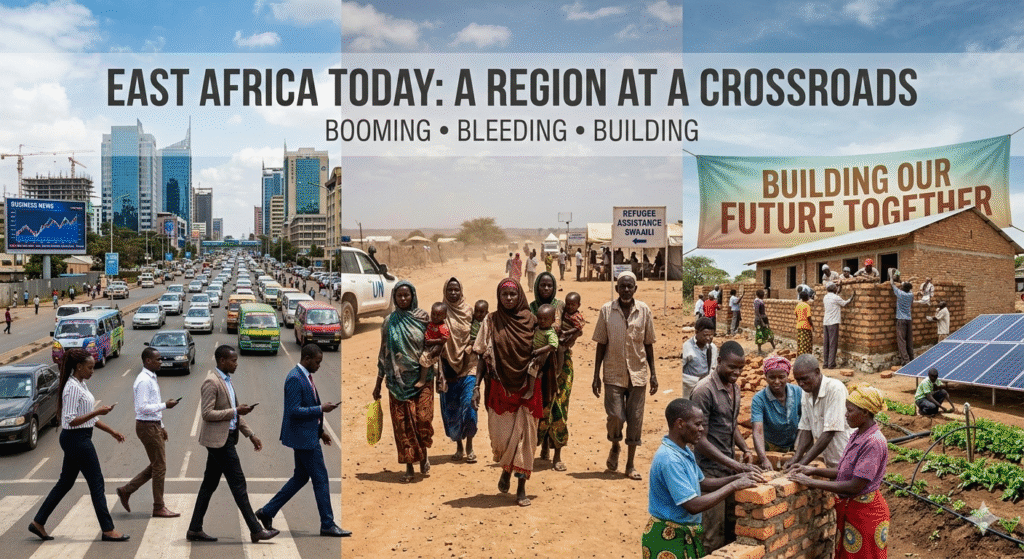
East Africa in 2026 is a land of stark and often brutal contrasts. It is the continent’s fastest-growing economic region, a beacon of hope for integration, and a hub for innovation. Yet, it is also a place where the ghosts of authoritarianism are resurfacing, where election violence has reached unprecedented levels, and where the dream of a borderless community is threatened by the very states that founded it. As the heads of state of the eight-nation East African Community (EAC) prepare to meet in Arusha on March 7, 2026, they do so presiding over a bloc that is simultaneously soaring economically and fraying politically .
This is East Africa today: a region undergoing what one columnist has aptly termed the “Great Sifting” —a brutal wake-up call that separates the champions from the liabilities .
The Economic Engine: Leading the Continent
Let’s start with the good news, because it is significant. According to the United Nations World Economic Situation and Prospects 2026 report, East Africa is projected to grow by an impressive 5.8% in 2026 . This outpaces every other sub-region on the continent, solidifying its position as Africa’s economic engine room.
This growth is largely driven by the region’s twin heavyweights: Ethiopia and Kenya . Ethiopia, despite its internal ethnic tensions and recent civil conflicts, is showing remarkable macroeconomic recovery. Kenya, meanwhile, continues to prove that its private sector is a “beast that refuses to be tamed by erratic policy,” with entrepreneurs innovating at breakneck speed in fintech, green energy, and the digital economy .
The UN report credits this acceleration to improved macroeconomic stability in major economies, supported by regional integration initiatives and the rapid expansion of renewable energy . The optimism, however, comes with a heavy asterisk. The region is still grappling with high debt-servicing costs (interest payments consuming nearly 15% of public revenue), persistent food inflation, and the slow, uneven implementation of the African Continental Free Trade Area (AfCFTA) . The growth is real, but for the average citizen facing high prices for basic goods, the “fruits of integration” can still feel like a distant promise.
The Summit of Ambition: The EAC’s 25th Ordinary Meeting
Against this economic backdrop, the EAC’s 25th Ordinary Summit in Arusha is more than just a diplomatic photo-op. Scheduled for March 7, 2026, under the theme “Deepening Integration for Improved Livelihoods of EAC Citizens,” the summit is expected to deliver two major tangible outcomes .
The first is the launch of the EAC Customs Bond. This is a classic example of boring, technical work that actually changes lives. Currently, a truck driver transporting goods from Mombasa to Kampala must secure multiple national bonds at each border crossing. The new single regional customs guarantee will replace this bureaucratic nightmare with one bond recognized across all eight partner states. The result? Lower compliance costs, faster movement of goods, and less opportunity for corruption .
The second major agenda item is the adoption of the 7th EAC Development Strategy (2026/27–2030/31) . This five-year plan sets the roadmap for accelerating integration and aligns the region’s goals with the broader aspirations of the African Union’s Agenda 2063 .
However, beneath the polished statements from Secretary General Veronica Nduva lies a financial headache. The EAC is currently owed over $89 million in arrears by its member states . The Democratic Republic of Congo leads the debtors’ list with $27 million owed, followed by Burundi and South Sudan. Kenya and Tanzania are the only countries that have fully paid their contributions . This funding gap raises serious questions about the bloc’s capacity to implement its ambitious new strategy. It is easy to dream big in a summit; it is much harder to pay the bills.
The Democratic Reckoning: Violence and the New Normal
If the economic story is one of cautious optimism, the political story is one of deep alarm. East Africa is currently experiencing a democratic regression that threatens to undo decades of progress.
The most shocking fall from grace has been Tanzania. Under President Samia Suluhu Hassan, the world had hoped for a gentle shift away from the repressive legacy of her predecessor, John Magufuli. The promise of “Mama Samia” was that she would lead Tanzania back to democratic respectability. That myth was shattered in the October 2025 elections.
What followed was the bloodiest electoral violence in Tanzania’s history. When protests erupted over alleged election manipulation, security forces responded with lethal force. Human Rights Watch and Amnesty International have documented horrific scenes. Media reports suggest that security forces killed hundreds, possibly up to 1,000 protesters . One verified photo showed 70 bodies piled up in a hospital morgue in the capital . The Tanzania we once knew as the region’s “steady hand” is gone. As one columnist put it, “the ferries to Zanzibar now carry more ghosts than tourists” .
The situation is hardly better in Uganda. The January 2026 elections saw the re-election of Yoweri Museveni, who is approaching 45 years in power. The poll was marred by the arrest of over 550 opposition members, the suspension of at least 10 human rights organizations, and yet another internet shutdown . The primary challenger, Robert Kyagulanyi (Bobi Wine), was effectively forced into hiding .
Most worryingly, a new phenomenon is taking hold: cross-border repression. East African states are now collaborating to silence critics across borders. In November 2024, veteran Ugandan opposition leader Kizza Besigye was abducted from Nairobi and arraigned before a military court in Kampala . In January 2025, a Tanzanian activist was snatched from a street in Kenya by men believed to be Tanzanian security officers. Kenyan activists who travelled to observe trials in Tanzania have been abducted, tortured, and dumped at border posts .
This is a chilling development. It suggests that the region’s autocrats are learning from each other and cooperating to create a “regional race to the bottom” on human rights .
The Champions and the Chain
In this sea of political uncertainty, two countries stand out as relative anchors: Kenya and Rwanda .
Kenya remains the indispensable nation. Its economy is the largest in the bloc, and its private sector is the region’s dynamo. Despite its own political theatrics and a debt-to-GDP ratio hovering around 70%, Kenyan entrepreneurs continue to innovate, particularly in fintech and the digital space . Yet, Kenya is not immune to the regional contagion. With elections due in 2027, there are worrying signs of pre-electoral repression. Activists and potential opposition candidates are facing harassment, and the reforms promised after the 2022 election remain largely unimplemented .
Rwanda, meanwhile, is playing the long game. While others squabble over land and cattle, Kigali is betting big on the “intangible economy.” It is positioning itself as the continent’s testbed for drone deliveries and AI-driven governance, boasting a projected growth rate of 7.5% .
And then there is the chain: the nations dragging the region down. The DRC remains a “potentially wealthy, but chronically ill giant” . Despite being the world’s battery, producing the cobalt that powers our phones and electric vehicles, it cannot keep the lights on at home. Its eastern provinces remain a playground for militias and foreign mercenaries.
South Sudan is facing another election cycle that promises to be more about which general gets the biggest slice of the oil pie than about democracy, with inflation having recently hit 179% . Somalia, the bloc’s newest member, is a coin toss: it could become the region’s maritime gateway or its most expensive security nightmare, especially given the spillover effects from the war in Yemen .
Conclusion: The Sifting Has Begun
East Africa today is not a single story; it is a collection of competing narratives playing out simultaneously. It is the story of a Kenyan fintech wizard building a billion-dollar app from a garage in Ngong Road. It is also the story of a Tanzanian teenager shot dead while protesting for her right to vote. It is the story of a Ugandan activist being tortured by security forces from three different countries for demanding free and fair elections.
The EAC leaders gathering in Arusha this week will launch bonds and strategies. They will talk about “shared prosperity” and “deepening integration.” But the real test is whether they can confront the uncomfortable truths in their own backyards.
The “East African Dream” has always been about more than just trade. It was supposed to be about shared values: democracy, human rights, and the rule of law. If Tanzania can kill its citizens with impunity, if Uganda can jail its opposition, and if Kenya can slide back into pre-electoral violence, then the economic integration they are building will rest on a foundation of sand.
The great reckoning is here. East Africa is booming, but it is also bleeding. The question for 2026 is whether the region’s leaders have the courage to stop the bleeding before it drowns the boom.