

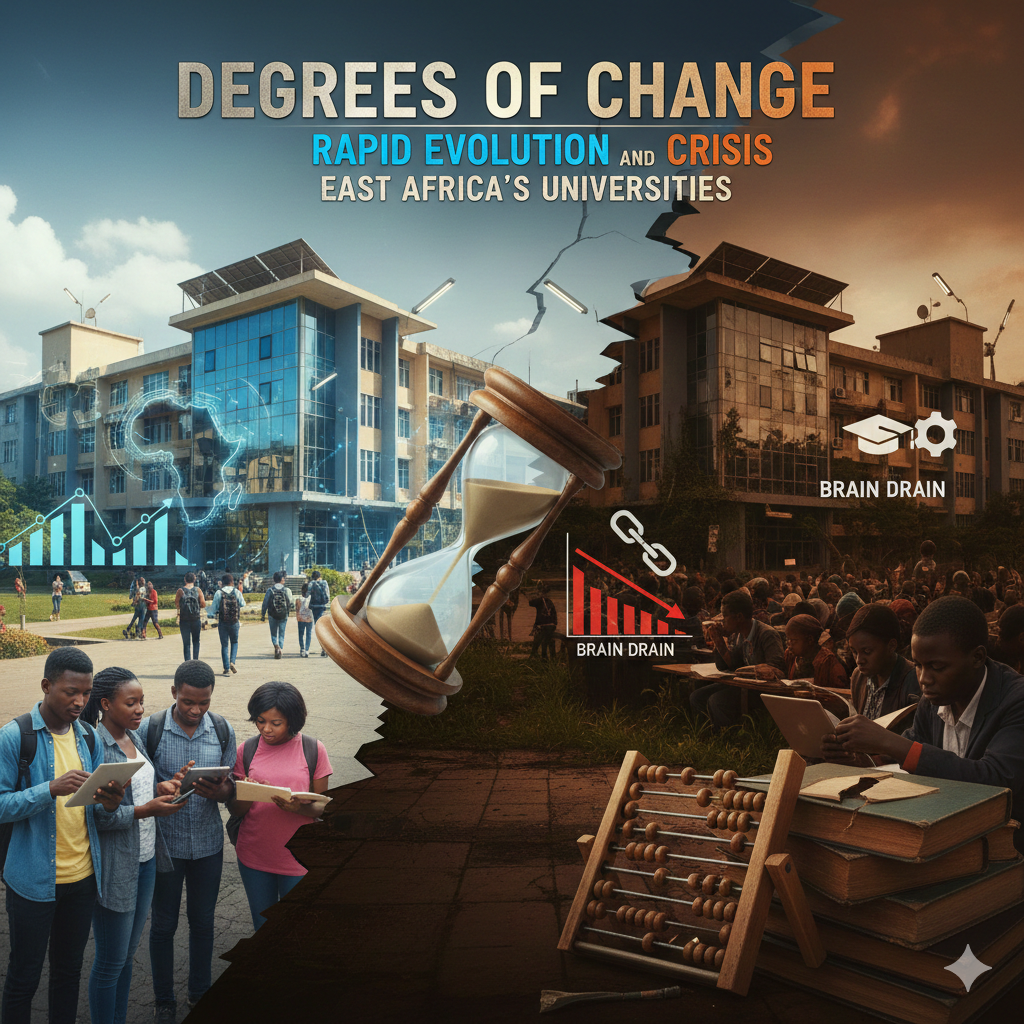
NAIROBI, KAMAPALA, DAR ES SALAAM – The university campus in East Africa today is a microcosm of the region’s most pressing contradictions and ambitions. On one hand, lecture halls are more crowded than ever before, with a generation of digitally-native students demanding relevance in a competitive global economy. On the other, these institutions are straining under the weight of explosive enrollment, chronic underfunding, and a persistent gap between the skills taught and the jobs available. The story of higher education in East Africa is one of unprecedented access colliding with a crisis of quality, where the promise of a degree as a ticket to the middle class is being tested like never before.
The Enrollment Explosion: Massification and Its Discontents
The most visible transformation is scale. Spurred by demographic growth, the UN’s Education for All agenda, and post-conflict rebuilding, university enrollment across Kenya, Uganda, Tanzania, Rwanda, and Ethiopia has skyrocketed. Kenya’s university student population, for instance, grew from under 100,000 in 2000 to over 500,000 today. This “massification” of higher education represents a historic democratization of opportunity, opening doors for first-generation students, women, and rural populations.
However, this expansion has far outstripped infrastructure and staffing. Public universities, which still educate the vast majority, are plagued by overcrowded lecture theatres, dilapidated dormitories, and overstretched laboratories. The once-sacred student-to-lecturer ratio has ballooned, with one professor often responsible for hundreds of students. The intimate tutorial system is a fading memory, replaced by impersonal mega-lectures. This factory-like model threatens the very essence of a university education: critical thinking, mentorship, and deep inquiry.
The Public-Private Dichotomy: A Two-Tiered System
A two-tiered system has emerged, mirroring societal inequalities.
- The Public University: Institutions like the University of Nairobi, Makerere University, and the University of Dar es Salaam remain prestigious flagships with storied histories as incubators of national leadership. Yet, they are caught in a vice. Government funding per student has plummeted, forcing them to rely heavily on parallel, fee-paying “Module II” programs to stay afloat. This internal privatization creates a chaotic blend of underfunded regular students and better-serviced parallel students on the same campus, breeding resentment and diluting academic standards as the core mission blurs with commercial survival.
- The Private University Boom: The funding gap has spawned a vast ecosystem of private universities, from reputable, well-endowed institutions like Strathmore University (Kenya) and Uganda Christian University to a proliferation of smaller, for-profit colleges of variable quality. These cater to students who missed public university slots or seek specialized, market-aligned programs. While they offer better facilities and smaller classes, their high fees cement higher education as a commodity, accessible primarily to the economic elite. Their focus is often narrowly vocational, potentially at the expense of the broader humanities and critical theory that underpin civic leadership.
The Relevance Rift: Education vs. Employability
This is the central tension defining East Africa’s universities today. Unemployment among graduates is persistently high, with employers consistently lamenting a “skills mismatch.” Critics argue that curricula are outdated, overly theoretical, and detached from the needs of a dynamic, informal economy and the Fourth Industrial Revolution.
In response, a powerful push for STEM (Science, Technology, Engineering, and Mathematics) is underway. Governments are prioritizing funding for technical programs, and students are flocking to courses in computer science, data analytics, and engineering, seen as tickets to employment. This shift is necessary but risky; it can marginalize the arts, social sciences, and humanities—the very disciplines that teach the critical analysis, ethical reasoning, and historical consciousness needed to navigate complex societies, combat authoritarianism, and foster innovation beyond mere technical skill.
Successful institutions are those forging industry linkages. Partnerships with tech firms for internships, curriculum co-design, and incubation hubs for student start-ups are becoming key differentiators. Universities like the African Leadership University (ALU), with a campus in Rwanda, are challenging the traditional model entirely, building their pedagogy around problem-solving, peer learning, and direct workplace preparation.
Regional Integration and Digital Disruption
Two external forces are reshaping the landscape:
- The East African Community (EAC) Common Higher Education Area: Efforts to harmonize accreditation, credit transfers, and qualifications are slowly gaining traction. This allows for student and faculty mobility, fosters healthy competition between institutions, and aims to create a regional labor market for graduates. A degree from Makerere or the University of Nairobi is increasingly seen as a regional, not just national, credential.
- The Digital Pivot: The COVID-19 pandemic was a forced experiment in online learning, exposing a stark digital divide. While it accelerated the adoption of Learning Management Systems (LMS) and digital resources, it also highlighted inequalities in device ownership, internet connectivity, and digital literacy. The future lies in blended learning—thoughtfully combining the irreplaceable value of on-campus community and practical labs with the flexibility and reach of high-quality online modules. This also opens the door to Massive Open Online Courses (MOOCs) from global universities, simultaneously a supplement and a threat to local institutions.
Governance, Autonomy, and the Political Sphere
University autonomy remains a contested space. Historically, East Africa’s universities have been hotbeds of political dissent and intellectual freedom. Today, many face increasing pressure from governments sensitive to criticism. Budgetary control is a powerful tool for influence. In some countries, the appointment of vice-chancellors is highly politicized, and campus protests are met with heavy-handed security responses. Maintaining the university as a space for open, rigorous, and sometimes uncomfortable debate is a constant struggle against political encroachment.
The Path Forward: Reimagining the African University
The sustainability and relevance of East Africa’s universities depend on a fundamental reimagining. Key priorities must include:
- Funding Innovation: Moving beyond sole reliance on strained state budgets and student fees. This requires cultivating philanthropy, building robust endowment funds, and monetizing research and consultancy services.
- Pedagogical Revolution: Shifting from rote memorization and lecture-based teaching to student-centered, interactive, and problem-based learning that cultivates critical thinkers, innovators, and entrepreneurs.
- Hyper-Local Relevance with Global Standards: Curricula must address East Africa’s specific challenges—climate change, public health, sustainable urbanization—while ensuring graduates can compete globally. Research must be incentivized to solve local problems, not just chase international publications.
- Embracing the Diaspora: Tapping into the vast network of East African academics abroad for guest lectures, joint research, and curriculum development through virtual exchange, reversing the brain drain into a “brain circulation.”
Conclusion: The Unfinished Project
The East African university is an unfinished project, caught between its colonial-era inheritance, its post-independence mission of nation-building, and the fierce demands of a globalized century. It is at once a beacon of hope for millions and a system under severe strain.
Its ultimate test will be whether it can produce graduates who are not merely job-seekers, but job-creators; not just technically proficient, but ethically grounded citizens capable of steering their societies through the complexities of the 21st century. The future of the region will be written, in large part, within the walls—and on the digital platforms—of its universities. They must evolve from degree factories into vibrant, resilient engines of knowledge, innovation, and transformative social progress. The lecture has begun; the region waits to see what its students will learn, and more importantly, what they will dare to build.