

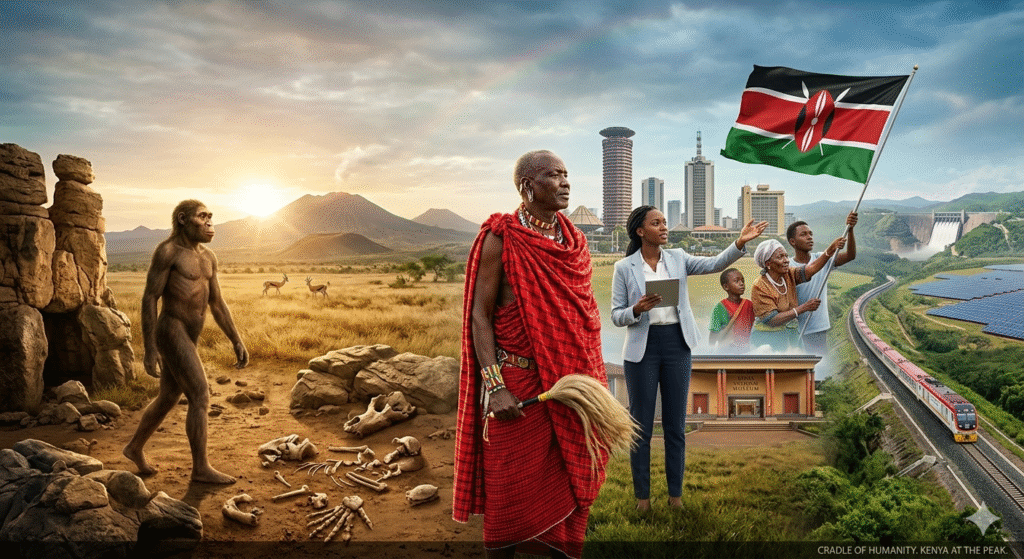
Kenya is a land of dramatic contrasts. It is a place where the modern skyline of Nairobi rises against the backdrop of a rift valley that witnessed the birth of humankind. The history of this East African nation is a epic narrative that stretches back millions of years, encompassing the dawn of humanity, the rise of cosmopolitan city-states, the brutality of colonialism, the euphoria of independence, and the complex struggles of building a modern nation-state. To understand Kenya today is to trace the footsteps of the peoples, powers, and ideas that have shaped it over millennia.
The Cradle of Humanity: Pre-Colonial Foundations
Long before it was a nation, the land that is now Kenya was a stage for the earliest chapters of human history. The Great Rift Valley, often called the “Cradle of Mankind,” has yielded some of the most significant paleoanthropological discoveries on Earth. Fossils found near Lake Turkana suggest that hominids like Australopithecus anamensis lived in the area as far back as 4.1 million years ago . Even more stunning were discoveries in the Tugen Hills dating to around 6 million years ago, which led to the naming of a potential early human ancestor, Orrorin tugenensis . These finds confirm that the Kenyan landscape has been home to our earliest ancestors for aeons.
Fast forward to more recent millennia, and we see the complex migration patterns that would create Kenya’s rich ethnic tapestry. Beginning around 2000 BC, Cushitic-speaking peoples from northern Africa migrated into the region . They were followed during the first millennium AD by two major groups: the Nilotic peoples, who moved into the western parts of the country, and the Bantu peoples, who migrated from the west and central Africa, settling in the fertile central highlands and coastal hinterlands . It was this Bantu group that would eventually comprise the majority of Kenya’s population.
While these interior communities developed sophisticated social and political systems, a unique civilization was flourishing on the coast. From around the 1st century AD, Arab traders, drawn by the monsoon winds, began frequenting the Kenyan coast . By the 8th century, this interaction had led to the establishment of permanent Arab and Persian settlements . Out of this fusion of African Bantu culture and Islamic influences, a new identity was born: Swahili. The Swahili language, a Bantu language with a rich infusion of Arabic loan words, developed as a lingua franca for trade, and city-states like Malindi and Mombasa became wealthy, cosmopolitan hubs connecting the African interior to the vast Indian Ocean trade network, which even connected them with traders from as far away as China during the Ming dynasty .
The Scramble for Africa: Colonial Penetration
This coastal cosmopolitanism was violently disrupted in 1498 with the arrival of the Portuguese explorer Vasco da Gama . The Portuguese sought to control the Indian Ocean trade and seized key ports, building the formidable Fort Jesus in Mombasa in 1593 to cement their rule. Their dominance, however, was not absolute. By the 1600s, they were pushed out by the more powerful Imam of Oman, who re-established Islamic control along the coast .
The most transformative colonial encounter, however, began in the 19th century with the British. The formal colonization of Kenya was set in motion not on African soil, but at the Berlin Conference of 1884-85, where European powers carved up the continent amongst themselves . Kenya was claimed by the British, who initially governed through the Imperial British East Africa Company. Facing financial difficulties, the company ceded control to the Crown, and in 1895, the British government established the East Africa Protectorate .
The key to unlocking and controlling the interior was the construction of the Uganda Railway, a monumental engineering feat that would forever change Kenya’s destiny. Begun in 1896 and completed in 1901, the “Lunatic Line” stretched 965 kilometers from Mombasa to Kisumu on Lake Victoria . Its construction was a saga of hardship, famously interrupted for months in 1898 by two man-eating lions in Tsavo that killed over 135 workers before they were shot . The railway not only opened the hinterland but also created new towns. Nairobi, founded in 1899 as a simple rail depot, grew so rapidly that it replaced Mombasa as the colonial capital in 1907 .
The railway’s completion had another profound consequence: it made the fertile and cool highlands accessible. The British government actively encouraged white settlement, offering land to European, mostly British, farmers. In 1902, the borders were adjusted, bringing these highlands firmly under the protectorate’s control . In 1920, the region’s status changed again; the interior was formally annexed as the Colony of Kenya, while a 16-kilometer coastal strip remained a protectorate under the nominal sovereignty of the Sultan of Zanzibar . This marked the beginning of the era that would create the deepest scars.
The colonial economy was built on a foundation of racial inequality. The best land, the “White Highlands,” was reserved for European settlers, while Africans were confined to “native reserves” and subjected to taxation that forced them to work as cheap labor on European farms . To build the railway, the British also brought in thousands of laborers from India. After its completion, many Indians stayed, becoming traders, artisans, and professionals, forming a crucial middle tier in the colonial racial hierarchy, sandwiched between the Europeans at the top and the Africans at the bottom .
The Birth of a Nation: Resistance, Revolt, and Uhuru
African resistance to colonial rule was constant. Early resistance came from leaders like Koitalel Arap Samoei of the Nandi, who fought the railway builders for a decade before being assassinated by the British in 1905 . Political organization grew in the 1920s with figures like Harry Thuku, who founded the Young Kikuyu Association to protest the loss of land and political rights . This movement eventually evolved into the Kenya African Union (KAU) , which by 1947 was led by a charismatic Kikuyu leader named Jomo Kenyatta .
The post-World War II period saw an intensification of these grievances, leading to the most significant challenge to British rule: the Mau Mau Uprising. From 1952 to 1960, Kenya was in a state of emergency . The Mau Mau, drawn primarily from the Kikuyu, Embu, and Meru communities, took an oath of unity and launched an armed struggle against the colonial state and the white settlers, whom they saw as the primary authors of their dispossession . The British response was brutal and draconian. They suspended civil liberties, carried out massacres of civilians, and implemented a massive “villagization” program, forcing hundreds of thousands of Kikuyu into concentration camps in an effort to isolate the insurgents . Kenyatta, though his exact role in the movement remains debated, was arrested and imprisoned in 1953 on false charges of directing the society .
The Mau Mau rebellion inflicted a heavy financial and moral cost on Britain . While the uprising was ultimately crushed militarily, with its field commander Dedan Kimathi captured and hanged in 1956, it succeeded in its political aims . It demonstrated unequivocally that the cost of maintaining the colony was too high. The British government realized that colonial rule was no longer sustainable and began a hurried retreat from empire. The state of emergency ended in 1959, and the first direct elections for Africans to the Legislative Council were held in 1957 .
The path to independence was negotiated at a series of conferences in London (Lancaster House) beginning in 1960 . Kenyatta was finally released from detention in 1961. In the May 1963 elections, his party, the Kenya African National Union (KANU) , emerged victorious . On June 1, 1963 , Kenyatta became Prime Minister of a self-governing Kenya, and on a humid December 12, 1963 , the British Union Jack was lowered and the new black, red, and green flag of Kenya was raised, marking the nation’s full independence . Uhuru—freedom—had finally been achieved.
The Republic and the One-Party State: The Kenyatta and Moi Eras
Just one year after independence, on December 12, 1964, Kenya became a republic, with Jomo Kenyatta as its first president . The early promise of independence, however, soon confronted the realities of power. The Kenya African Democratic Union (KADU), a party representing smaller tribes fearful of Kikuyu-Luo dominance, voluntarily dissolved and merged with KANU in 1964 . This spirit of unity was short-lived. In 1966, a ideological and ethnic rift led to the formation of a leftist opposition party, the Kenya People’s Union (KPU) , led by Jaramogi Oginga Odinga, a Luo elder and the country’s first vice president . The KPU was banned in 1969, and its leaders detained following the assassination of Tom Mboya, a popular Luo politician, which sparked ethnic unrest . From that point until 1991, Kenya functioned as a de facto one-party state under the iron grip of KANU.
When Jomo Kenyatta died in office in 1978, he was succeeded peacefully by his vice president, Daniel arap Moi, a member of the Kalenjin community . Moi consolidated his power ruthlessly, and in June 1982, he amended the constitution to make Kenya officially a de jure one-party state . His 24-year reign was characterized by the consolidation of authoritarian rule, a cult of personality around his person (Nyayo philosophy), and widespread corruption and human rights abuses . The economy stagnated, and political dissent was brutally suppressed.
The Second Liberation: The Return of Multi-Party Democracy
By the early 1990s, the winds of change were blowing again. The fall of the Berlin Wall and the subsequent pressure from Western donors forced Moi to capitulate. In December 1991, parliament repealed the one-party section of the constitution . The first multi-party elections in 1992 and again in 1997 were deeply flawed. The opposition was fragmented, and both elections were marred by politically instigated ethnic violence, particularly in the Rift Valley, orchestrated by Moi’s regime to intimidate opponents and prove that multi-partyism led to chaos . Despite these maneuvers, Moi and his KANU party managed to hold onto power in both elections.
Moi was constitutionally barred from running again in 2002. His attempt to hand-pick Uhuru Kenyatta, the son of Jomo Kenyatta, as his successor backfired spectacularly . The opposition united behind a single candidate, Mwai Kibaki, under the National Rainbow Coalition (NARC). Kibaki won in a landslide, ending KANU’s 40-year hold on power and ushering in a new era of hope .
A Troubled Democracy: The 2007 Crisis and the Path to Reform
Kibaki’s first term brought economic growth and expanded democratic space, but his second term was nearly catastrophic. The December 2007 presidential election was deeply flawed. When Kibaki was hastily declared the winner, the opposition, led by Raila Odinga, alleged massive fraud. The result was an explosion of pent-up ethnic grievances and political anger. For two months, Kenya descended into its worst violence since independence, leaving over 1,100 people dead and 650,000 displaced . The violence exposed the deep ethnic fissures in Kenyan society, rooted in unresolved historical injustices over land and political exclusion .
A breakthrough was achieved through mediation led by former UN chief Kofi Annan. The resulting National Accord created a Grand Coalition government, with Kibaki as President and Odinga as the new Prime Minister . The crisis also spurred a long-awaited constitutional reform process. In August 2010, Kenyans voted overwhelmingly in favor of a new constitution. This transformative document devolved power to 47 counties, created a robust system of checks and balances, and established a Bill of Rights to prevent the recurrence of the authoritarianism and electoral violence that had plagued the nation’s history .
Since the promulgation of the 2010 constitution, Kenya’s history has continued to be written. The ICC prosecuted some of those accused of orchestrating the 2007-08 violence, in a process that had mixed results but was significant for its attempt to end impunity . The country has held regular elections, though the 2017 election was annulled by the Supreme Court due to irregularities, a historic first in Africa, leading to a repeat election. The political landscape continues to evolve, with the “handshake” between long-time rivals Uhuru Kenyatta and Raila Odinga in 2018 demonstrating both the fragility and the resilience of Kenya’s political bargains.
From the shores of Turkana to the high-rises of Nairobi, Kenya’s journey has been one of profound transformation. It is a history marked by deep wounds and remarkable resilience. The nation that emerged from colonialism, survived authoritarianism, and weathered the storm of post-election violence continues its march, striving to live up to the promise of its founding Uhuru: to become a true, united, and prosperous nation for all its people.
