

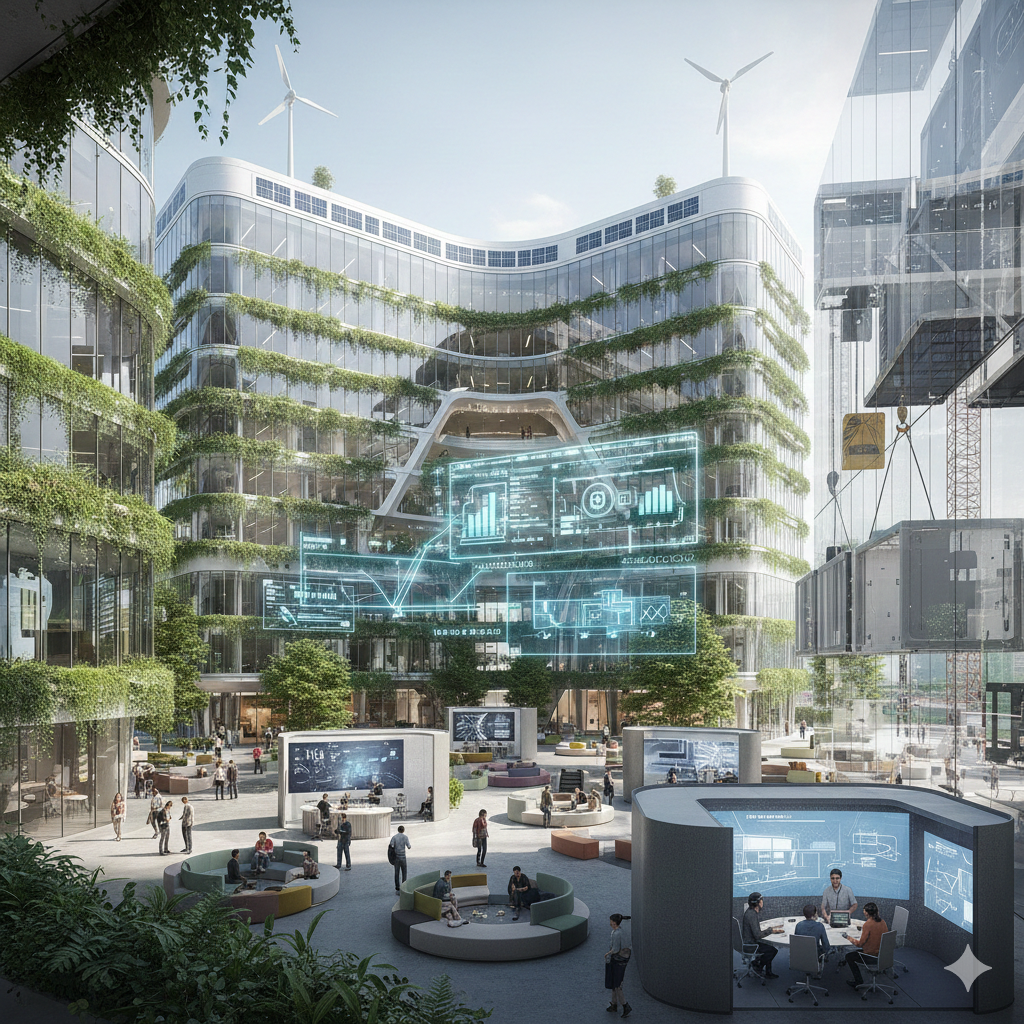
In 2025, the boundary between “business” and “architecture” has largely dissolved. We are seeing a shift where the physical structure of a building is no longer just a container for commerce, but a strategic lever for corporate performance, employee mental health, and environmental accountability.
Here is an overview of the state of business and architecture today.
- The ROI of “Human-Centric” Design
The most significant trend in 2025 is the shift from attendance-based metrics to outcome-based design. Organizations are moving away from measuring how many people are in the office and toward how the office facilitates “social capital” and innovation.
- Wellness as Wealth: Features like advanced air filtration, biophilic elements (living walls), and ergonomic “choice-based” workstations are now standard. A 2025 study shows that buildings with high-tier wellness certifications see a marked increase in employee retention.
- The Hybrid “Hub”: Rather than rows of desks, corporate architecture now prioritizes “collision zones”—cafés, open lounges, and adaptable workshops designed specifically to spark the serendipitous interactions that Zoom can’t replicate.
- AI: From “Tool” to “Thought Partner”
Artificial Intelligence has matured from a speculative novelty into the backbone of architectural business operations.
- Generative Design: Architects are using AI to run thousands of simulations on energy loads, light exposure, and material costs in seconds. This allows firms to present clients with “data-backed” designs that guarantee a specific energy performance.
- Operational Efficiency: Small and mid-sized firms are using AI to automate administrative tasks like “clash detection” (finding where pipes hit beams before they are built) and contract management, allowing them to compete with much larger legacy firms.
- The Rise of the “Digital Twin”: Businesses are increasingly commissioning a digital replica of their physical building. This “Digital Twin” uses IoT sensors to monitor energy use in real-time, allowing for predictive maintenance that can save companies up to 40% in operational costs.
- Sustainability as a Business Mandate
In 2025, “green building” is no longer a marketing buzzword; it is a regulatory and financial requirement.
Trend Business Impact
Net-Zero & Carbon-Positive Lowers long-term utility costs and satisfies ESG (Environmental, Social, and Governance) investor requirements.
Adaptive Reuse Converting old malls or warehouses into offices or housing is often faster and cheaper than new construction, while also reducing the “embodied carbon” of the project.
Modular Construction Prefabricated sections are built off-site, reducing construction waste and shortening project timelines by up to 50%. The New Architecture Business Model
The way architecture firms make money is also changing. Instead of the traditional “percentage of construction cost” model, many are moving toward:- Performance-Based Fees: Architects get bonuses if the building hits specific energy efficiency or employee satisfaction targets.
- Architecture-as-a-Service: Firms provide ongoing data analysis and building management services long after the ribbon-cutting ceremony.
