

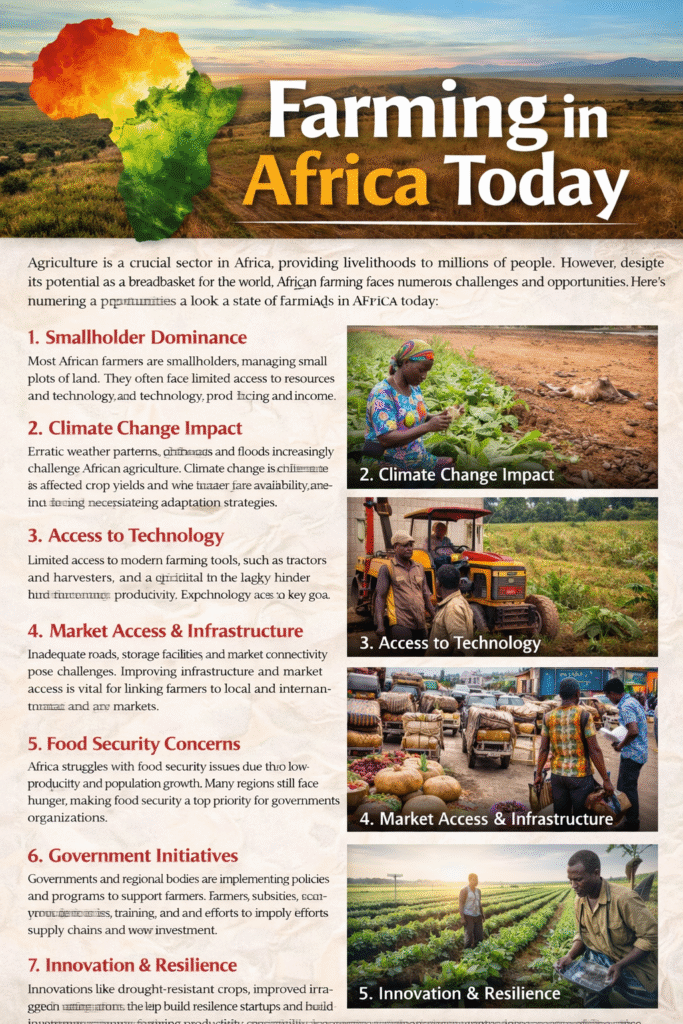
Farming plays a central role in Africa’s economy and society. It is the main source of livelihood for millions of people and a key contributor to food security, employment, and export earnings. Today, farming in Africa is undergoing important changes as farmers, governments, and organizations respond to population growth, climate change, technological progress, and global market demands. While challenges remain significant, agriculture continues to offer great potential for economic growth and sustainable development across the continent.
Importance of Agriculture in Africa
Agriculture is the backbone of many African economies. In several countries, it employs more than half of the population and contributes a large share of national income. Smallholder farmers dominate the sector, cultivating small plots of land mainly for subsistence, while also producing cash crops for local and international markets. Farming supports rural livelihoods, reduces poverty, and provides raw materials for agro-processing industries.
Major Crops and Farming Systems
Africa produces a wide variety of crops due to its diverse climates and ecosystems. Staple crops such as maize, rice, cassava, millet, and sorghum are grown across different regions to meet local food needs. Cash crops like cocoa, coffee, tea, cotton, sugarcane, and tobacco are important sources of foreign exchange. Livestock farming, including cattle, sheep, goats, and poultry, also plays a vital role, particularly in pastoral and semi-arid areas.
Smallholder Farming and Rural Life
Most African farmers are smallholders who rely on family labor and traditional farming methods. These farmers often face limited access to land, modern tools, quality seeds, fertilizers, credit, and markets. Despite these constraints, smallholder farming remains resilient and adaptive. Community cooperation, indigenous knowledge, and mixed farming systems help farmers manage risks and survive economic and environmental pressures.
Technology and Innovation in Farming
Technology is increasingly transforming farming in Africa. The use of improved seeds, irrigation systems, fertilizers, and mechanized tools is helping to increase productivity. Digital technology also plays a growing role, with mobile phones providing farmers access to weather forecasts, market prices, financial services, and agricultural advice. Innovations such as solar-powered irrigation, drought-resistant crops, and precision farming are gaining attention across the continent.
Climate Change and Environmental Challenges
Climate change is one of the greatest threats to farming in Africa today. Rising temperatures, unpredictable rainfall, droughts, floods, and soil degradation reduce crop yields and threaten food security. Many farmers depend on rain-fed agriculture, making them highly vulnerable to climate variability. In response, climate-smart agriculture practices such as conservation farming, agroforestry, water harvesting, and sustainable land management are being promoted to increase resilience.
Government Policies and Support
African governments recognize the importance of agriculture and have introduced policies to support farmers and improve productivity. These include subsidies for seeds and fertilizers, investment in rural infrastructure, extension services, and agricultural research. Regional and continental initiatives also aim to promote food security, improve value chains, and encourage trade in agricultural products. However, implementation challenges and limited funding often reduce the impact of these policies.
Agribusiness and Commercial Farming
Agribusiness and commercial farming are expanding in parts of Africa. Large-scale farms and agribusiness companies invest in modern production methods, processing facilities, and export-oriented agriculture. These developments create employment and improve market access but can also raise concerns about land rights, environmental sustainability, and inclusion of smallholder farmers. Balancing commercial growth with social equity remains a key issue.
Role of Women and Youth in Agriculture
Women play a crucial role in African farming, contributing significantly to food production, processing, and household nutrition. Despite their importance, women often face unequal access to land, credit, education, and technology. Youth involvement in agriculture is also essential for the future of farming. Programs promoting agripreneurship, training, and access to finance aim to make agriculture more attractive to younger generations.
Challenges Facing African Farming
Farming in Africa faces many challenges, including low productivity, poor infrastructure, limited access to finance, post-harvest losses, pests and diseases, and market instability. Conflict and political instability in some regions further disrupt agricultural activities. Addressing these challenges requires coordinated efforts from governments, private sector actors, development partners, and local communities.
Future Prospects and Conclusion
Despite the challenges, the future of farming in Africa holds great promise. With abundant land, a growing population, and increasing demand for food, agriculture has the potential to drive inclusive growth and development. Investment in technology, education, infrastructure, and sustainable practices will be critical. By empowering farmers, especially women and youth, and adapting to climate change, farming in Africa can become more productive, resilient, and sustainable in the years to come.
