

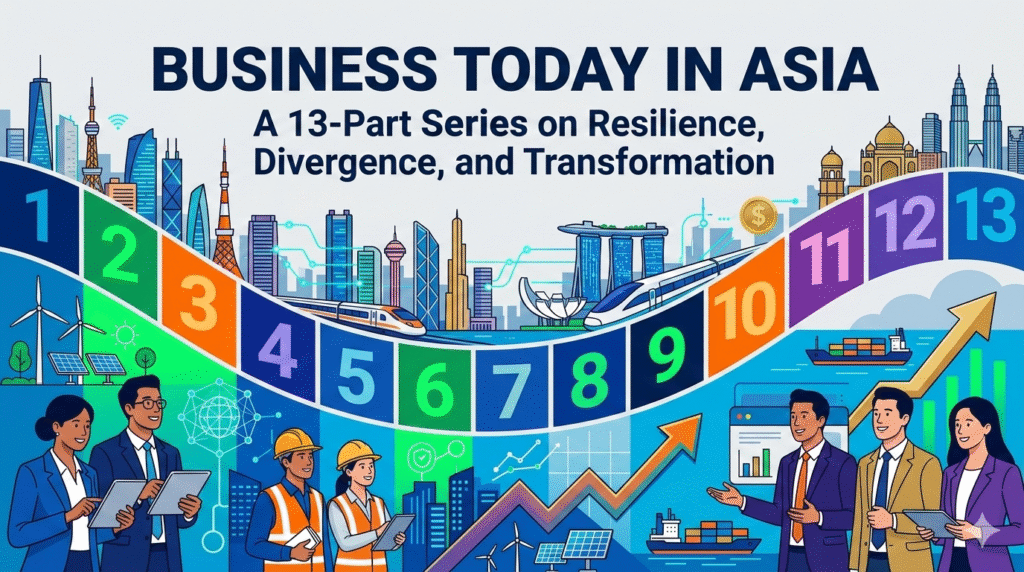
Introduction: The New Center of Gravity
Asia in 2026 is no longer just the world’s factory—it has become the world’s growth engine. The region now contributes approximately 60% of global GDP growth, expanding at around 4.5% annually despite persistent global headwinds . This transformation represents a fundamental reordering of the global economy: Asia is no longer simply producing goods for Western consumption but has emerged as an increasingly critical consumer and capital allocator within its own ecosystem .
Yet beneath this headline resilience lies a story of growing divergence. Economic prospects across Asia are increasingly uneven, shaped by differentiated policy paths, varying exposure to global technology cycles, and distinct demographic trajectories . As PIMCO’s 2026 outlook notes, the region presents “diverging policies, enduring opportunities”—a landscape where disciplined, selective positioning is essential .
This 13-part series explores the multifaceted reality of business in Asia today—from the AI-driven transformation of manufacturing to the evolution of regional trade corridors, from China’s managed slowdown to Japan’s historic policy shift, from Southeast Asia’s rising consumer markets to the Middle East’s deepening integration with Asian supply chains. Each installment examines a different dimension of Asia’s business landscape, drawing on the latest data, expert analysis, and on-the-ground reporting to paint a comprehensive picture of a region in profound transition.
Part 1: The Macro Picture — Resilience Amid Global Uncertainty
Asia’s economies enter 2026 with a defining characteristic: resilience. Despite ongoing trade tensions, monetary policy divergence, and geopolitical uncertainty, the region continues to outpace global growth averages. The Asian Development Bank projects Asia-Pacific developing economies to grow 4.6% in 2026, with variations across subregions reflecting different structural positions and policy responses .
Southeast Asia exemplifies this resilience. The UBS OneASEAN Summit, convening over 850 institutional investors in Singapore in March 2026, projected ASEAN-6 GDP growth of approximately 4.9% for the year. Grace Lim, Senior ASEAN and Asia Economist at UBS Investment Bank, attributes this momentum to the region’s “deep integration into global manufacturing value chains, supported by a sizeable domestic market” .
The drivers vary by country. Household consumption fuels momentum in Indonesia. Private investment is accelerating in Thailand and the Philippines. Resilient tech-related exports strengthen Singapore and Malaysia . This diversity of growth drivers insulates the region from sector-specific shocks—a structural advantage that has become increasingly valuable in an uncertain global environment.
Inflation has broadly moderated across Asia, creating space for differentiated monetary policy responses. The Asian Development Bank forecasts regional inflation of 2.1% for 2026, slightly above 2025 levels but well within central bank comfort zones . This stability reflects several factors: stable energy and food prices, relatively strong Asian currencies, and in some cases, persistent disinflationary pressures from China’s excess industrial capacity .
The policy landscape, however, is increasingly fragmented. As Nomura Research notes, “2026年亚洲各大央行的货币政策可能并不一致”—Asia’s central banks are pursuing diverging paths . Korea and Malaysia have effectively ended their easing cycles; Malaysia may even hike rates in late 2026 due to financial stability concerns. Philippines and Indonesia, with inflation comfortably within target ranges, retain scope for further cuts. Thailand faces potential deflation risks, while Singapore contends with stickier inflation .
This policy divergence creates complexity for businesses operating across the region—but also opportunity for those equipped to navigate differentiated national contexts.
Part 2: The AI Revolution — Driving Asia’s Tech-Led Transformation
Artificial intelligence has emerged as the defining force in Asia’s business landscape. The AI boom that gathered momentum through 2025 shows no signs of abating entering 2026. According to Nomura research, Asia’s technology giants are projected to increase AI capital expenditure by 15% in 2026, reaching $139 billion .
This investment surge reflects Asia’s unique position in the global AI value chain. The region serves as the world’s primary AI hardware manufacturing hub. Benefits flow主要通过出口—primarily through exports—followed by investment, while consumption-driven gains remain relatively limited. This contrasts sharply with the United States, where investment is the primary channel of AI-related economic benefit .
The semiconductor sector tells the story vividly. Driven by sustained demand from major US cloud service providers—whose capital expenditures are projected to grow 40-60% year-on-year in 2026—Asian chipmakers are operating at full capacity. Nomura analysts project DRAM and NAND flash memory prices to increase 44% and 61% respectively in 2026, delivering significant trade gains for Korea and other major semiconductor producers .
Exposure to the AI supply chain varies dramatically across Asian economies. The Philippines leads with 45% of its exports classified as AI-related, followed closely by Singapore at 41.1% and Malaysia at 38.8%. Korea, China, Japan, and Thailand occupy a middle tier with AI-related export shares between 16.9% and 28.3%. India and Indonesia trail substantially, with less than 4% exposure—a reminder that the AI boom’s benefits are far from evenly distributed .
Beyond semiconductors, the AI revolution is reshaping multiple sectors. Data center capacity across Asia-Pacific is projected to grow from 12.6 GW in early 2025 to 26.1 GW by 2028, with China, Japan, Malaysia, and India leading the expansion . This infrastructure build-out creates cascading demand for construction, cooling systems, power management, and network equipment.
The World Trade Organization projects AI could boost global trade by 34-37% by 2040 . For Asia, positioned at the center of AI hardware production, this represents an extraordinary opportunity—but also a concentration risk. As the International Monetary Fund has cautioned, current AI investment enthusiasm echoes the dot-com bubble era; if technological returns disappoint, market corrections could be severe .
Part 3: Manufacturing Realignment — The Asia Manufacturing Index 2026
Asia’s manufacturing landscape is undergoing its most significant restructuring in decades. The Asia Manufacturing Index 2026, released by Dezan Shira & Associates, reveals intensifying competition as economies vie for manufacturing leadership amid ongoing supply chain rebalancing .
China retains the top position for the third consecutive year, supported by “unmatched industrial scale, deeply integrated supply chains, and technological depth.” Despite diversification narratives, China’s manufacturing ecosystem continues to set the regional benchmark for production depth and efficiency .
The most notable shift: Malaysia has climbed to second place, overtaking Vietnam. This reflects Malaysia’s growing competitiveness across multiple weighted parameters—skilled workforce, infrastructure quality, and advanced manufacturing capabilities—rather than any weakening in Vietnam’s underlying fundamentals, which remain strong .
Singapore advances to fourth place, reinforcing its role in high-value and advanced manufacturing. Thailand records significant improvement, moving from 10th to eighth. Japan, South Korea, and the Philippines experience incremental ranking changes reflecting stable but increasingly competitive positions. India and Indonesia remain sixth and seventh respectively, while Bangladesh continues at 11th .
The index underscores a fundamental reality: there is no single “best” manufacturing destination. Optimal location decisions depend on sector-specific requirements, supply chain structure, regulatory environment, cost sensitivity, and risk tolerance. Even small adjustments to factors like labor costs, logistics performance, energy reliability, or water pricing can significantly alter rankings for specific manufacturing strategies .
The index also reveals the growing importance of “China+1” strategies—but with an evolved rationale. Matthew Moodey of Deutsche Bank observes that many corporations are “no longer just optimizing for cost, but for resilience and sustainability” . As China moves into higher-value manufacturing, production activity is increasingly dispersing into frontier and emerging markets. “New flows into Bangladesh, Sri Lanka, parts of Africa, and South Asia are key examples of how supply chains are adapting” .
The result is a more diffuse and circular trade network across the Global South, with intra-Asian and South-South flows expanding faster than trans-Pacific routes. According to UNCTAD data, China’s exports to the US declined nearly 10% in early 2025, while trade with ASEAN, Africa, and Central Asia grew over 7% .
Part 4: China’s Managed Transition — Growth, Rebalancing, and Structural Challenges
China’s economy in 2026 presents a study in managed transition. Growth is moderating toward 4-4.5%—a slowdown by historical standards, but still contributing substantially to global expansion. ING forecasts 4.6% growth; Deloitte projects 4.5%; Morgan Stanley’s range is 4.1-4.6% . The IMF projects 4.5%, reflecting ongoing property-sector adjustment and rebalancing away from investment-led growth .
The “15th Five-Year Plan” (2026-2030) emphasizes productivity enhancement, technology development, and strategic infrastructure . These priorities should help China continue expanding global export share and climbing value chains. Yet domestic demand recovery remains uneven. Retail momentum softened as last year’s “trade-in” programs faded. Infrastructure activity has slowed, and ongoing property sector restructuring constrains investment .
Real estate remains the dominant drag on confidence. Persistent weakness in the property sector drives precautionary savings, limiting consumption growth. Policymakers are responding with expanded support for consumption, social welfare, strategic infrastructure, and property markets. Fiscal deficits are likely to widen. The People’s Bank continues accommodative monetary policy, with room for further rate cuts and ample liquidity provision .
Deflationary pressures present a unique challenge. China’s low export prices help contain inflation across Asia but also pressure trade balances and corporate profits in other markets. The government’s “anti-involution” policies aim to curb excessive price competition and overcapacity, partially addressing imbalances .
For investors, China’s bond market offers near-term appeal in a low-inflation, accommodative policy environment—particularly long-dated government bonds. The current account remains strong, and capital回流 should support modest renminbi appreciation against the dollar and major trading partners .
However, as PIMCO notes, “China’s slower growth reshapes regional credit dynamics” . Banks in Hong Kong and Singapore face not uniform slowdown but selective financing demand, with capital-market activity and cross-border flows increasingly sensitive to policy signals and confidence rather than headline growth alone.
Part 5: Japan’s Historic Shift — Leaving Negative Rates Behind
Japan’s economy in 2026 operates under fundamentally different monetary conditions. After decades of zero and negative interest rates, the Bank of Japan has embarked on a historic normalization. The 10-year Japanese government bond yield recently exceeded 2%—levels unseen in nearly 30 years—bringing valuations closer to Japan’s evolving macroeconomic fundamentals .
Nomura projects Japan’s growth conditions to improve in 2026, with core inflation remaining above 2%. This could prompt the Bank of Japan to consider a 25 basis point rate hike, bringing the policy rate to 1.0% . Morgan Stanley shares this view, noting that food inflation—particularly rice prices—drove 2025’s inflation pickup but showed signs of peaking late in the year. Reduced gasoline taxes and restored electricity/gas subsidies should further ease energy inflation .
The new government of Prime Minister Sanae Takaichi has introduced more expansionary fiscal policies, adding uncertainty to the outlook. However, PIMCO expects financial market pressures will ultimately limit excessive fiscal expansion .
For investors, Japan’s yield levels now present attractive opportunities. PIMCO notes it can construct yen-denominated portfolios with potential returns exceeding 3% while maintaining duration and credit quality similar to Japanese bond benchmarks. Even with inflation near 2%, such portfolios should prove increasingly attractive to domestic investors .
Hedging costs currently favor global investors, making Japanese bonds more attractive relative to global comparators. PIMCO remains constructive on long-dated bonds (30-year JGBs), supported by steep yield curve structure and Ministry of Finance incentives to limit long-end issuance .
Yet geopolitical tensions have added new risk dimensions. In November 2025, Prime Minister Takaichi triggered an escalating dispute with China after remarks suggesting a hypothetical Chinese attack on Taiwan could draw a Japanese military response—breaking with strategic ambiguity long maintained by Japanese leaders. China responded with unusually explicit warnings about intervention, underlining how quickly political signaling can raise risk premiums across trade, investment, and currency markets .
Part 6: ASEAN’s Growth Story — Diverging Paths, Shared Momentum
Southeast Asia’s 2026 growth story is one of shared momentum but diverging drivers. The ASEAN-6 is projected to grow approximately 4.9%, reflecting steady expansion across the region’s major economies .
Indonesia, the region’s largest economy, continues to benefit from robust household consumption. Domestic demand remains the primary growth engine, supported by stable inflation and improving consumer confidence. Policy continuity following the 2024 election has reinforced investor confidence.
Thailand is witnessing an increase in private investment after prolonged political uncertainty. The new government’s focus on infrastructure development and investment facilitation is beginning to yield results, though structural challenges remain. Tourism continues its recovery, supporting services sector growth .
The Philippines combines strong domestic demand with improving investment dynamics. The administration’s infrastructure program (“Build Better More”) sustains construction activity, while remittances from overseas workers support household consumption. Private investment is showing encouraging momentum .
Singapore and Malaysia exemplify the tech-driven growth story. Both economies benefit from resilient tech-related exports, deeply integrated into global semiconductor and electronics supply chains. Singapore’s full-year 2025 growth reached 4.8%, with fourth-quarter growth at 5.7% year-on-year—supported by electronics and biomedical manufacturing as AI-related semiconductor and server exports surged .
Singapore’s export structure reveals its positioning: 41.1% of exports are AI-related, reflecting participation in high-precision component assembly and the city-state’s role as a regional data center and high-value services hub . Malaysia follows closely with 38.8% AI-related exports, having attracted substantial investment in large-scale data centers, back-end assembly, testing, packaging, and AI server assembly .
Vietnam, despite slipping to third in manufacturing rankings, maintains strong fundamentals. Its AI exposure sits at a moderate level—not as deep as Malaysia or Singapore, but sufficient to benefit from ongoing supply chain diversification .
The region’s diversity—in growth drivers, policy frameworks, and sector specialization—creates both complexity and opportunity for businesses operating across ASEAN. As UBS notes, Southeast Asia “continues to be a strategic alternative for investors,” with strong deal-making momentum expected throughout 2026, particularly in healthcare, real estate, and consumer sectors .
Part 7: South Asia’s Potential — India’s Steady Ascent
India occupies a distinctive position in Asia’s 2026 business landscape. As a primarily domestic demand-driven economy, it is less exposed to global trade fluctuations than export-oriented East Asian peers—a structural buffer that has proven valuable amid global uncertainty.
The Asian Development Bank maintains India’s 2026 growth forecast at 6.5% . This steady expansion reflects sustained domestic consumption, improving investment climate, and gradual structural reforms. The IMF projects India’s growth to remain robust, though credit growth has moderated, reflecting the need for enhanced public investment and structural reforms .
India’s limited integration into global AI supply chains—less than 4% AI-related exports—means it captures relatively little direct benefit from the current tech investment boom . However, this limited exposure also insulates India from sector-specific downturns. The economy’s primary drivers remain domestic: consumption, infrastructure investment, and services exports.
Monetary policy is turning accommodative. The Reserve Bank of India previously downgraded its 2026 fiscal year inflation forecast from 3.1% to 2.6%, creating space for rate reductions if growth softens .
Challenges persist. Credit growth has moderated, reflecting both tighter financial conditions and structural constraints in the banking system. Private investment, while improving, remains below the levels needed to sustain 7-8% growth. The government’s continued focus on infrastructure spending provides partial compensation but cannot fully substitute for private capital formation.
For investors, India offers exposure to domestic consumption growth in the world’s most populous nation—a demographic dividend that will shape global consumption patterns for decades. The key question is whether structural reforms can accelerate formalization, improve ease of doing business, and unlock India’s full productive potential.
Part 8: Trade Transformation — From Export Hub to Growth Anchor
Asia’s trade landscape has fundamentally transformed. The traditional model—Western capital financing Asian low-cost production for Western consumption—has given way to a more complex reality. As Deutsche Bank’s Matthew Moodey observes, “Around 50% of trade finance flows within Asia now remain within Asia. Asia was sending its goods out—now it has become the destination” .
This shift reflects both macroeconomic evolution and structural change. Production, investment, and consumption patterns have become more regionally integrated. Asia’s economies—particularly India, Indonesia, and Vietnam—benefit from sustained domestic investment and stable consumption growth .
Supply chain diversification has evolved from simple “China+1” risk mitigation into broader production network transformation. As Moodey notes, “Many corporations are no longer just optimizing for cost, but for resilience and sustainability” .
New flows are emerging into frontier markets. Bangladesh, Sri Lanka, and parts of South Asia are capturing investment in last-mile production and component assembly as firms balance resilience, regulatory risk, and market proximity . This geographical diversification creates new complexities for financial institutions, as frontier markets often lack established credit frameworks and consistent regulatory processes.
The Middle East has emerged as a pivotal region in this evolving landscape. China’s Belt and Road Initiative recorded $124 billion in new contracts during first-half 2025, with Middle Eastern engagement reaching $19.4 billion—focusing on digital infrastructure and energy transition . Deutsche Bank’s integration of Asia-Pacific and Middle East operations reflects recognition that “increased interconnectivity” between these regions is creating new value chains linking Asian manufacturing strength with Gulf capital and energy ecosystems .
The results are visible in trade data. China’s exports to the US declined nearly 10% in early 2025, while trade with ASEAN, Africa, and Central Asia grew over 7%. The outcome is a more diffuse, circular trade network across the Global South, with intra-Asian and South-South flows expanding faster than traditional trans-Pacific routes .
Part 9: Fintech’s Maturation — From Experimentation to Scale
Asia’s fintech ecosystem has reached an inflection point. According to the Money20/20 Asia “Future of Fintech in APAC” report, the region is shifting “from experimentation to production-grade innovation across AI, digital payments, and assets” .
Based on insights from over 130 senior fintech leaders, the report reveals an industry moving beyond pilot programs toward enterprise-scale solutions. Key findings underscore the sector’s maturation: 22.9% of respondents identify Asia-Pacific as their primary growth target; 90.6% say social good initiatives are now embedded in corporate strategy—confirming impact has become commercial imperative; and 61.2% have already adopted AI or machine learning .
Digital trust has emerged as the new currency. With digital adoption accelerating, 63.5% of leaders cite fraud prevention as their highest operational priority. Justin Lie, founder of SHIELD, observes: “The speed of digital adoption in APAC has outpaced traditional fraud models. What we’re seeing now is a shift toward real-time, device-level intelligence that operates silently in the background. Trust is the new currency of digital finance” .
Stablecoins are moving into mainstream financial infrastructure. New regulatory frameworks in Singapore, Hong Kong, and Japan are driving institutional adoption of stablecoins and tokenized assets. Circle’s Yam Ki Chan notes: “Across Asia, stablecoins are already embedded in real economic activity—from payments and cross-border settlements to treasury optimization. The region is demonstrating how digital assets can scale within financial systems” .
Digital lending is expanding financial access. 72.9% of respondents believe SME-tailored fintech solutions are key to APAC’s economic growth. Tala Philippines’ Moritz Gastl emphasizes: “Financial inclusion isn’t achieved by simply putting products online—it requires building for the realities of everyday consumers. In markets like the Philippines, trust, transparency, and flexibility matter just as much as credit scoring” .
As AI scales, payment rails interconnect, and digital assets enter regulated markets, Asia-Pacific is emerging as a global blueprint for future financial systems. The Money20/20 report concludes that “APAC markets are proving that financial innovation and inclusion can advance together” .
Part 10: Banking and Finance — Navigating Divergence
Asia-Pacific’s banking systems enter 2026 with growth prospects exceeding those of Europe—but increasingly uneven across jurisdictions. The IMF projects advanced Asian economies to grow faster than the advanced-economy average of around 1.6%, but well below pre-pandemic trends .
Japan’s constrained 0.7% growth limits domestic credit demand. Banks face sluggish loan growth and continued margin pressure, with credit needs concentrated among large corporates and overseas activities rather than domestic households .
Korea (1.9% projected growth), Singapore (2.4%), and Australia (2.1%) present stronger but moderating profiles. For banks, this supports selective credit expansion in trade finance, services, and infrastructure, rather than broad-based household lending .
China’s moderation reshapes regional credit dynamics. Banks in Hong Kong and Singapore are indirectly exposed through reduced deal flow, capital market issuance, and cross-border financing volumes. The implication is not uniform slowdown but selective financing demand, with capital-market activity increasingly sensitive to policy signals and confidence .
Financial stability risks are shaped less by balance-sheet weakness than by market integration, capital-flow volatility, and geopolitical exposure. The IMF emphasizes that banking systems across Asia-Pacific are deeply integrated into global capital markets. Stability depends not only on domestic growth but on exposure to global financial conditions, currency movements, and market confidence .
Sovereign bond markets play critical roles in collateral frameworks and liquidity buffers. Market functioning, rather than sovereign solvency, is therefore a key determinant of stability. Differences in fiscal capacity across jurisdictions translate into materially different funding conditions, stress scenarios, and liquidity assumptions .
Non-bank financial institutions play growing roles, especially in asset management and private credit. Banks remain interconnected with these entities through funding, derivatives, custody, and settlement services—creating channels for potential stress transmission .
Part 11: Energy Security — The LNG Challenge and Coal’s Comeback
Energy security has emerged as a critical business risk in 2026. Middle East geopolitical conflicts have disrupted Asian LNG supply chains, forcing difficult tradeoffs between decarbonization commitments and grid stability.
Morgan Stanley analysis reveals Asia depends on Middle Eastern LNG imports for approximately 20% of electricity supply. Recent Iranian conflict has created supply disruption risks directly impacting data centers and grid stability .
India and Thailand face the most acute exposure due to heavy reliance on spot LNG markets. By contrast, Malaysia and Indonesia’s utilities benefit from more diversified fuel mixes, limiting impact .
The response has been a controversial pivot: coal is making a comeback. Morgan Stanley analysts note that South Asia retains dispatchable coal-fired capacity, with multiple new plants completed in recent years providing operational flexibility. If LNG prices remain elevated, efficient operators could see expanded profit margins in wholesale power markets—particularly in Philippines and Singapore .
This dynamic reflects immediate tradeoffs between energy security and climate transition. In the short term, coal plants serve as “transition solutions” for grid stability. But experts emphasize accelerating renewable energy development as the only sustainable path to reducing fossil fuel dependence .
The energy challenge intersects with Asia’s AI-driven data center boom. Data center capacity across Asia-Pacific is projected to more than double by 2028, creating enormous new electricity demand. Meeting this load while maintaining climate commitments will require unprecedented investment in renewable generation, grid infrastructure, and energy storage.
For businesses across Asia, energy costs and reliability have become strategic variables. Countries with diversified fuel mixes, robust grid infrastructure, and favorable renewable resources gain competitive advantage. Those dependent on imported LNG face structural cost disadvantages—and difficult policy choices between affordability, stability, and sustainability.
Part 12: Processing and Packaging — Feeding Asia’s Consumers
Asia’s processing and packaging industry is experiencing sustained growth, driven by rising food and beverage demand and expanding manufacturing activity. Informa Markets reports continued expansion in 2026, with Thailand—ranked 12th globally in food exports in 2023—exemplifying the sector’s strength .
Across Asian markets, demand for processed food and modern packaging solutions continues growing. Sanchai Noombunnam, Informa Markets Thailand Country General Manager, notes that manufacturers are increasingly seeking advanced technologies to improve production efficiency, enhance product safety, and extend shelf life—responding to changing consumer expectations and evolving regulatory requirements .
Technology investment is accelerating. As global supply chains evolve, manufacturers are investing in automation, digitalization, sustainability, and intelligent production systems. Rising production costs, regulatory pressures, and increasing demand for traceability and environmentally responsible packaging are reshaping industrial strategies across ASEAN and beyond .
ProPak Asia 2026, scheduled for June in Bangkok, reflects this momentum. The exhibition will showcase over 18,000 technologies across nine specialized zones, with more than 2,500 exhibiting brands from 45 countries. Participation includes 15 international pavilions from 14 countries and regions—Australia, Bavaria, China, France, Italy, Japan, Malaysia, North America, Singapore, South Korea, Switzerland, Taiwan, Spain, and the UK .
Featured technologies span AI-powered automation, robotics, smart factory systems, IoT-enabled production monitoring, advanced processing equipment, cold chain innovations, and sustainable packaging materials and design. The event is expected to attract over 90,000 attendees, including 15,000 international participants, with 95% of exhibition space already sold .
The processing and packaging industry’s growth reflects broader trends: Asia’s rising consumer class demanding higher-quality, safer, and more convenient food products; manufacturers responding with technology investment; and the region positioning itself at the center of global food value chains.
Part 13: The Road Ahead — Navigating Divergence, Seizing Opportunity
As this 13-part series has documented, business in Asia today is defined by productive tension between integration and divergence. The region is simultaneously more connected than ever—with intra-Asian trade now accounting for half of trade finance flows—and more differentiated, as policy paths, growth drivers, and sector exposures diverge across economies .
The common thread is transformation. Asia’s business landscape is being reshaped by powerful forces: the AI revolution driving semiconductor investment and data center construction; supply chain realignment creating new production hubs in frontier markets; financial integration linking Asian manufacturing with Middle Eastern capital; energy security concerns forcing difficult tradeoffs; and consumer markets expanding as incomes rise.
The challenges are real. Geopolitical tensions—from US-China strategic competition to Japan-China disputes over Taiwan—introduce uncertainty that affects trade corridors, investment flows, and currency markets . Energy security risks expose vulnerabilities in LNG-dependent economies . China’s property adjustment and deflationary pressures ripple through regional supply chains . Monetary policy divergence creates complexity for cross-border businesses .
Yet the opportunities are equally substantial. Asia contributes 60% of global GDP growth . The AI boom is driving $139 billion in technology investment . ASEAN economies are growing nearly 5% with diversified drivers . India’s 6.5% growth offers domestic demand exposure in the world’s most populous nation . Frontier markets from Bangladesh to Sri Lanka are capturing new investment as supply chains diversify .
The path forward requires disciplined, selective positioning:
- Manufacturing location decisions must align with sector-specific requirements, not generic rankings. Malaysia’s rise reflects competitiveness in advanced manufacturing; Vietnam remains strong for labor-intensive production; Singapore leads in high-value activities .
- AI exposure varies dramatically across economies. Understanding where your business fits in the AI value chain—hardware manufacturing, data center services, or end-user applications—determines opportunity .
- Policy divergence demands nuanced country strategies. Monetary conditions, fiscal trajectories, and regulatory frameworks increasingly differ across Asia—one size fits none .
- Energy strategy has become a competitive variable. LNG dependence, renewable resources, and grid infrastructure affect cost structures and reliability .
- Trade corridors are evolving. Asia-Middle East links are deepening; intra-Asian flows now dominate; trans-Pacific routes are relatively less central. Supply chain strategy must reflect this new geography .
The businesses that thrive in 2026 Asia will be those that embrace complexity rather than seeking simplicity—that recognize both the region’s remarkable dynamism and its growing differentiation. As PIMCO concludes, investors “focused on high-quality spreads and relative value, actively exploiting cross-regional differences, will be better positioned to capture opportunities in an era of divergence” .
Asia is no longer just the world’s factory or its fastest-growing region. It has become the world’s new center of economic gravity—complex, diverse, and indispensable. Understanding its contradictions is the first step toward seizing its opportunities.
