

Business in East Africa Today
Part 1: Introduction – A Region on the Rise
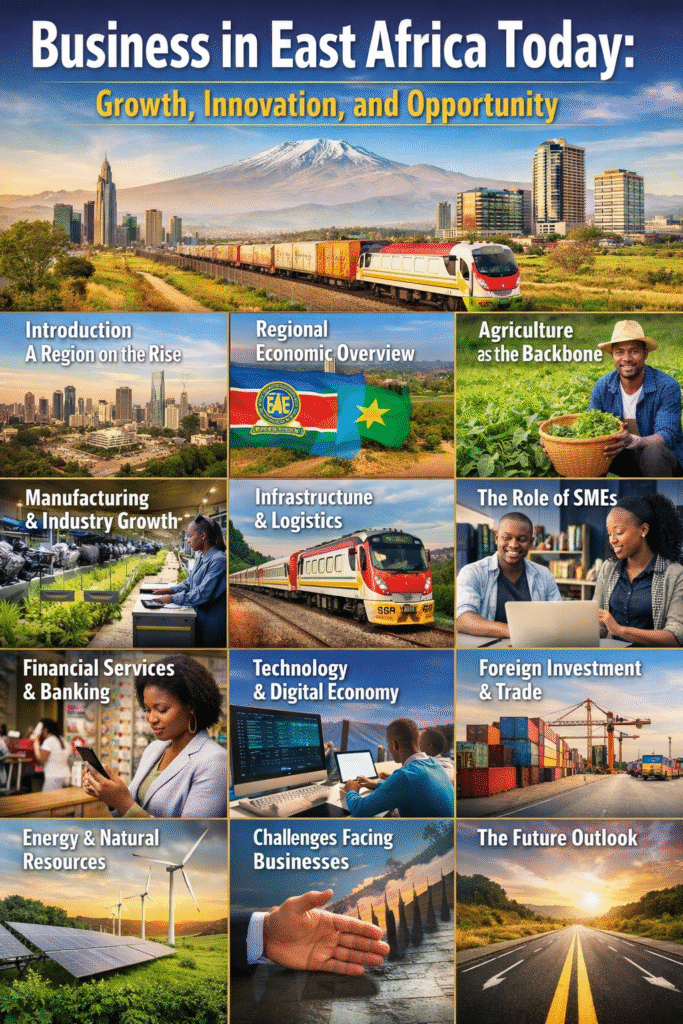
East Africa has emerged as one of the most dynamic economic regions in Africa. With a youthful population, strategic location, and growing regional integration, countries such as Kenya, Tanzania, Uganda, Rwanda, Ethiopia, and South Sudan are positioning themselves as hubs for trade, investment, and innovation.
Part 2: Regional Economic Overview
The East African Community (EAC) continues to play a critical role in driving economic cooperation. Despite global economic pressures, East Africa has maintained relatively strong GDP growth compared to other regions, supported by agriculture, services, and infrastructure development.
Part 3: Agriculture as the Economic Backbone
Agriculture remains the backbone of East African economies, employing the majority of the population. Key exports include coffee, tea, flowers, and horticultural products. Increasing investment in agribusiness, value addition, and climate-smart farming is reshaping the sector.
Part 4: Manufacturing and Industrial Growth
Industrialization is gaining momentum through Special Economic Zones (SEZs) and government-led industrial policies. Light manufacturing, food processing, cement, textiles, and pharmaceuticals are expanding, particularly in Kenya, Ethiopia, and Tanzania.
Part 5: Infrastructure and Logistics Development
Major investments in roads, railways, ports, and energy are transforming trade and mobility. Projects such as standard gauge railways, port expansions, and regional highways are reducing the cost of doing business and strengthening regional connectivity.
Part 6: The Role of Small and Medium Enterprises (SMEs)
SMEs dominate East Africa’s private sector and are key drivers of employment and innovation. Governments and development partners are increasingly supporting SMEs through access to finance, digital tools, and entrepreneurship training.
Part 7: Financial Services and Banking Evolution
East Africa has one of the most innovative financial sectors in Africa. Mobile money platforms, digital banking, microfinance, and fintech startups have revolutionized access to financial services, particularly for rural and underserved populations.
Part 8: Technology and the Digital Economy
The region’s digital economy is expanding rapidly. Tech hubs, startups, and innovation centers are thriving in cities like Nairobi, Kigali, and Kampala. E-commerce, health tech, edtech, and agritech are attracting local and international investors.
Part 9: Foreign Investment and Trade Opportunities
East Africa continues to attract foreign direct investment (FDI) from Asia, Europe, the Middle East, and within Africa. Key sectors include energy, manufacturing, real estate, mining, and telecommunications. Regional trade under the African Continental Free Trade Area (AfCFTA) presents new opportunities.
Part 10: Energy and Natural Resources
Energy development is central to business growth. Investments in renewable energy—hydropower, geothermal, solar, and wind—are increasing energy access and lowering costs. Oil, gas, and mining sectors also offer long-term potential.
Part 11: Challenges Facing Businesses
Despite progress, businesses face challenges such as regulatory bottlenecks, high taxation, limited access to long-term financing, climate risks, and political uncertainty in some areas. Addressing these issues is essential for sustainable growth.
Part 12: The Future Outlook
The future of business in East Africa is promising. With continued reforms, regional integration, digital transformation, and private-sector-led growth, the region is well positioned to become a major economic powerhouse in Africa over the next decade.
