

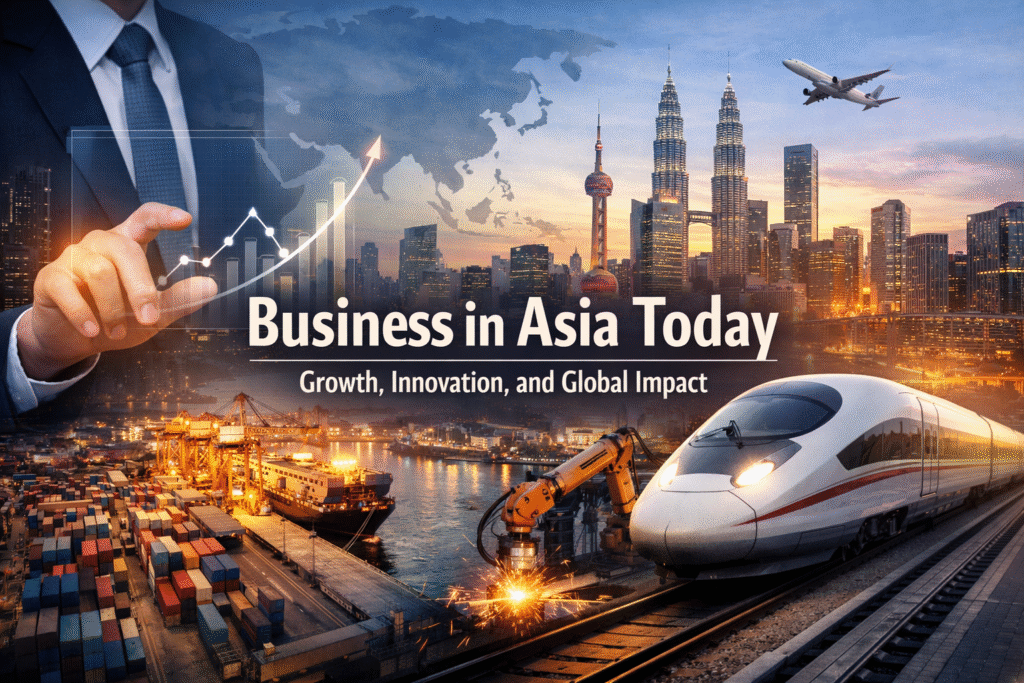
Business in Asia Today: Growth, Transformation, and Global Influence
Asia today stands at the center of global business activity. Home to some of the world’s fastest-growing economies, largest consumer markets, and most dynamic technology ecosystems, the region continues to reshape international trade, investment, and innovation. While Asia faces challenges ranging from geopolitical tensions to economic inequality, its business landscape remains defined by resilience, adaptability, and long-term growth potential.
Economic Power and Regional Diversity
Asia is not a single market but a highly diverse region encompassing advanced economies such as Japan, South Korea, and Singapore, rapidly developing nations like India, Vietnam, and the Philippines, and manufacturing giants such as China. Together, Asian economies contribute more than half of global economic growth in recent years, making the region indispensable to multinational corporations and investors.
China remains a central force, transitioning from export-driven manufacturing to a consumption- and innovation-led economy. India, meanwhile, has emerged as one of the world’s fastest-growing major economies, supported by a young population, expanding digital infrastructure, and strong domestic demand. Southeast Asia continues to attract investment as companies diversify supply chains and seek alternatives for production and sourcing.
Technology and Digital Transformation
Technology lies at the heart of modern Asian business. The region is a global leader in e-commerce, fintech, artificial intelligence, and mobile payments. Super apps, cashless economies, and digitally native consumers have transformed how businesses operate and how customers engage with brands.
Asian startups increasingly compete on the global stage, supported by venture capital, government incentives, and large domestic markets. Cities such as Shenzhen, Bangalore, Singapore, and Seoul have become major innovation hubs, producing unicorns and setting trends in software, electronics, and green technology.
Digital transformation is also reshaping traditional industries. Manufacturing is becoming smarter through automation, data analytics, and robotics, while agriculture, logistics, and healthcare are rapidly adopting digital solutions to improve efficiency and reach.
Manufacturing, Supply Chains, and Trade
Asia remains the backbone of global manufacturing. However, supply chains are evolving. Rising labor costs, geopolitical uncertainty, and the lessons learned from recent global disruptions have encouraged companies to diversify operations across multiple Asian countries rather than relying on a single hub.
This shift has benefited nations such as Vietnam, Indonesia, and Malaysia, while China moves further up the value chain into high-tech manufacturing, electric vehicles, and advanced materials. Regional trade agreements have strengthened intra-Asian commerce, fostering deeper economic integration and cross-border collaboration.
Sustainability and Green Business
Sustainability is becoming a strategic priority for Asian businesses. Governments and corporations are investing heavily in renewable energy, electric mobility, and environmentally responsible manufacturing. Asia is now a leading producer of solar panels, batteries, and electric vehicles, positioning the region as a key player in the global transition to a low-carbon economy.
While environmental challenges remain significant, especially in rapidly industrializing areas, consumer awareness and regulatory pressure are pushing businesses to adopt greener practices and transparent governance standards.
Challenges and the Road Ahead
Despite its strengths, Asia faces notable challenges. Economic inequality, aging populations in some countries, youth unemployment in others, regulatory complexity, and geopolitical tensions all influence business confidence. Companies operating in Asia must navigate different legal systems, cultures, and political environments.
Nevertheless, the long-term outlook for business in Asia remains positive. A growing middle class, continuous innovation, expanding regional cooperation, and entrepreneurial energy suggest that Asia will continue to shape the future of global business.
Conclusion
Business in Asia today is defined by momentum and transformation. The region is not only a manufacturing base or emerging market but a source of innovation, consumption, and global leadership. For companies and investors willing to understand its diversity and manage its risks, Asia offers unparalleled opportunities in the modern global economy.
