

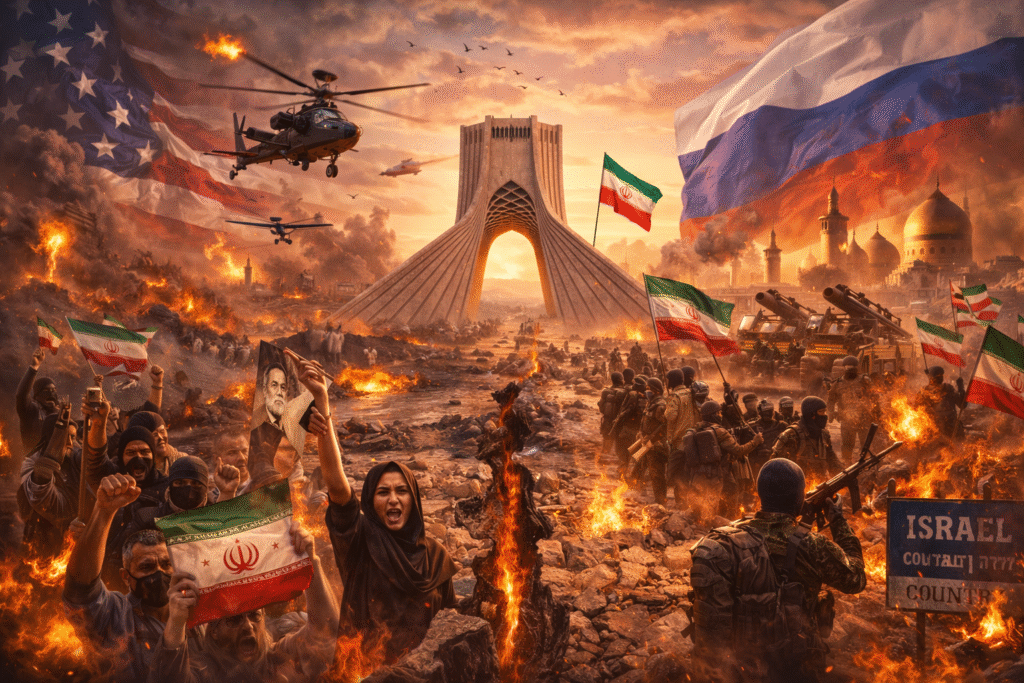
Part 1: Introduction – A State of Contradiction
Iran today is a nation of profound and escalating contradictions. It projects military confidence across the Middle East while its economy buckles under sanctions and mismanagement. Its leadership enforces rigid social codes as its youthful population stages the most sustained and profound protests since the 1979 revolution. The Islamic Republic is a state navigating an inflection point, simultaneously resolute and brittle, as it confronts internal decay, external pressure, and the looming shadow of leadership succession.
Part 2: The People’s Discontent: The “Woman, Life, Freedom” Legacy
The spark of the 2022 Mahsa Amini protests may have been extinguished by state violence, but its embers glow hot beneath the surface. The “Woman, Life, Freedom” movement revealed a fundamental shift: a generation that rejects the ideological foundations of the state. The mandatory hijab has become a battleground of daily resistance, with women appearing unveiled in unprecedented numbers despite escalating legal punishments. The state’s heavy-handed response has won it fear, not loyalty, and the chasm between ruler and ruled has never been wider.
Part 3: The Economic Strangulation: Sanctions and Mismanagement
Iran’s economy is in a state of perpetual crisis. The primary driver is the U.S.-led “maximum pressure” sanctions regime, which has crippled oil exports, severed access to global finance, and triggered hyperinflation. However, this is compounded by systemic corruption and the dominance of the Islamic Revolutionary Guard Corps (IRGC) over vast, opaque economic sectors. The result is a plummeting currency, widespread poverty, and a massive brain drain as the educated middle class seeks opportunity abroad, hollowing out the nation’s future.
Part 4: The Green State: The IRGC’s Shadow Empire
To understand power in Iran, look beyond the clerical establishment to the Islamic Revolutionary Guard Corps. The IRGC is a military, economic, and ideological empire within a state. It controls Iran’s missile and drone programs, commands its regional proxy network, and owns a multi-billion-dollar business conglomerate spanning construction, oil, and telecommunications. Its power rivals that of the civilian government, making it the ultimate arbiter of regime security and a key player in any succession plan.
Part 5: Regional Power Projection: The “Axis of Resistance” Strategy
While its domestic foundations shake, Iran projects formidable power abroad. Its “Axis of Resistance”—a network of proxies and allies including Hezbollah, Houthi rebels in Yemen, and Shia militias in Iraq and Syria—serves as a cost-effective tool of deterrence and influence. The recent Houthi attacks on Red Sea shipping and Hezbollah’s clashes with Israel demonstrate Iran’s ability to leverage these partners to project strength, disrupt adversaries, and negotiate from a position of regional power, even while isolated globally.
Part 6: The Nuclear Threshold: A High-Stakes Stalemate
Iran’s nuclear program remains the central point of global contention. The 2015 nuclear deal (JCPOA) is effectively dead, and Iran has advanced its capabilities to the brink of weapons-grade enrichment. It now possesses enough enriched uranium for several bombs, should it decide to weaponize. This policy of nuclear latency, or “threshold” status, provides strategic leverage and a deterrent threat, but it also brings the constant risk of a catastrophic miscalculation or a preemptive military strike by Israel or the U.S.
Part 7: The Presidential Figurehead: Raisi and a Weakened Executive
President Ebrahim Raisi, a hardline cleric handpicked by the establishment, embodies the system’s inward turn. His administration focuses on ideological purity, redistributive justice rhetoric, and cracking down on dissent. However, the presidency’s power is structurally limited, subordinate to the Supreme Leader and the security apparatus. The office primarily manages a failing economy and serves as a lightning rod for public frustration, with limited capacity to enact meaningful change.
Part 8: The Succession Loom: The Question After Khamenei
The most significant political question hangs over the 85-year-old Supreme Leader, Ayatollah Ali Khamenei. His eventual passing will trigger the most consequential power transition since 1989. Behind closed doors, factions—the IRGC, hardline clerics, and political families—are maneuvering. The outcome will determine whether the system opts for another single, powerful leader or devolves into a more collective, junta-like leadership centered on the IRGC to maintain control.
Part 9: The Crumbling Social Contract
The foundational bargain of the Islamic Republic—political and social obedience in exchange for welfare and piety—has broken. The state can no longer provide economic prosperity or social freedom, and the population, particularly the youth, has withdrawn its consent. This has led to a crisis of legitimacy where the regime maintains power almost solely through coercion and the distribution of patronage to its core supporters, abandoning any pretense of popular mandate.
Part 10: The Environmental Crisis: A Parched Future
Beneath the political and economic turmoil lies an existential environmental catastrophe. Decades of mismanagement have led to severe water shortages, desertification, and apocalyptic dust storms. Lake Urmia, once the Middle East’s largest lake, has dramatically shrunk. This crisis fuels internal migration, devastates agriculture, and sparks local protests, adding another layer of instability that the state is ill-equipped to address.
Part 11: The Cultural Civil War
A silent civil war rages over Iran’s cultural soul. The state continues its campaign of internet throttling, satellite dish confiscation, and morality police patrols. In response, a tech-savvy population uses VPNs to access global media, and underground artistic and musical scenes flourish. This tug-of-war between state control and societal defiance defines daily life, with the state increasingly losing ground in the digital and private spheres.
Part 12: Diplomatic Isolation and Pragmatic Pivots
Internationally, Iran remains deeply isolated from the West. Yet, it is pursuing pragmatic, survivalist diplomacy elsewhere. It has secured full membership in the China and Russia-led Shanghai Cooperation Organisation (SCO) and is deepening strategic ties with both nations. It has also restored diplomatic relations with Saudi Arabia through a China-brokered deal, a tactical move to reduce regional tension while maintaining its core adversarial stance toward the U.S. and Israel.
Part 13: The Future Scenarios: Crackdown, Collapse, or Controlled Transition
Three potential pathways loom. The most likely is deepened authoritarian consolidation: a further militarization of politics, stricter social controls, and a managed succession that maintains the status quo. A second, less probable path is systemic collapse, triggered by an economic shock, a leadership crisis, or a mass uprising that the security forces cannot contain. A third, hopeful but remote, path is a managed transition toward a more pragmatic, less ideologically rigid state, though this would require a fundamental shift within the ruling elite.
Part 14: Conclusion: The Weight of Resistance
Iran today is defined by resistance: the state’s resistance against its people, its people’s resistance against the state, and the nation’s resistance against external pressure. It is a country whose leadership has chosen security and ideological purity over prosperity and integration. This path has granted it significant regional influence but at a devastating domestic cost. As internal pressures mount and the succession nears, the Islamic Republic faces its most severe test. Its ability to navigate this period will determine not only its own future but the stability of the entire Middle East.