

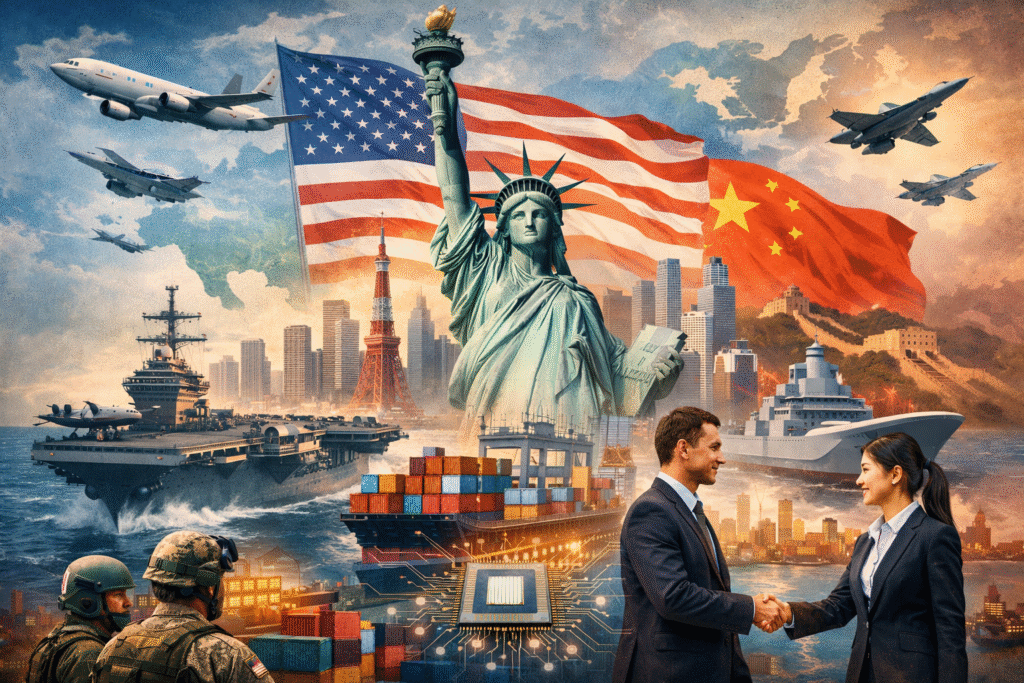
The role of the United States in Asia has shifted significantly over the past two decades. Once defined largely by post–World War II security alliances and military deployments, America’s presence in Asia today is more complex, shaped by strategic rivalry with China, evolving trade relationships, technological competition, and regional conflicts. Asia is now the center of global economic growth and geopolitical tension, and the United States remains deeply embedded in its security and economic architecture—though not without challenges.
Strategic Competition with China
At the heart of America’s current posture in Asia is its strategic competition with China. The U.S. sees China as its primary long-term competitor economically, militarily, and technologically. Disputes in the South China Sea, concerns about Taiwan, and tensions over trade and advanced technology exports have driven a recalibration of U.S. foreign policy.
Washington has restricted the export of advanced semiconductor technologies to China, arguing that such measures are necessary for national security. Beijing, in turn, views these actions as attempts to contain its rise. The rivalry is not purely military; it extends to influence in international institutions, digital infrastructure, artificial intelligence development, and regional trade agreements.
The Taiwan issue remains particularly sensitive. The United States maintains a policy of “strategic ambiguity,” supporting Taiwan’s self-defense capabilities without formally recognizing it as an independent state. Meanwhile, China has increased military activity around Taiwan, raising concerns across the region. The risk of miscalculation is real, and any escalation would have major global consequences.
The Alliance System: Japan, South Korea, and Beyond
America’s alliances are its most enduring advantage in Asia. Long-standing partnerships with countries like Japan and South Korea remain central pillars of U.S. strategy. These alliances, originally formed during the Cold War, have adapted to new realities, including missile defense cooperation and joint military exercises.
Japan has significantly increased its defense spending and revised aspects of its security policies in response to regional threats. The U.S.-Japan alliance has become more integrated, with expanded coordination in cybersecurity and space. South Korea, while balancing its economic relationship with China, continues to rely on the U.S. security guarantee against threats from North Korea.
Beyond traditional alliances, the United States has strengthened ties with countries such as India and the Philippines. The revitalization of defense agreements with Manila reflects growing concerns over maritime disputes in the South China Sea. Meanwhile, U.S.-India cooperation has deepened through mechanisms like the Quad (Quadrilateral Security Dialogue), which also includes Japan and Australia. While not a formal military alliance, the Quad signals shared concerns over regional stability and rules-based order.
Economic Engagement and Trade Realities
Economically, Asia is indispensable to the United States. The region hosts key supply chains in electronics, manufacturing, and energy. However, America’s approach to trade has evolved from broad multilateral agreements toward more targeted frameworks.
After withdrawing from the Trans-Pacific Partnership (TPP), the United States sought alternative arrangements, such as the Indo-Pacific Economic Framework (IPEF). While IPEF focuses on supply chain resilience, clean energy, and anti-corruption measures, it lacks the tariff-reduction incentives that many Asian countries prefer. This limits its attractiveness compared to trade agreements where market access is more clearly defined.
At the same time, American companies remain heavily invested in Asian markets. U.S. technology firms operate throughout Southeast Asia, and American financial institutions are deeply integrated in regional economies. Despite political tensions, trade volumes between the United States and China remain substantial, illustrating that economic decoupling is partial rather than complete.
Military Presence and Security Posture
The U.S. military footprint in Asia remains extensive. Tens of thousands of American troops are stationed in Japan and South Korea, with naval assets regularly operating in the Pacific. Freedom of navigation operations in contested waters aim to reinforce international maritime law.
Recent years have seen renewed emphasis on distributed military capabilities to counter anti-access strategies. The United States has also expanded rotational deployments to Australia and enhanced defense cooperation with the Philippines. These moves signal a strategic shift toward flexibility and resilience, rather than reliance on a small number of permanent bases.
North Korea continues to pose a persistent challenge. Its missile tests and expanding nuclear capabilities create instability. The United States coordinates closely with South Korea and Japan on missile defense and intelligence sharing, recognizing that deterrence requires visible unity.
ASEAN and Southeast Asia
Southeast Asia occupies a strategic crossroads between the Pacific and Indian Oceans. The Association of Southeast Asian Nations (ASEAN) plays a central role in regional diplomacy, though its consensus-based structure can limit decisive action. The United States has sought deeper engagement with ASEAN members, emphasizing infrastructure, maritime security, and digital economy partnerships.
Yet competition with China complicates this effort. Beijing’s Belt and Road Initiative has financed major infrastructure projects across the region, increasing its economic leverage. While some Southeast Asian nations welcome U.S. security engagement, many prefer not to choose sides. They balance relations carefully, pursuing economic ties with China while maintaining security links with the United States.
This balancing act constrains American policy. If Washington frames its engagement purely as anti-China, it risks alienating countries that seek strategic autonomy. U.S. diplomacy increasingly recognizes that regional states value development and stability more than ideological alignment.
Technological and Supply Chain Competition
Technology is now central to U.S.-Asia relations. Semiconductors, rare earth elements, and clean energy supply chains are viewed through a national security lens. The United States has promoted partnerships with Japan, South Korea, and Taiwan in advanced chip manufacturing to reduce dependence on Chinese-controlled supply chains.
The push for resilient supply chains intensified after the COVID-19 pandemic exposed vulnerabilities in global logistics networks. Initiatives to diversify production—sometimes called “friend-shoring”—aim to relocate critical manufacturing to trusted partners. However, reshaping supply chains is costly and complex. Asian economies are deeply interconnected, and rapid restructuring carries economic risks.
Human Rights, Democracy, and Values
American policy in Asia also reflects concerns about human rights and democratic governance. Sanctions related to China’s treatment of ethnic minorities and criticism of restrictions on freedoms in Hong Kong highlight value-based tensions.
At the same time, U.S. relationships with non-democratic states reveal practical compromises. Security cooperation with partners that have domestic governance challenges illustrates the tension between strategic interests and normative commitments. Critics argue that selective emphasis on human rights undermines credibility.
Challenges and Limitations
America’s influence in Asia remains significant but not uncontested. Regional countries have more options than in the past. China’s economic scale, regional trade frameworks like the Regional Comprehensive Economic Partnership (RCEP), and growing regional institutions create alternative centers of influence.
Domestic politics within the United States also affect consistency. Trade skepticism among American voters, budgetary constraints, and political polarization can limit long-term commitments. Asian leaders watch closely for signs of reliability, particularly after abrupt policy shifts in recent years.
Moreover, the risk of escalation in flashpoints such as the South China Sea or Taiwan cannot be dismissed. Even if neither Washington nor Beijing seeks open conflict, accidents or miscalculations could spiral.
The Road Ahead
America today is firmly engaged in Asia but navigating a more competitive and multipolar environment than ever before. Its military alliances remain strong, yet economic integration is more complex. Strategic competition with China frames much of its policy, but regional dynamics extend beyond that rivalry.
The future of U.S. influence in Asia will depend on its ability to align security commitments with credible economic leadership. Regional countries are pragmatic. They welcome American engagement but expect tangible benefits—trade access, investment, infrastructure, and stability.
If the United States can balance competition with cooperation, invest consistently in relationships, and adapt to Asia’s economic realities, it will remain a central actor in the region. If not, its relative influence may gradually erode as Asia continues to define the contours of the twenty-first century.
