

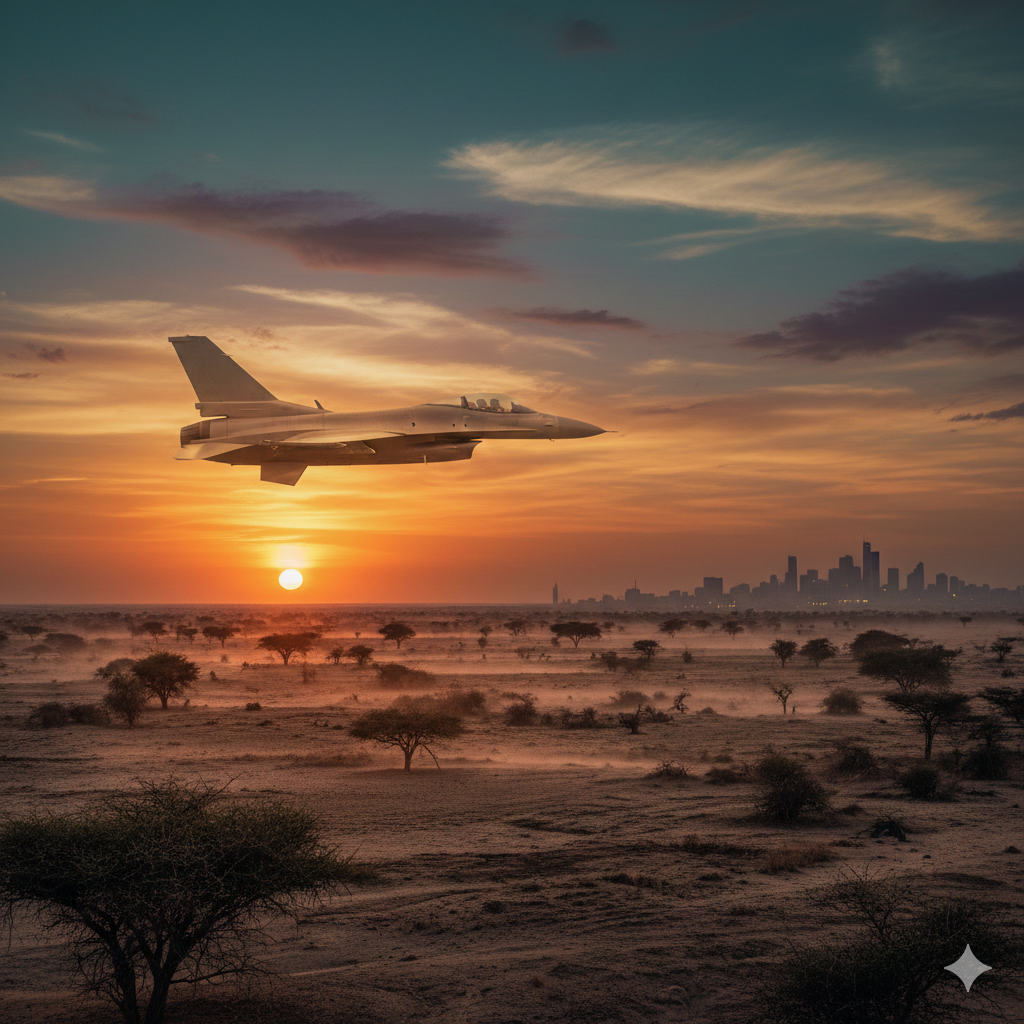
MOGADISHU, Somalia – In the annals of defense procurement and national aspiration, few symbols carry the weight of the F-16 Fighting Falcon. For decades, this American-made multirole fighter jet has been the ultimate marker of military modernity, technological acceptance into a U.S.-led security architecture, and aerial sovereignty for nations from NATO allies to key strategic partners across Asia and the Middle East. In recent months, a bold and seemingly fantastical idea has emerged in some Somali security and political circles, whispered in the halls of Villa Somalia and debated in online forums: the notion of one day establishing a Somali Air Force equipped with F-16s. While a powerful emblem of a nation yearning to reclaim full control of its skies and its future, the proposition of Somalia operating F-16s in the near-to-medium term is less a feasible defense plan and more a revealing parable of the chasm between national ambition and stark, on-the-ground reality.
The Symbolism of the Falcon: Reclaiming the Skies
To understand the allure, one must first understand the history and the humiliation. The Somali Aeronautical Corps, active from the 1960s to the early 1990s, once operated a modest but functional fleet of MiG-17s, MiG-21s, and Shenyang F-6s (Chinese copies of the MiG-19). This force disintegrated alongside the state in 1991, with its aircraft destroyed, cannibalized, or left to rust on the tarmac of Mogadishu’s Aden Adde International Airport. For over three decades, Somalia’s sovereignty has been compromised not only on land but in its airspace. Counter-terrorism strikes have been the exclusive domain of U.S. drones and occasional Kenyan jet overflights, while logistical and medical evacuation support for African Union forces relied on foreign aircraft. The skies above Somalia have been a theater of action where the nation itself was merely the stage, not an actor.
Acquiring a jet like the F-16, therefore, is not merely a military procurement; it is a profound statement of restored sovereignty. It would symbolize a final break from the status of a perpetual security ward, a declaration that the Federal Government of Somalia (FGS) possesses not just the will but the advanced capability to project power, monitor its vast territory, and decisively engage threats like Al-Shabaab from the air on its own terms. For a nation rebuilding its identity, the psychological and political appeal is immense.
The Daunting Calculus of Reality: A Seven-Layer Challenge
However, the leap from operating a handful of makeshift, ground-attack drones to managing a fleet of fourth-generation fighter aircraft is astronomically vast. The obstacles form a near-insurmountable pyramid of prerequisites:
1. The Financial Impossibility: A single new F-16 Block 70/72 Viper costs over $65 million. The used price for older models, with significant remaining airframe life, still runs into the tens of millions per unit. This is before the lifetime costs: advanced pilot training (millions per pilot), maintenance contracts, sophisticated munitions (a single AIM-120 AMRAAM missile exceeds $1 million), fuel, and the construction of hardened, climate-controlled hangars and maintenance facilities. Somalia’s entire annual federal budget hovers around $700 million, almost entirely dedicated to recurrent costs like salaries and basic operations, with over 70% of security spending funded by international partners. The idea of allocating hundreds of millions for a fighter jet program is a fiscal fantasy.
2. The Human Capital Desert: An F-16 is not a point-and-shoot weapon. It requires a vast, expert ecosystem. Somalia currently has no fighter pilots. It has a severe shortage of even basic aircraft mechanics for its nascent, propeller-driven air wing. Creating an F-16 pilot requires selecting elite candidates, years of basic flight training, followed by specialized, language-specific training in the United States (or another operator nation), likely totaling over five years and $10 million per individual before they are combat-ready. A parallel cadre of weapons systems officers, radar specialists, avionics technicians, and engine experts would need to be built from absolute zero.
3. The Political-Hurdle: U.S. Congressional Approval: The F-16 is not a commercial airliner; its export is tightly controlled by the U.S. government under the Arms Export Control Act. A sale requires a determination that it strengthens U.S. security and promotes regional stability, followed by a mandatory notification to Congress, which can block it. Given Somalia’s fragile state, ongoing internal conflicts, and the risk of advanced technology diversion, gaining U.S. legislative approval would be a herculean diplomatic task, unlikely to succeed without decades of demonstrated stability and transparent security governance.
4. The Infrastructure Abyss: F-16s require pristine runways (Aden Adde’s is serviceable but heavily used commercially), secure and sophisticated bases with fuel hydrants, munitions depots, and advanced radar and air traffic control systems for command and control. They need constant, clean electrical power and climate control to prevent sensitive avionics from degrading in Somalia’s heat and dust. The country’s pervasive infrastructure deficits directly contradict these needs.
5. The Maintenance Mountain: The F-16’s readiness rate in advanced air forces relies on deep supply chains, constant access to proprietary spare parts, and contractor-led tech support. Somalia’s geography and lack of secure logistics corridors would make sustaining even a two-jet fleet a logistical nightmare, with a high probability the aircraft would be grounded within months due to a lack of a single specialized component.
6. The Strategic Misalignment: For the core counter-insurgency mission against Al-Shabaab, the F-16 is a spectacularly inefficient tool. It is designed for air superiority and precision strikes against high-value, fixed targets in conventional warfare. The fight in Somalia requires persistence, low-cost surveillance, and the ability to strike small, mobile groups in populated areas—a role far better suited to armed drones like the Turkish Bayraktar TB2s Somalia is already acquiring, which are cheaper, easier to maintain, and offer longer loiter times.
7. The Regional Security Dilemma: The introduction of supersonic fighter jets into the Horn of Africa’s tense security environment would trigger immediate alarm in neighboring capitals, particularly Addis Ababa and Nairobi. It could spur a regional air arms race, destabilizing a fragile balance and potentially diverting resources from more critical ground-force needs.
A Pragmatic Pathway: Building a Functional Air Wing from the Ground Up
The responsible and achievable path for the Somali National Army’s Air Force lies not in fantasy fleets but in the steady, incremental development of a multi-tiered, mission-specific air wing:
- Tier 1: Unmanned Aerial Systems (UAS): Doubling down on drone capacity for ISR (Intelligence, Surveillance, Reconnaissance) and precision strike. This includes not only armed drones but smaller tactical models for battalion-level reconnaissance.
- Tier 2: Light Attack & Armed Reconnaissance: As skills grow, introducing propeller-driven, low-cost light attack aircraft (like the AT-6 Wolverine or similar) that can carry precision-guided munitions but have vastly lower acquisition and operating costs than jets, and can use rough airstrips.
- Tier 3: Transport and Mobility: Expanding the fleet of transport aircraft (like the Cessna 208 or larger turboprops) for rapid troop deployment, medical evacuation, and logistical support to forward operating bases, which is the most critical airpower need for the SNA ground forces.
- Tier 4: Rotary Wing: Developing a robust helicopter force for tactical mobility, close air support in complex terrain, and CASEVAC.
Conclusion: Sovereignty Through Sustainability, Not Symbols
The dream of an F-16 soaring with Somali markings is a powerful metaphor for a nation’s desire to stand tall and self-reliant. However, true aerial sovereignty will not be won by chasing prestigious but impractical symbols of a bygone era of conventional warfare. It will be built through the patient, professional development of an air arm tailored to the nation’s actual counter-insurgency needs, fiscal reality, and human capacity.
Somalia’s security partners, notably Turkey and the United States, are correctly focused on this pragmatic capacity-building. The ultimate strength of the Somali Air Force will be measured not by the top speed of its fighters, but by the reliability of its medical evacuation flights, the accuracy of its drone-delivered strikes on Al-Shabaab commanders, and its ability to sustain its own operations. For now, the F-16 should remain a distant aspiration on a very long-term vision board, while the real work—and the real victories—happen at a lower, slower, but far more strategically sound altitude. The path to reclaiming the skies begins with mastering the tools one can realistically own, maintain, and effectively employ.