

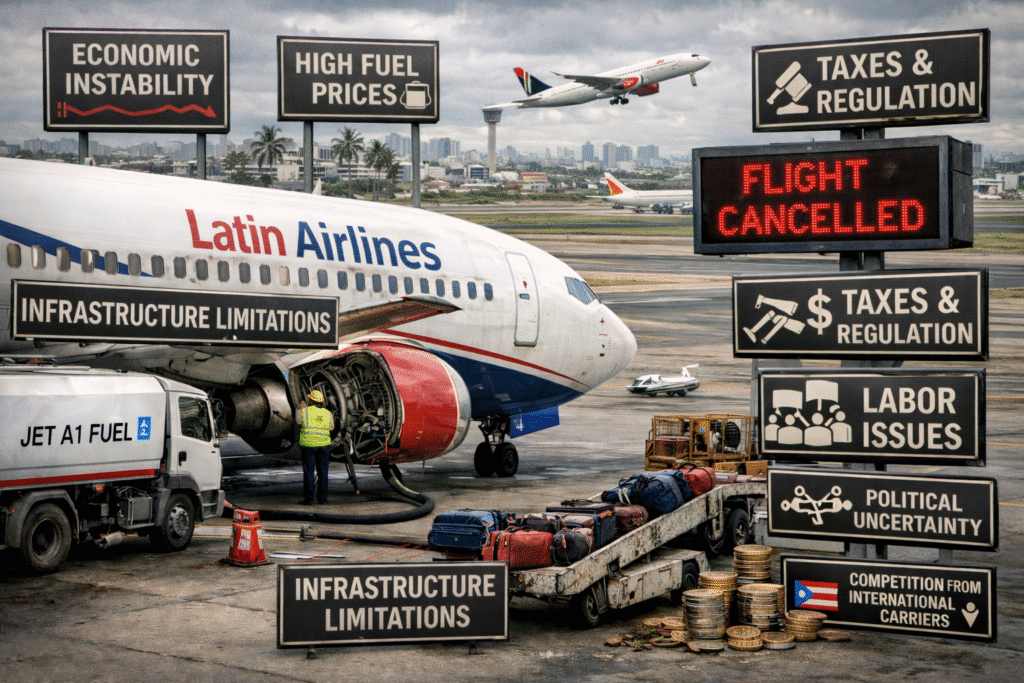
Major Problems Facing Airlines in Latin America Today
The airline industry in Latin America plays a crucial role in connecting vast distances, supporting tourism, and facilitating regional trade. Despite steady growth in air travel demand, airlines in the region face serious challenges that affect their stability, profitability, and service quality.
1. Economic Instability and Currency Fluctuations
Many Latin American countries experience frequent economic instability, inflation, and currency devaluation. Since airline expenses such as aircraft leasing, maintenance, and fuel are often paid in U.S. dollars, weaker local currencies significantly increase operating costs and financial risk.
2. High Fuel Prices and Operating Costs
Fuel prices in Latin America are among the highest in the world due to taxes, limited refining capacity, and supply constraints. Combined with high airport fees and maintenance costs, this puts heavy financial pressure on airlines.
3. Government Taxes and Regulatory Burdens
Airlines face heavy taxation, including ticket taxes, fuel levies, and airport charges. Complex regulations and slow government approvals further increase costs and limit route expansion, making it difficult for airlines to operate efficiently.
4. Infrastructure Limitations
Many airports in Latin America suffer from congestion, outdated terminals, and limited runway capacity. Poor ground transportation links and inadequate air traffic control systems contribute to delays and reduced service quality.
5. Financial Instability and Airline Bankruptcies
Several Latin American airlines have struggled with bankruptcy, restructuring, or government bailouts in recent years. High debt levels, economic downturns, and unexpected crises often threaten airline survival.
6. Political Uncertainty and Policy Changes
Frequent political changes in some countries lead to inconsistent aviation policies. Sudden regulatory shifts, nationalization threats, or changes in aviation leadership reduce investor confidence and hinder long-term planning.
7. Labor Issues and Workforce Challenges
Airlines in the region face labor disputes, pilot shortages, and rising wage demands. Strikes and industrial action frequently result in flight delays and cancellations, damaging airline reputations.
8. Competition from International Carriers
Major foreign airlines, especially from North America and Europe, dominate many international routes. Their strong financial backing and modern fleets often make it difficult for local carriers to compete effectively.
Conclusion
Airlines in Latin America face a complex mix of economic, regulatory, and operational challenges. Addressing these issues will require stable economic policies, infrastructure investment, fair taxation, and strong airline management. Overcoming these problems is essential for ensuring sustainable growth and improving connectivity across the region.