

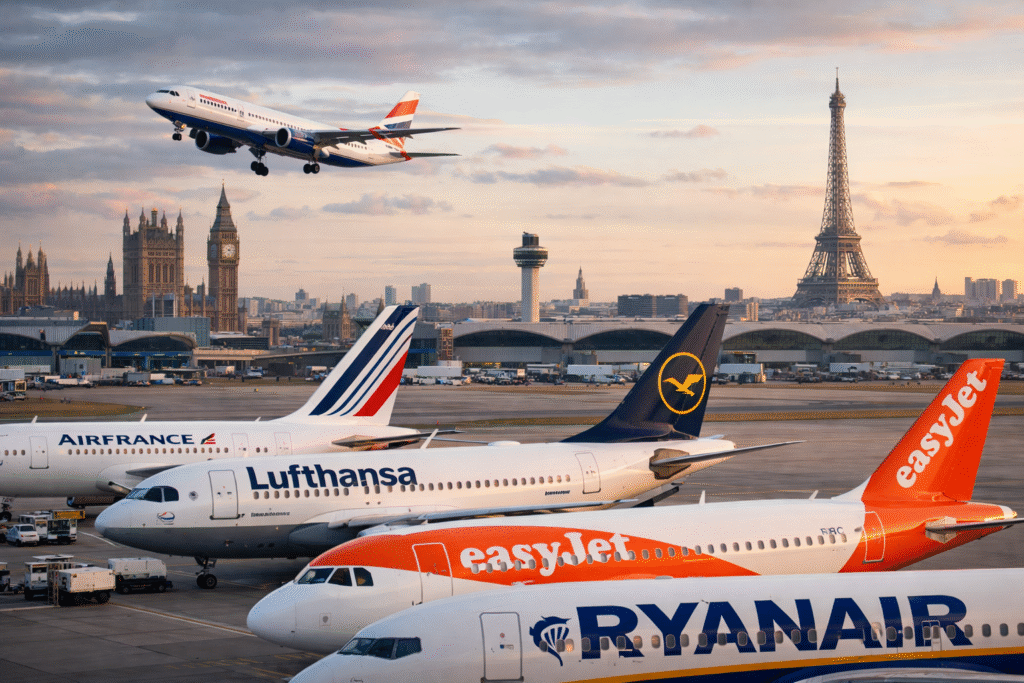
✈️ Airlines in Europe Today: Recovery, Competition, and a Sustainable Future
Europe’s airline industry today is navigating a complex but promising landscape shaped by strong passenger demand, intense competition, environmental regulation, and evolving travel patterns. As one of the world’s most mature aviation markets, Europe continues to balance recovery-driven growth with long-term sustainability and operational efficiency.
📈 Steady Passenger Demand and Market Recovery
European airlines have largely completed their post-pandemic recovery, with short-haul and intra-European routes leading traffic growth:
- Leisure travel remains the strongest driver, especially to Southern Europe, the Mediterranean, and major city destinations.
- Business travel continues its gradual return, supported by improved connectivity and flexible travel policies.
- Cross-border travel within the Schengen Area remains a major strength, enabling high-frequency and affordable air services.
Major hubs such as London, Paris, Frankfurt, Amsterdam, Madrid, and Istanbul continue to anchor Europe’s aviation network.
🌍 Full-Service and Low-Cost Carriers Compete Side by Side
Europe’s aviation market is defined by a diverse mix of airline models:
- Network carriers like Lufthansa Group, Air France–KLM, British Airways, and Iberia dominate long-haul and premium travel, supported by global alliance memberships.
- Low-cost carriers (LCCs) such as Ryanair, easyJet, and Wizz Air control a large share of short-haul travel, offering dense route networks and competitive fares.
- Hybrid airlines and regional operators play a key role in connecting smaller cities and underserved regions.
This competitive environment benefits travelers but places constant pressure on airline costs and margins.
🛠️ Fleet Modernization and Operational Efficiency
European airlines are investing heavily in modern, fuel-efficient aircraft:
- New-generation aircraft like the Airbus A320neo, A321XLR, A350, and Boeing 787 are being introduced to reduce fuel consumption and emissions.
- Airlines are optimizing networks with longer-range narrowbody aircraft, enabling direct routes between secondary cities.
- Digitalization, including automated operations, dynamic pricing, and AI-driven maintenance, is improving efficiency and resilience.
♻️ Sustainability at the Center of Strategy
Europe is at the forefront of aviation sustainability initiatives:
- Airlines are under increasing pressure to meet European Union climate regulations, including emissions trading schemes.
- Many carriers have committed to carbon neutrality targets and greater use of Sustainable Aviation Fuel (SAF).
- Investment in cleaner fleets, greener airports, and operational efficiency is accelerating, though rising costs remain a challenge.
⚠️ Key Challenges Facing European Airlines
Despite progress, European airlines face persistent challenges:
- High operating costs, including fuel, labor, and airport charges.
- Air traffic control constraints and seasonal congestion.
- Geopolitical tensions and airspace restrictions affecting certain routes.
- Supply chain issues impacting aircraft deliveries and maintenance schedules.
Airlines must continuously adapt to maintain profitability in a highly regulated environment.
🔮 Outlook for European Aviation
Looking ahead, Europe’s airline sector remains stable but competitive:
- Demand is expected to grow steadily rather than rapidly, reflecting market maturity.
- Premium long-haul travel and high-quality service differentiation will shape competition among legacy carriers.
- Low-cost airlines will continue to expand, particularly in Central and Eastern Europe.
- Sustainability will increasingly influence fleet planning, pricing, and airline strategy.
🛫 Conclusion
Airlines in Europe today operate in one of the world’s most complex aviation ecosystems — balancing competition, innovation, and environmental responsibility. With strong connectivity, modern fleets, and a renewed focus on efficiency and sustainability, European airlines remain essential players in global air transport and regional economic growth.
