

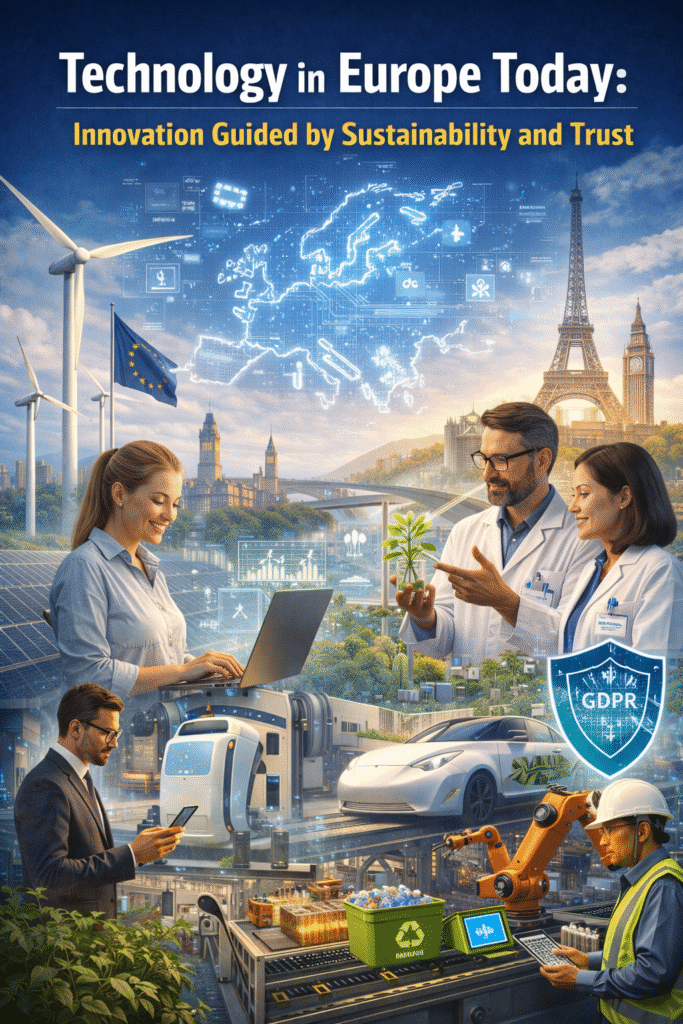
Technology in Europe today reflects a unique balance between innovation, social responsibility, and strong regulation. As a region made up of diverse economies and cultures, Europe leverages technology to drive economic growth, improve quality of life, and address global challenges such as climate change, data protection, and digital sovereignty.
Digital Infrastructure and Connectivity
Europe has made steady progress in expanding high-speed broadband and 5G networks. Countries such as Germany, France, the Netherlands, Sweden, and the United Kingdom continue to upgrade digital infrastructure to support smart industries and digital services. The European Union (EU) plays a central role by funding cross-border projects that improve connectivity, especially in rural and less-developed regions.
This digital foundation supports remote work, e-government services, digital education, and cross-border collaboration.
Artificial Intelligence and Advanced Research
Europe is a global leader in scientific research and ethical artificial intelligence. Universities, research institutions, and technology companies collaborate extensively on AI, robotics, quantum computing, and biotechnology. European AI development strongly emphasizes transparency, accountability, and human rights.
The EU’s regulatory approach aims to encourage innovation while ensuring that technologies are safe and trustworthy for citizens.
Green Technology and Sustainability
One of Europe’s strongest technological focuses is sustainability. European countries are investing heavily in renewable energy, electric vehicles, smart grids, and climate technology. Innovations in wind power, solar energy, hydrogen fuel, and energy-efficient buildings are helping Europe move toward its climate goals.
Technology is also being used to support the circular economy by improving recycling systems, reducing waste, and tracking resource use digitally.
Digital Economy, Startups, and Industry 4.0
Europe’s digital economy is supported by a growing startup ecosystem in cities such as Berlin, Paris, London, Stockholm, and Amsterdam. European startups are particularly strong in fintech, healthtech, cybersecurity, and enterprise software.
In manufacturing, Europe leads in Industry 4.0—integrating automation, robotics, AI, and the Internet of Things (IoT) into factories. This has increased productivity and global competitiveness, especially in automotive and advanced manufacturing sectors.
Data Protection and Cybersecurity
Europe is known globally for its strong data protection laws, particularly the General Data Protection Regulation (GDPR). These regulations have influenced global standards for privacy and data security. Cybersecurity is also a top priority, with investments in protecting critical infrastructure, financial systems, and digital identities.
Challenges and the Future
Despite its strengths, Europe faces challenges such as fragmented digital markets, competition from global tech giants, and the need for more digital skills among its workforce. Ongoing cooperation between governments, businesses, and educational institutions is key to overcoming these barriers.
Conclusion
Technology in Europe today is defined by responsible innovation. By combining advanced research, sustainability, and strong regulation, Europe continues to shape a digital future that prioritizes human values as much as technological progress. As Europe adapts to rapid global change, its approach offers a model for balanced and ethical technological development.
