

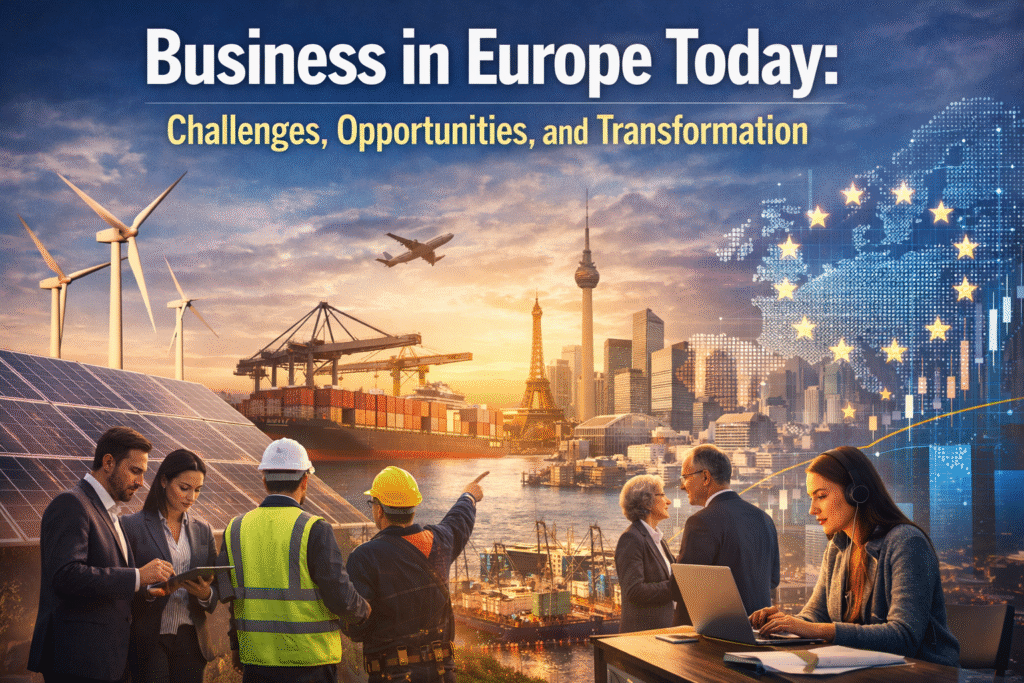
Business in Europe Today
Business in Europe today is shaped by a dynamic mix of economic recovery, technological innovation, geopolitical change, and sustainability goals. As one of the world’s largest economic regions, Europe remains a major hub for trade, finance, manufacturing, and services. However, European businesses are also navigating significant challenges, including inflation, energy costs, labor shortages, and global competition.
Economic Landscape
The European economy is diverse, ranging from advanced industrial powers such as Germany and France to fast-growing economies in Central and Eastern Europe. Following the economic disruption caused by the COVID-19 pandemic, many European countries have focused on recovery and resilience. Governments and institutions such as the European Union (EU) have introduced investment programs aimed at stabilizing economies, supporting small and medium-sized enterprises (SMEs), and encouraging innovation.
Inflation and interest rates have become major concerns in recent years, affecting consumer purchasing power and business investment. At the same time, Europe remains an attractive market due to its strong infrastructure, skilled workforce, and large consumer base.
The Role of the European Union
The European Union plays a central role in shaping the business environment. Through its single market, the EU allows free movement of goods, services, capital, and people across member states. This gives businesses access to over 440 million consumers and reduces trade barriers.
EU regulations strongly influence business practices, especially in areas such as competition, data protection, environmental standards, and consumer rights. While these regulations can increase compliance costs, they also create stability, transparency, and trust, making Europe a reliable place to do business.
Digital Transformation and Innovation
Digitalization is transforming European business across all sectors. Companies are increasingly investing in artificial intelligence, automation, cloud computing, and e-commerce. The rise of remote work and digital services has changed how businesses operate and compete.
Europe has also seen strong growth in startups and technology hubs, particularly in cities such as Berlin, Paris, Amsterdam, Stockholm, and Barcelona. The EU supports innovation through funding programs that promote research, digital skills, and cross-border collaboration.
At the same time, Europe emphasizes digital responsibility, with strict rules on data privacy and platform accountability. This approach aims to balance technological progress with ethical and social considerations.
Sustainability and Green Business
Sustainability is one of the most defining features of business in Europe today. The European Green Deal sets ambitious targets for reducing carbon emissions, promoting renewable energy, and achieving climate neutrality. As a result, businesses are under increasing pressure to adopt sustainable practices.
Many European companies now prioritize environmental, social, and governance (ESG) goals. Green finance, clean technology, and sustainable supply chains are growing rapidly. While the transition can be costly, it also creates new opportunities in renewable energy, electric mobility, and circular economy models.
Labor Market and Workforce Trends
Europe’s labor market is experiencing change due to demographic shifts, aging populations, and skills shortages. Businesses face challenges in recruiting talent, particularly in technology, engineering, healthcare, and skilled trades.
To address this, companies are investing more in training, diversity, and flexible work arrangements. Cross-border mobility within the EU helps fill labor gaps, while digital tools allow companies to access global talent. At the same time, strong labor laws and worker protections remain a defining feature of the European business environment.
Global Trade and Geopolitical Challenges
European businesses operate in a complex global environment. Trade relations, supply chain disruptions, and geopolitical tensions affect exports and imports. Europe continues to seek a balance between economic openness and strategic independence, particularly in critical industries such as energy, technology, and defense.
The shift toward reshoring and diversifying supply chains is influencing manufacturing and logistics strategies. Businesses are becoming more risk-aware and focusing on long-term resilience rather than short-term efficiency.
Conclusion
Business in Europe today is marked by both opportunity and transformation. While companies face economic uncertainty, regulatory complexity, and global competition, they also benefit from a strong single market, innovation-driven growth, and leadership in sustainability. European businesses that embrace digital transformation, adapt to green priorities, and remain resilient in a changing world are well positioned for long-term success.