

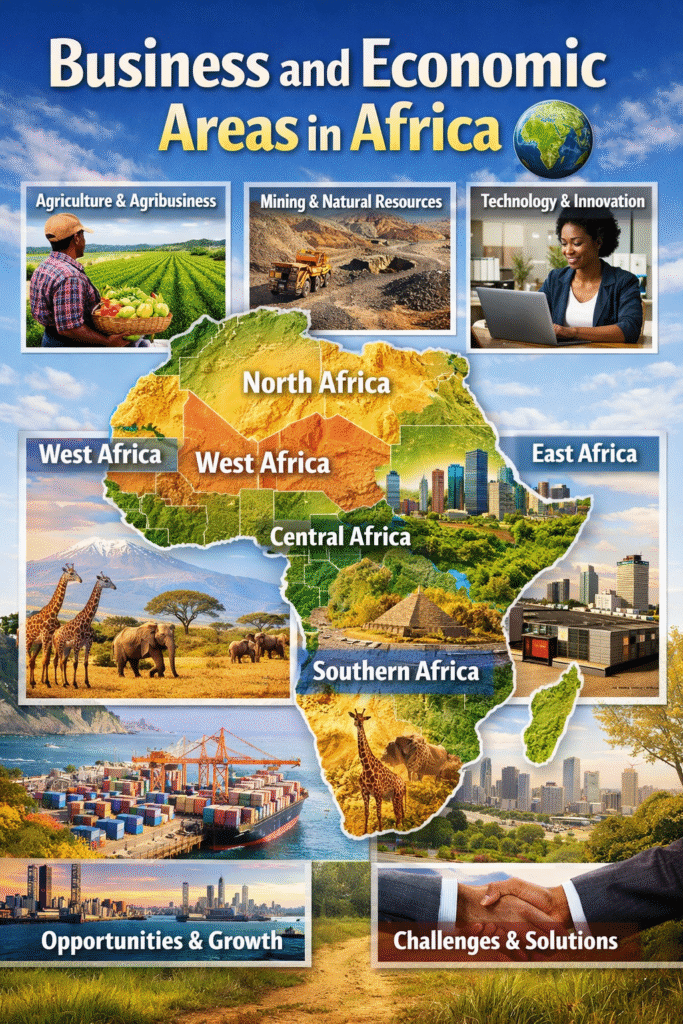
Business and Economic Areas in Africa 🌍
Africa is one of the world’s fastest-growing and most diverse economic regions. With over 1.4 billion people, abundant natural resources, and rapidly expanding urban centers, the continent offers significant opportunities for business development across various areas and industries. In recent years, improvements in infrastructure, technology, and regional integration have strengthened Africa’s position in the global economy.
1. Key Business Sectors in Africa
Agriculture and Agribusiness
Agriculture remains the backbone of many African economies, employing more than half of the population. Africa is a major producer of cocoa, coffee, tea, cotton, and cereals. Today, agribusiness is expanding beyond traditional farming into food processing, packaging, and export-oriented value chains, attracting both local and foreign investors.
Natural Resources and Mining
Africa is rich in natural resources such as gold, diamonds, oil, gas, cobalt, and lithium. Countries like Nigeria, Angola, South Africa, and the Democratic Republic of Congo play a major role in global energy and mineral markets. The focus is gradually shifting from raw material exports to local processing and value addition.
Manufacturing and Industrialization
Manufacturing is growing, especially in textiles, construction materials, cement, and consumer goods. Ethiopia, Egypt, Morocco, and South Africa are emerging as manufacturing hubs due to better industrial policies and access to regional and international markets.
Technology and Digital Economy
Africa’s tech ecosystem is expanding rapidly. Fintech, e-commerce, mobile banking, and digital services are transforming business operations. Cities such as Nairobi, Lagos, Cape Town, and Kigali are known as innovation hubs, supported by a young, tech-savvy population.
Tourism and Hospitality
Africa’s diverse landscapes, wildlife, and cultural heritage make tourism an important business area. Countries like Kenya, Tanzania, Morocco, Egypt, and South Africa generate significant revenue from eco-tourism, heritage tourism, and business travel.
2. Major Business Regions in Africa
North Africa
North Africa benefits from proximity to Europe and strong trade ties. Egypt, Morocco, and Tunisia are key players in manufacturing, energy, agriculture, and tourism.
West Africa
West Africa is known for trade, agriculture, and energy resources. Nigeria, Ghana, and Senegal serve as major commercial centers, with growing financial services and startup ecosystems.
East Africa
East Africa is one of the fastest-growing regions. Kenya, Ethiopia, Rwanda, and Tanzania are investing heavily in infrastructure, logistics, and digital services, making the region attractive for investors.
Central Africa
Central Africa is rich in minerals and forests. While challenges remain, countries like Cameroon and the DRC offer strong potential in mining, energy, and agriculture.
Southern Africa
Southern Africa has more developed infrastructure and financial systems. South Africa is a continental business hub, while Botswana, Zambia, and Namibia are expanding in mining, tourism, and energy.
3. Opportunities and Challenges
Africa offers vast opportunities due to its growing population, expanding middle class, and regional trade agreements such as the African Continental Free Trade Area (AfCFTA). However, challenges such as infrastructure gaps, access to finance, and regulatory barriers still exist. Addressing these issues can unlock even greater economic growth.
4. Conclusion
Africa is no longer just a resource-based economy; it is a continent of innovation, entrepreneurship, and opportunity. With continued investment, good governance, and regional cooperation, Africa’s business areas are set to play an increasingly important role in the global economy 🌍.